The primary interface to the low-level networking layer in this package. More...
#include "connectionManager.h"
Classes | |
| class | Interface |
Public Member Functions | |
| const Interface & | get_interface (size_t n) |
| size_t | get_num_interfaces () |
| PT (Connection) open_UDP_connection(uint16_t port=0) | |
| PT (Connection) open_TCP_client_connection(const NetAddress &address | |
| void | scan_interfaces () |
| Repopulates the list reported by get_num_interface()/get_interface(). More... | |
| bool | wait_for_readers (double timeout) |
| Blocks the process for timeout number of seconds, or until any data is available on any of the non-threaded ConnectionReaders or ConnectionListeners, whichever comes first. More... | |
Static Public Member Functions | |
| static std::string | get_host_name () |
Public Attributes | |
| PT(Connection) open_UDP_connection(const std int | backlog |
| PT(Connection) open_TCP_server_rendezvous(const std int | backlog |
| get_host_name | |
| Returns the name of this particular machine on the network, if available, or the empty string if the hostname cannot be determined. More... | |
| get_interface | |
| Returns the nth usable network interface detected on this machine. More... | |
| get_num_interfaces | |
| This returns the number of usable network interfaces detected on this machine. More... | |
| int | timeout_ms |
Friends | |
| class | Connection |
| class | ConnectionListener |
| class | ConnectionReader |
| class | ConnectionWriter |
Detailed Description
The primary interface to the low-level networking layer in this package.
A ConnectionManager is used to establish and destroy TCP and UDP connections. Communication on these connections, once established, is handled via ConnectionReader, ConnectionWriter, and ConnectionListener.
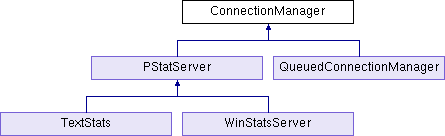
You may use this class directly if you don't care about tracking which connections have been unexpectedly closed; otherwise, you should use QueuedConnectionManager to get reports about these events (or derive your own class to handle these events properly).
Definition at line 41 of file connectionManager.h.
Member Function Documentation
◆ scan_interfaces()
| void ConnectionManager::scan_interfaces | ( | ) |
Repopulates the list reported by get_num_interface()/get_interface().
It is not necessary to call this explicitly, unless you want to re-determine the connected interfaces (for instance, if you suspect the hardware has recently changed).
Definition at line 476 of file connectionManager.cxx.
◆ wait_for_readers()
| bool ConnectionManager::wait_for_readers | ( | double | timeout | ) |
Blocks the process for timeout number of seconds, or until any data is available on any of the non-threaded ConnectionReaders or ConnectionListeners, whichever comes first.
The return value is true if there is data available (but you have to iterate through all readers to find it), or false if the timeout occurred without any data.
If the timeout value is negative, this will block forever or until data is available.
This only works if all ConnectionReaders and ConnectionListeners are non- threaded. If any threaded ConnectionReaders are part of the ConnectionManager, the timeout value is implicitly treated as 0.
Definition at line 383 of file connectionManager.cxx.
References Socket_fdset::clear(), TrueClock::get_global_ptr(), and ConnectionReader::is_polling().
Member Data Documentation
◆ get_host_name
| string ConnectionManager::get_host_name |
Returns the name of this particular machine on the network, if available, or the empty string if the hostname cannot be determined.
Definition at line 111 of file connectionManager.h.
◆ get_interface
| const ConnectionManager::Interface & ConnectionManager::get_interface |
Returns the nth usable network interface detected on this machine.
See scan_interfaces() to repopulate this list.
Definition at line 109 of file connectionManager.h.
◆ get_num_interfaces
| size_t ConnectionManager::get_num_interfaces |
This returns the number of usable network interfaces detected on this machine.
See scan_interfaces() to repopulate this list.
Definition at line 109 of file connectionManager.h.
The documentation for this class was generated from the following files:
- panda/src/net/connectionManager.h
- panda/src/net/connectionManager.cxx