Represents a texture object, which is typically a single 2-d image but may also represent a 1-d or 3-d texture image, or the six 2-d faces of a cube map texture. More...
#include "texture.h"
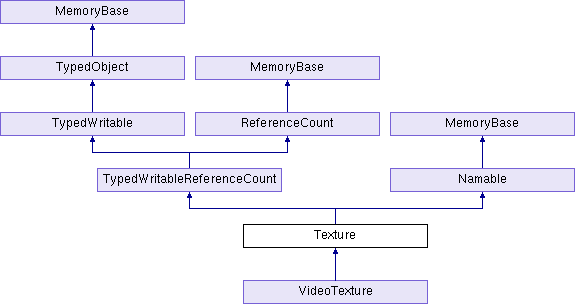
Public Member Functions | |
| Texture (const std::string &name=std::string()) | |
| Constructs an empty texture. More... | |
| bool | adjust_this_size (int &x_size, int &y_size, const std::string &name, bool for_padding) const |
| Works like adjust_size, but also considers the texture class. More... | |
| void | clear () |
| void | clear_alpha_filename () |
| void | clear_alpha_fullpath () |
| void | clear_aux_data (const std::string &key) |
| void | clear_clear_color () |
| void | clear_filename () |
| void | clear_fullpath () |
| void | clear_image () |
| Clears the texture data without changing its format or resolution. More... | |
| void | clear_ram_image () |
| Discards the current system-RAM image. More... | |
| void | clear_ram_mipmap_image (int n) |
| Discards the current system-RAM image for the nth mipmap level. More... | |
| void | clear_ram_mipmap_images () |
| Discards the current system-RAM image for all mipmap levels, except level 0 (the base image). More... | |
| void | clear_simple_ram_image () |
| Discards the current "simple" image. More... | |
| bool | compress_ram_image (CompressionMode compression=CM_on, QualityLevel quality_level=QL_default, GraphicsStateGuardianBase *gsg=nullptr) |
| Attempts to compress the texture's RAM image internally, to a format supported by the indicated GSG. More... | |
| void | consider_rescale (PNMImage &pnmimage) |
| Asks the PNMImage to change its scale when it reads the image, according to the whims of the Config.prc file. More... | |
| virtual bool | cull_callback (CullTraverser *trav, const CullTraverserData &data) const |
| If has_cull_callback() returns true, this function will be called during the cull traversal to perform any additional operations that should be performed at cull time. More... | |
| virtual void | ensure_loader_type (const Filename &filename) |
| May be called prior to calling read_txo() or any bam-related Texture- creating callback, to ensure that the proper dynamic libraries for a Texture of the current class type, and the indicated filename, have been already loaded. More... | |
| size_t | estimate_texture_memory () const |
| Estimates the amount of texture memory that will be consumed by loading this texture. More... | |
| virtual void | finalize (BamReader *manager) |
| Called by the BamReader to perform any final actions needed for setting up the object after all objects have been read and all pointers have been completed. More... | |
| virtual TypeHandle | force_init_type () |
| void | generate_alpha_scale_map () |
| Generates a special 256x1 1-d texture that can be used to apply an arbitrary alpha scale to objects by judicious use of texture matrix. More... | |
| void | generate_normalization_cube_map (int size) |
| Generates a special cube map image in the texture that can be used to apply bump mapping effects: for each texel in the cube map that is indexed by the 3-d texture coordinates (x, y, z), the resulting value is the normalized vector (x, y, z) (compressed from -1..1 into 0..1). More... | |
| void | generate_ram_mipmap_images () |
| Automatically fills in the n mipmap levels of the Texture, based on the texture's source image. More... | |
| void | generate_simple_ram_image () |
| Computes the "simple" ram image by loading the main RAM image, if it is not already available, and reducing it to 16x16 or smaller. More... | |
| bool | get_active (PreparedGraphicsObjects *prepared_objects) const |
| Returns true if this Texture was rendered in the most recent frame within the indicated GSG. More... | |
| const Filename & | get_alpha_filename () const |
| const Filename & | get_alpha_fullpath () const |
| int | get_anisotropic_degree () const |
| AutoTextureScale | get_auto_texture_scale () const |
| TypedReferenceCount * | get_aux_data (const std::string &key) const |
| LColor | get_border_color () const |
| LColor | get_clear_color () const |
| vector_uchar | get_clear_data () const |
| Returns the raw image data for a single pixel if it were set to the clear color. More... | |
| ComponentType | get_component_type () const |
| int | get_component_width () const |
| CompressionMode | get_compression () const |
| size_t | get_data_size_bytes (PreparedGraphicsObjects *prepared_objects) const |
| Returns the number of bytes which the texture is reported to consume within graphics memory, for the indicated GSG. More... | |
| const SamplerState & | get_default_sampler () const |
| int | get_effective_anisotropic_degree () const |
| SamplerState::FilterType | get_effective_magfilter () const |
| SamplerState::FilterType | get_effective_minfilter () const |
| QualityLevel | get_effective_quality_level () const |
| int | get_expected_mipmap_num_pages (int n) const |
| Returns the total number of pages that the nth mipmap level should have, based on the texture's size. More... | |
| int | get_expected_mipmap_x_size (int n) const |
| Returns the x_size that the nth mipmap level should have, based on the texture's size. More... | |
| int | get_expected_mipmap_y_size (int n) const |
| Returns the y_size that the nth mipmap level should have, based on the texture's size. More... | |
| int | get_expected_mipmap_z_size (int n) const |
| Returns the z_size that the nth mipmap level should have, based on the texture's size. More... | |
| int | get_expected_num_mipmap_levels () const |
| size_t | get_expected_ram_image_size () const |
| size_t | get_expected_ram_mipmap_image_size (int n) const |
| Returns the number of bytes that *ought* to be used by the in-memory image for mipmap level n, based on the texture parameters. More... | |
| size_t | get_expected_ram_mipmap_page_size (int n) const |
| Returns the number of bytes that should be used per each Z page of the 3-d texture, for mipmap level n. More... | |
| size_t | get_expected_ram_mipmap_view_size (int n) const |
| Returns the number of bytes that *ought* to be used by each view of the in- memory image for mipmap level n, based on the texture parameters. More... | |
| size_t | get_expected_ram_page_size () const |
| const Filename & | get_filename () const |
| Format | get_format () const |
| const Filename & | get_fullpath () const |
| UpdateSeq | get_image_modified () const |
| virtual bool | get_keep_ram_image () const |
| bool | get_loaded_from_image () const |
| bool | get_loaded_from_txo () const |
| SamplerState::FilterType | get_magfilter () const |
| bool | get_match_framebuffer_format () const |
| SamplerState::FilterType | get_minfilter () const |
| int | get_num_components () const |
| int | get_num_loadable_ram_mipmap_images () const |
| int | get_num_pages () const |
| int | get_num_ram_mipmap_images () const |
| int | get_num_views () const |
| int | get_orig_file_x_size () const |
| int | get_orig_file_y_size () const |
| int | get_orig_file_z_size () const |
| int | get_pad_x_size () const |
| Returns size of the pad region. More... | |
| int | get_pad_y_size () const |
| Returns size of the pad region. More... | |
| int | get_pad_z_size () const |
| Returns size of the pad region. More... | |
| bool | get_post_load_store_cache () const |
| UpdateSeq | get_properties_modified () const |
| QualityLevel | get_quality_level () const |
| CPTA_uchar | get_ram_image () |
| Returns the system-RAM image data associated with the texture. More... | |
| CPTA_uchar | get_ram_image_as (const std::string &requested_format) |
| Returns the uncompressed system-RAM image data associated with the texture. More... | |
| CompressionMode | get_ram_image_compression () const |
| size_t | get_ram_image_size () const |
| CPTA_uchar | get_ram_mipmap_image (int n) const |
| Returns the system-RAM image data associated with the nth mipmap level, if present. More... | |
| size_t | get_ram_mipmap_image_size (int n) const |
| Returns the number of bytes used by the in-memory image for mipmap level n, or 0 if there is no in-memory image for this mipmap level. More... | |
| size_t | get_ram_mipmap_page_size (int n) const |
| Returns the number of bytes used by the in-memory image per page for mipmap level n, or 0 if there is no in-memory image for this mipmap level. More... | |
| void * | get_ram_mipmap_pointer (int n) const |
| Similiar to get_ram_mipmap_image(), however, in this case the void pointer for the given ram image is returned. More... | |
| size_t | get_ram_mipmap_view_size (int n) const |
| Returns the number of bytes used by the in-memory image per view for mipmap level n, or 0 if there is no in-memory image for this mipmap level. More... | |
| size_t | get_ram_page_size () const |
| size_t | get_ram_view_size () const |
| bool | get_render_to_texture () const |
| bool | get_resident (PreparedGraphicsObjects *prepared_objects) const |
| Returns true if this Texture is reported to be resident within graphics memory for the indicated GSG. More... | |
| UpdateSeq | get_simple_image_modified () const |
| CPTA_uchar | get_simple_ram_image () const |
| size_t | get_simple_ram_image_size () const |
| Returns the number of bytes used by the "simple" image, or 0 if there is no simple image. More... | |
| int | get_simple_x_size () const |
| int | get_simple_y_size () const |
| LVecBase2 | get_tex_scale () const |
| Returns a scale pair that is suitable for applying to geometry via NodePath::set_tex_scale(), which will convert texture coordinates on the geometry from the range 0..1 into the appropriate range to render the video part of the texture. More... | |
| TextureType | get_texture_type () const |
| virtual TypeHandle | get_type () const |
| CPTA_uchar | get_uncompressed_ram_image () |
| Returns the system-RAM image associated with the texture, in an uncompressed form if at all possible. More... | |
| GeomEnums::UsageHint | get_usage_hint () const |
| SamplerState::WrapMode | get_wrap_u () const |
| SamplerState::WrapMode | get_wrap_v () const |
| SamplerState::WrapMode | get_wrap_w () const |
| int | get_x_size () const |
| int | get_y_size () const |
| int | get_z_size () const |
| bool | has_all_ram_mipmap_images () const |
| Returns true if all expected mipmap levels have been defined and exist in the system RAM, or false if even one mipmap level is missing. More... | |
| bool | has_alpha_filename () const |
| bool | has_alpha_fullpath () const |
| bool | has_auto_texture_scale () const |
| Returns true if set_auto_texture_scale() has been set to something other than ATS_unspecified for this particular texture. More... | |
| bool | has_clear_color () const |
| bool | has_compression () const |
| Returns true if the texture indicates it wants to be compressed, either with CM_on or higher, or CM_default and compressed-textures is true. More... | |
| virtual bool | has_cull_callback () const |
| Should be overridden by derived classes to return true if cull_callback() has been defined. More... | |
| bool | has_filename () const |
| bool | has_fullpath () const |
| bool | has_ram_image () const |
| Returns true if the Texture has its image contents available in main RAM, false if it exists only in texture memory or in the prepared GSG context. More... | |
| bool | has_ram_mipmap_image (int n) const |
| Returns true if the Texture has the nth mipmap level available in system memory, false otherwise. More... | |
| bool | has_simple_ram_image () const |
| bool | has_uncompressed_ram_image () const |
| Returns true if the Texture has its image contents available in main RAM and is uncompressed, false otherwise. More... | |
| virtual bool | is_cacheable () const |
| bool | is_prepared (PreparedGraphicsObjects *prepared_objects) const |
| Returns true if the texture has already been prepared or enqueued for preparation on the indicated GSG, false otherwise. More... | |
| bool | load (const PNMImage &pnmimage, const LoaderOptions &options=LoaderOptions()) |
| Replaces the texture with the indicated image. More... | |
| bool | load (const PNMImage &pnmimage, int z, int n, const LoaderOptions &options=LoaderOptions()) |
| Stores the indicated image in the given page and mipmap level. More... | |
| bool | load (const PfmFile &pfm, const LoaderOptions &options=LoaderOptions()) |
| Replaces the texture with the indicated image. More... | |
| bool | load (const PfmFile &pfm, int z, int n, const LoaderOptions &options=LoaderOptions()) |
| Stores the indicated image in the given page and mipmap level. More... | |
| Texture * | load_related (const InternalName *suffix) const |
| Loads a texture whose filename is derived by concatenating a suffix to the filename of this texture. More... | |
| bool | load_sub_image (const PNMImage &pnmimage, int x, int y, int z=0, int n=0) |
| Stores the indicated image in a region of the texture. More... | |
| PTA_uchar | make_ram_image () |
| Discards the current system-RAM image for the texture, if any, and allocates a new buffer of the appropriate size. More... | |
| PTA_uchar | make_ram_mipmap_image (int n) |
| Discards the current system-RAM image for the nth mipmap level, if any, and allocates a new buffer of the appropriate size. More... | |
| bool | might_have_ram_image () const |
| Returns true if the texture's image contents are currently available in main RAM, or there is reason to believe it can be loaded on demand. More... | |
| PTA_uchar | modify_ram_image () |
| Returns a modifiable pointer to the system-RAM image. More... | |
| PTA_uchar | modify_ram_mipmap_image (int n) |
| Returns a modifiable pointer to the system-RAM image for the nth mipmap level. More... | |
| PTA_uchar | modify_simple_ram_image () |
| Returns a modifiable pointer to the internal "simple" texture image. More... | |
| PTA_uchar | new_simple_ram_image (int x_size, int y_size) |
| Creates an empty array for the simple ram image of the indicated size, and returns a modifiable pointer to the new array. More... | |
| TextureContext * | prepare_now (int view, PreparedGraphicsObjects *prepared_objects, GraphicsStateGuardianBase *gsg) |
| Creates a context for the texture on the particular GSG, if it does not already exist. More... | |
| typedef | PT (Texture) MakeTextureFunc() |
| PT (Texture) make_copy() const | |
| PT (TexturePeeker) peek() | |
| PT (AsyncFuture) prepare(PreparedGraphicsObjects *prepared_objects) | |
| bool | read (const Filename &fullpath, const LoaderOptions &options=LoaderOptions()) |
| Reads the named filename into the texture. More... | |
| bool | read (const Filename &fullpath, const Filename &alpha_fullpath, int primary_file_num_channels, int alpha_file_channel, const LoaderOptions &options=LoaderOptions()) |
| Combine a 3-component image with a grayscale image to get a 4-component image. More... | |
| bool | read (const Filename &fullpath, int z, int n, bool read_pages, bool read_mipmaps, const LoaderOptions &options=LoaderOptions()) |
| Reads a single file into a single page or mipmap level, or automatically reads a series of files into a series of pages and/or mipmap levels. More... | |
| bool | read (const Filename &fullpath, const Filename &alpha_fullpath, int primary_file_num_channels, int alpha_file_channel, int z, int n, bool read_pages, bool read_mipmaps, BamCacheRecord *record=nullptr, const LoaderOptions &options=LoaderOptions()) |
| Reads the texture from the indicated filename. More... | |
| bool | read_dds (std::istream &in, const std::string &filename="", bool header_only=false) |
| Reads the texture from a DDS file object. More... | |
| bool | read_ktx (std::istream &in, const std::string &filename="", bool header_only=false) |
| Reads the texture from a KTX file object. More... | |
| bool | read_txo (std::istream &in, const std::string &filename="") |
| Reads the texture from a Panda texture object. More... | |
| bool | release (PreparedGraphicsObjects *prepared_objects) |
| Frees the texture context only on the indicated object, if it exists there. More... | |
| int | release_all () |
| Frees the context allocated on all objects for which the texture has been declared. More... | |
| bool | reload () |
| Re-reads the Texture from its disk file. More... | |
| bool | rescale_texture () |
| This method is similar to consider_rescale(), but instead of scaling a separate PNMImage, it will ask the Texture to rescale its own internal image to a power of 2, according to the config file requirements. More... | |
| void | set_alpha_filename (const Filename &alpha_filename) |
| void | set_alpha_fullpath (const Filename &alpha_fullpath) |
| void | set_anisotropic_degree (int anisotropic_degree) |
| void | set_auto_texture_scale (AutoTextureScale scale) |
| void | set_aux_data (const std::string &key, TypedReferenceCount *aux_data) |
| void | set_border_color (const LColor &color) |
| void | set_clear_color (const LColor &color) |
| void | set_component_type (ComponentType component_type) |
| void | set_compression (CompressionMode compression) |
| void | set_default_sampler (const SamplerState &sampler) |
| void | set_filename (const Filename &filename) |
| void | set_format (Format format) |
| void | set_fullpath (const Filename &fullpath) |
| void | set_keep_ram_image (bool keep_ram_image) |
| void | set_loaded_from_image (bool flag=true) |
| void | set_loaded_from_txo (bool flag=true) |
| void | set_magfilter (FilterType filter) |
| void | set_match_framebuffer_format (bool flag) |
| void | set_minfilter (FilterType filter) |
| void | set_num_views (int num_views) |
| void | set_orig_file_size (int x, int y, int z=1) |
| Specifies the size of the texture as it exists in its original disk file, before any Panda scaling. More... | |
| void | set_pad_size (int x=0, int y=0, int z=0) |
| Sets the size of the pad region. More... | |
| void | set_post_load_store_cache (bool flag) |
| void | set_quality_level (QualityLevel quality_level) |
| void | set_ram_image (CPTA_uchar image, CompressionMode compression=CM_off, size_t page_size=0) |
| Replaces the current system-RAM image with the new data. More... | |
| void | set_ram_image_as (CPTA_uchar image, const std::string &provided_format) |
| Replaces the current system-RAM image with the new data, converting it first if necessary from the indicated component-order format. More... | |
| void | set_ram_mipmap_image (int n, CPTA_uchar image, size_t page_size=0) |
| Replaces the current system-RAM image for the indicated mipmap level with the new data. More... | |
| void | set_ram_mipmap_pointer (int n, void *image, size_t page_size=0) |
| Sets an explicit void pointer as the texture's mipmap image for the indicated level. More... | |
| void | set_ram_mipmap_pointer_from_int (long long pointer, int n, int page_size) |
| Accepts a raw pointer cast as an int, which is then passed to set_ram_mipmap_pointer(); see the documentation for that method. More... | |
| void | set_render_to_texture (bool render_to_texture) |
| void | set_simple_ram_image (CPTA_uchar image, int x_size, int y_size) |
| Replaces the internal "simple" texture image. More... | |
| void | set_size_padded (int x=1, int y=1, int z=1) |
| Changes the size of the texture, padding if necessary, and setting the pad region as well. More... | |
| void | set_wrap_u (WrapMode wrap) |
| void | set_wrap_v (WrapMode wrap) |
| void | set_wrap_w (WrapMode wrap) |
| void | set_x_size (int x_size) |
| void | set_y_size (int y_size) |
| void | set_z_size (int z_size) |
| void | setup_1d_texture () |
| Sets the texture as an empty 1-d texture with no dimensions. More... | |
| void | setup_1d_texture (int x_size, ComponentType component_type, Format format) |
| Sets the texture as an empty 1-d texture with the specified dimensions and properties. More... | |
| void | setup_2d_texture () |
| Sets the texture as an empty 2-d texture with no dimensions. More... | |
| void | setup_2d_texture (int x_size, int y_size, ComponentType component_type, Format format) |
| Sets the texture as an empty 2-d texture with the specified dimensions and properties. More... | |
| void | setup_2d_texture_array (int z_size=1) |
| Sets the texture as an empty 2-d texture array with no dimensions (though if you know the depth ahead of time, it saves a bit of reallocation later). More... | |
| void | setup_2d_texture_array (int x_size, int y_size, int z_size, ComponentType component_type, Format format) |
| Sets the texture as an empty 2-d texture array with the specified dimensions and properties. More... | |
| void | setup_3d_texture (int z_size=1) |
| Sets the texture as an empty 3-d texture with no dimensions (though if you know the depth ahead of time, it saves a bit of reallocation later). More... | |
| void | setup_3d_texture (int x_size, int y_size, int z_size, ComponentType component_type, Format format) |
| Sets the texture as an empty 3-d texture with the specified dimensions and properties. More... | |
| void | setup_buffer_texture (int size, ComponentType component_type, Format format, GeomEnums::UsageHint usage) |
| Sets the texture as an empty buffer texture with the specified size and properties. More... | |
| void | setup_cube_map () |
| Sets the texture as an empty cube map texture with no dimensions. More... | |
| void | setup_cube_map (int size, ComponentType component_type, Format format) |
| Sets the texture as an empty cube map texture with the specified dimensions and properties. More... | |
| void | setup_cube_map_array (int num_cube_maps) |
| Sets the texture as cube map array with N cube maps. More... | |
| void | setup_cube_map_array (int size, int num_cube_maps, ComponentType component_type, Format format) |
| Sets the texture as cube map array with N cube maps with the specified dimensions and format. More... | |
| void | setup_texture (TextureType texture_type, int x_size, int y_size, int z_size, ComponentType component_type, Format format) |
| Sets the texture to the indicated type and dimensions, presumably in preparation for calling read() or load(), or set_ram_image() or modify_ram_image(), or use set_clear_color to let the texture be cleared to a solid color. More... | |
| bool | store (PNMImage &pnmimage) const |
| Saves the texture to the indicated PNMImage, but does not write it to disk. More... | |
| bool | store (PNMImage &pnmimage, int z, int n) const |
| Saves the indicated page and mipmap level of the texture to the PNMImage. More... | |
| bool | store (PfmFile &pfm) const |
| Saves the texture to the indicated PfmFile, but does not write it to disk. More... | |
| bool | store (PfmFile &pfm, int z, int n) const |
| Saves the indicated page and mipmap level of the texture to the PfmFile. More... | |
| void | texture_uploaded () |
| This method is called by the GraphicsEngine at the beginning of the frame *after* a texture has been successfully uploaded to graphics memory. More... | |
| bool | uncompress_ram_image () |
| Attempts to uncompress the texture's RAM image internally. More... | |
| bool | uses_mipmaps () const |
| Returns true if the minfilter settings on this texture indicate the use of mipmapping, false otherwise. More... | |
| bool | was_image_modified (PreparedGraphicsObjects *prepared_objects) const |
| Returns true if the texture needs to be re-loaded onto the indicated GSG, either because its image data is out-of-date, or because it's not fully prepared now. More... | |
| bool | write (const Filename &fullpath) |
| Writes the texture to the named filename. More... | |
| bool | write (const Filename &fullpath, int z, int n, bool write_pages, bool write_mipmaps) |
| Writes a single page or mipmap level to a single file, or automatically writes a series of pages and/or mipmap levels to a numbered series of files. More... | |
| void | write (std::ostream &out, int indent_level) const |
| Not to be confused with write(Filename), this method simply describes the texture properties. More... | |
| virtual void | write_datagram (BamWriter *manager, Datagram &me) |
| Function to write the important information in the particular object to a Datagram. More... | |
 Public Member Functions inherited from TypedWritableReferenceCount Public Member Functions inherited from TypedWritableReferenceCount | |
| TypedWritableReferenceCount (const TypedWritableReferenceCount ©) | |
| virtual ReferenceCount * | as_reference_count () |
| Returns the pointer cast to a ReferenceCount pointer, if it is in fact of that type. More... | |
| void | operator= (const TypedWritableReferenceCount ©) |
| Public Member Functions inherited from TypedWritable | |
| TypedWritable (const TypedWritable ©) | |
| virtual int | complete_pointers (TypedWritable **p_list, BamReader *manager) |
| Receives an array of pointers, one for each time manager->read_pointer() was called in fillin(). More... | |
| vector_uchar | encode_to_bam_stream () const |
| Converts the TypedWritable object into a single stream of data using a BamWriter, and returns that data as a bytes object. More... | |
| bool | encode_to_bam_stream (vector_uchar &data, BamWriter *writer=nullptr) const |
| Converts the TypedWritable object into a single stream of data using a BamWriter, and stores that data in the indicated string. More... | |
| virtual void | fillin (DatagramIterator &scan, BamReader *manager) |
| This internal function is intended to be called by each class's make_from_bam() method to read in all of the relevant data from the BamFile for the new object. More... | |
| UpdateSeq | get_bam_modified () const |
| Returns the current bam_modified counter. More... | |
| void | mark_bam_modified () |
| Increments the bam_modified counter, so that this object will be invalidated and retransmitted on any open bam streams. More... | |
| void | operator= (const TypedWritable ©) |
| virtual bool | require_fully_complete () const |
| Some objects require all of their nested pointers to have been completed before the objects themselves can be completed. More... | |
| virtual void | update_bam_nested (BamWriter *manager) |
| Called by the BamWriter when this object has not itself been modified recently, but it should check its nested objects for updates. More... | |
| Public Member Functions inherited from TypedObject | |
| TypedObject (const TypedObject ©)=default | |
| TypedObject * | as_typed_object () |
| Returns the object, upcast (if necessary) to a TypedObject pointer. More... | |
| const TypedObject * | as_typed_object () const |
| Returns the object, upcast (if necessary) to a TypedObject pointer. More... | |
| int | get_best_parent_from_Set (const std::set< int > &) const |
| int | get_type_index () const |
| Returns the internal index number associated with this object's TypeHandle, a unique number for each different type. More... | |
| bool | is_exact_type (TypeHandle handle) const |
| Returns true if the current object is the indicated type exactly. More... | |
| bool | is_of_type (TypeHandle handle) const |
| Returns true if the current object is or derives from the indicated type. More... | |
| TypedObject & | operator= (const TypedObject ©)=default |
| Public Member Functions inherited from ReferenceCount | |
| int | get_ref_count () const |
| WeakReferenceList * | get_weak_list () const |
| Returns the WeakReferenceList associated with this ReferenceCount object. More... | |
| bool | has_weak_list () const |
| Returns true if this particular ReferenceCount object has a WeakReferenceList created, false otherwise. More... | |
| void | local_object () |
| This function should be called, once, immediately after creating a new instance of some ReferenceCount-derived object on the stack. More... | |
| void | ref () const |
| Explicitly increments the reference count. More... | |
| bool | ref_if_nonzero () const |
| Atomically increases the reference count of this object if it is not zero. More... | |
| bool | test_ref_count_integrity () const |
| Does some easy checks to make sure that the reference count isn't completely bogus. More... | |
| bool | test_ref_count_nonzero () const |
| Does some easy checks to make sure that the reference count isn't zero, or completely bogus. More... | |
| virtual bool | unref () const |
| Explicitly decrements the reference count. More... | |
| WeakReferenceList * | weak_ref () |
| Adds the indicated PointerToVoid as a weak reference to this object. More... | |
| void | weak_unref () |
| Removes the indicated PointerToVoid as a weak reference to this object. More... | |
| Public Member Functions inherited from Namable | |
| Namable (const std::string &initial_name="") | |
| void | clear_name () |
| Resets the Namable's name to empty. More... | |
| const std::string & | get_name () const |
| bool | has_name () const |
| Returns true if the Namable has a nonempty name set, false if the name is empty. More... | |
| void | output (std::ostream &out) const |
| Outputs the Namable. More... | |
| void | set_name (const std::string &name) |
Static Public Member Functions | |
| static bool | adjust_size (int &x_size, int &y_size, const std::string &name, bool for_padding, AutoTextureScale auto_texture_scale=ATS_unspecified) |
| Computes the proper size of the texture, based on the original size, the filename, and the resizing whims of the config file. More... | |
| static void | consider_rescale (PNMImage &pnmimage, const std::string &name, AutoTextureScale auto_texture_scale=ATS_unspecified) |
| Asks the PNMImage to change its scale when it reads the image, according to the whims of the Config.prc file. More... | |
| static int | down_to_power_2 (int value) |
| Returns the largest power of 2 less than or equal to value. More... | |
| static std::string | format_component_type (ComponentType ct) |
| Returns the indicated ComponentType converted to a string word. More... | |
| static std::string | format_compression_mode (CompressionMode cm) |
| Returns the indicated CompressionMode converted to a string word. More... | |
| static std::string | format_format (Format f) |
| Returns the indicated Format converted to a string word. More... | |
| static std::string | format_quality_level (QualityLevel tql) |
| Returns the indicated QualityLevel converted to a string word. More... | |
| static std::string | format_texture_type (TextureType tt) |
| Returns the indicated TextureType converted to a string word. More... | |
| static TypeHandle | get_class_type () |
| static AutoTextureScale | get_textures_power_2 () |
| This flag returns ATS_none, ATS_up, or ATS_down and controls the scaling of textures in general. More... | |
| static bool | has_alpha (Format format) |
| Returns true if the indicated format includes alpha, false otherwise. More... | |
| static bool | has_binary_alpha (Format format) |
| Returns true if the indicated format includes a binary alpha only, false otherwise. More... | |
| static bool | has_textures_power_2 () |
| If true, then get_textures_power_2 has been set using set_textures_power_2. More... | |
| static void | init_type () |
| static bool | is_specific (CompressionMode compression) |
| Returns true if the indicated compression mode is one of the specific compression types, false otherwise. More... | |
| static bool | is_srgb (Format format) |
| Returns true if the indicated format is in the sRGB color space, false otherwise. More... | |
| static bool | is_unsigned (ComponentType ctype) |
| Returns true if the indicated component type is unsigned, false otherwise. More... | |
| static | PT (Texture) make_texture() |
| static void | register_with_read_factory () |
| Factory method to generate a Texture object. More... | |
| static void | set_textures_power_2 (AutoTextureScale scale) |
| Set this flag to ATS_none, ATS_up, ATS_down, or ATS_pad to control the scaling of textures in general, if a particular texture does not override this. More... | |
| static ComponentType | string_component_type (const std::string &str) |
| Returns the ComponentType corresponding to the indicated string word. More... | |
| static CompressionMode | string_compression_mode (const std::string &str) |
| Returns the CompressionMode value associated with the given string representation. More... | |
| static Format | string_format (const std::string &str) |
| Returns the Format corresponding to the indicated string word. More... | |
| static QualityLevel | string_quality_level (const std::string &str) |
| Returns the QualityLevel value associated with the given string representation. More... | |
| static TextureType | string_texture_type (const std::string &str) |
| Returns the TextureType corresponding to the indicated string word. More... | |
| static int | up_to_power_2 (int value) |
| Returns the smallest power of 2 greater than or equal to value. More... | |
| Static Public Member Functions inherited from TypedWritableReferenceCount | |
| static TypeHandle | get_class_type () |
| static void | init_type () |
| static | PT (TypedWritableReferenceCount) decode_from_bam_stream(vector_uchar data |
| Static Public Member Functions inherited from TypedWritable | |
| static bool | decode_raw_from_bam_stream (TypedWritable *&ptr, ReferenceCount *&ref_ptr, vector_uchar data, BamReader *reader=nullptr) |
| Reads the bytes created by a previous call to encode_to_bam_stream(), and extracts the single object on those bytes. More... | |
| static TypeHandle | get_class_type () |
| static void | init_type () |
| Static Public Member Functions inherited from TypedObject | |
| static TypeHandle | get_class_type () |
| static void | init_type () |
| This function is declared non-inline to work around a compiler bug in g++ 2.96. More... | |
| Static Public Member Functions inherited from ReferenceCount | |
| static TypeHandle | get_class_type () |
| static void | init_type () |
| Static Public Member Functions inherited from Namable | |
| static TypeHandle | get_class_type () |
| static void | init_type () |
Public Attributes | |
| clear_alpha_filename | |
| Removes the alpha filename, if it was previously set. More... | |
| clear_alpha_fullpath | |
| Removes the alpha fullpath, if it was previously set. More... | |
| clear_aux_data | |
| Removes a record previously recorded via set_aux_data(). More... | |
| clear_clear_color | |
| The opposite of set_clear_color. More... | |
| clear_filename | |
| Removes the alpha filename, if it was previously set. More... | |
| clear_fullpath | |
| Removes the alpha fullpath, if it was previously set. More... | |
| get_alpha_filename | |
| Returns the alpha_filename that has been set. More... | |
| get_alpha_fullpath | |
| Returns the alpha_fullpath that has been set. More... | |
| get_anisotropic_degree | |
| Returns the degree of anisotropic filtering that should be applied to the texture. More... | |
| get_auto_texture_scale | |
| Returns the power-of-2 texture-scaling mode that will be applied to this particular texture when it is next loaded from disk. More... | |
| get_aux_data | |
| Returns a record previously recorded via set_aux_data(). More... | |
| get_border_color | |
| Returns the solid color of the texture's border. More... | |
| get_clear_color | |
| Returns the color that was previously set using set_clear_color. More... | |
| get_component_type | |
| Returns the numeric interpretation of each component of the texture. More... | |
| get_component_width | |
| Returns the number of bytes stored for each color component of a texel. More... | |
| get_compression | |
| Returns the compression mode requested for this particular texture, or CM_off if the texture is not to be compressed. More... | |
| get_default_sampler | |
| This returns the default sampler state for this texture, containing the wrap and filter properties specified on the texture level; it may still be overridden by a sampler state specified at a higher level. More... | |
| get_effective_anisotropic_degree | |
| Returns the degree of anisotropic filtering that should be applied to the texture. More... | |
| get_effective_magfilter | |
| Returns the filter mode of the texture for magnification, with special treatment for FT_default. More... | |
| get_effective_minfilter | |
| Returns the filter mode of the texture for minification, with special treatment for FT_default. More... | |
| get_effective_quality_level | |
| Returns the current quality_level hint, or the global default quality_level if this texture doesn't specify a quality level. More... | |
| get_expected_num_mipmap_levels | |
| Returns the number of mipmap levels that should be defined for this texture, given the texture's size. More... | |
| get_expected_ram_image_size | |
| Returns the number of bytes that *ought* to be used by the in-memory image, based on the texture parameters. More... | |
| get_expected_ram_page_size | |
| Returns the number of bytes that should be used per each Z page of the 3-d texture. More... | |
| get_filename | |
| Returns the filename that has been set. More... | |
| get_format | |
| Returns the format of the texture, which represents both the semantic meaning of the texels and, to some extent, their storage information. More... | |
| get_fullpath | |
| Returns the fullpath that has been set. More... | |
| get_image_modified | |
| Returns a sequence number which is guaranteed to change at least every time the texture image data (including mipmap levels) are modified. More... | |
| get_keep_ram_image | |
| Returns the flag that indicates whether this Texture is eligible to have its main RAM copy of the texture memory dumped when the texture is prepared for rendering. More... | |
| get_loaded_from_image | |
| Returns the flag that indicates the texture has been loaded from a disk file or PNMImage. More... | |
| get_loaded_from_txo | |
| Returns the flag that indicates the texture has been loaded from a txo file. More... | |
| get_magfilter | |
| Returns the filter mode of the texture for magnification. More... | |
| get_match_framebuffer_format | |
| Returns true if the special flag was set that indicates to the GSG that the Texture's format should be chosen to exactly match the framebuffer's format, presumably because the application intends to copy image data from the framebuffer into the Texture (or vice-versa). More... | |
| get_minfilter | |
| Returns the filter mode of the texture for minification. More... | |
| get_num_components | |
| Returns the number of color components for each texel of the texture image. More... | |
| get_num_loadable_ram_mipmap_images | |
| Returns the number of contiguous mipmap levels that exist in RAM, up until the first gap in the sequence. More... | |
| get_num_pages | |
| Returns the total number of pages in the texture. More... | |
| get_num_ram_mipmap_images | |
| Returns the maximum number of mipmap level images available in system memory. More... | |
| get_num_views | |
| Returns the number of "views" in the texture. More... | |
| get_orig_file_x_size | |
| Returns the X size of the original disk image that this Texture was loaded from (if it came from a disk file), before any automatic rescaling by Panda. More... | |
| get_orig_file_y_size | |
| Returns the Y size of the original disk image that this Texture was loaded from (if it came from a disk file), before any automatic rescaling by Panda. More... | |
| get_orig_file_z_size | |
| Returns the Z size of the original disk image that this Texture was loaded from (if it came from a disk file), before any automatic rescaling by Panda. More... | |
| get_post_load_store_cache | |
| Returns the setting of the post_load_store_cache flag. More... | |
| get_properties_modified | |
| Returns a sequence number which is guaranteed to change at least every time the texture properties (unrelated to the image) are modified. More... | |
| get_quality_level | |
| Returns the current quality_level hint. More... | |
| get_ram_image_compression | |
| Returns the compression mode in which the ram image is already stored pre- compressed. More... | |
| get_ram_image_size | |
| Returns the total number of bytes used by the in-memory image, across all pages and views, or 0 if there is no in-memory image. More... | |
| get_ram_page_size | |
| Returns the number of bytes used by the in-memory image per page, or 0 if there is no in-memory image. More... | |
| get_ram_view_size | |
| Returns the number of bytes used by the in-memory image per view, or 0 if there is no in-memory image. More... | |
| get_render_to_texture | |
| Returns a flag on the texture that indicates whether the texture is intended to be used as a direct-render target, by binding a framebuffer to a texture and rendering directly into the texture. More... | |
| get_simple_image_modified | |
| Returns a sequence number which is guaranteed to change at least every time the texture's "simple" image data is modified. More... | |
| get_simple_ram_image | |
| Returns the image data associated with the "simple" texture image. More... | |
| get_simple_x_size | |
| Returns the width of the "simple" image in texels. More... | |
| get_simple_y_size | |
| Returns the height of the "simple" image in texels. More... | |
| get_texture_type | |
| Returns the overall interpretation of the texture. More... | |
| get_usage_hint | |
| Returns the usage hint specified for buffer textures, or UH_unspecified for all other texture types. More... | |
| get_wrap_u | |
| Returns the wrap mode of the texture in the U direction. More... | |
| get_wrap_v | |
| Returns the wrap mode of the texture in the V direction. More... | |
| get_wrap_w | |
| Returns the wrap mode of the texture in the W direction. More... | |
| get_x_size | |
| Returns the width of the texture image in texels. More... | |
| get_y_size | |
| Returns the height of the texture image in texels. More... | |
| get_z_size | |
| Returns the depth of the texture image in texels. More... | |
| has_alpha_filename | |
| Returns true if the alpha_filename has been set and is available. More... | |
| has_alpha_fullpath | |
| Returns true if the alpha_fullpath has been set and is available. More... | |
| has_clear_color | |
| Returns true if a color was previously set using set_clear_color. More... | |
| has_filename | |
| Returns true if the filename has been set and is available. More... | |
| has_fullpath | |
| Returns true if the fullpath has been set and is available. More... | |
| has_simple_ram_image | |
| Returns true if the Texture has a "simple" image available in main RAM. More... | |
| is_cacheable | |
| Returns true if there is enough information in this Texture object to write it to the bam cache successfully, false otherwise. More... | |
| set_alpha_filename | |
| Sets the name of the file that contains the image's alpha channel contents. More... | |
| set_alpha_fullpath | |
| Sets the full pathname to the file that contains the image's alpha channel contents, as found along the search path. More... | |
| set_anisotropic_degree | |
| Specifies the level of anisotropic filtering to apply to the texture. More... | |
| set_auto_texture_scale | |
| Specifies the power-of-2 texture-scaling mode that will be applied to this particular texture when it is next loaded from disk. More... | |
| set_aux_data | |
| Records an arbitrary object in the Texture, associated with a specified key. More... | |
| set_border_color | |
| Specifies the solid color of the texture's border. More... | |
| set_clear_color | |
| Sets the color that will be used to fill the texture image in absence of any image data. More... | |
| set_component_type | |
| Changes the data value for the texture components. More... | |
| set_compression | |
| Requests that this particular Texture be compressed when it is loaded into texture memory. More... | |
| set_default_sampler | |
| This sets the default sampler state for this texture, containing the wrap and filter properties specified on the texture level; it may still be overridden by a sampler state specified at a higher level. More... | |
| set_filename | |
| Sets the name of the file that contains the image's contents. More... | |
| set_format | |
| Changes the format value for the texture components. More... | |
| set_fullpath | |
| Sets the full pathname to the file that contains the image's contents, as found along the search path. More... | |
| set_keep_ram_image | |
| Sets the flag that indicates whether this Texture is eligible to have its main RAM copy of the texture memory dumped when the texture is prepared for rendering. More... | |
| set_loaded_from_image | |
| Sets the flag that indicates the texture has been loaded from a disk file or PNMImage. More... | |
| set_loaded_from_txo | |
| Sets the flag that indicates the texture has been loaded from a txo file. More... | |
| set_magfilter | |
| Sets the filtering method that should be used when viewing the texture up close. More... | |
| set_match_framebuffer_format | |
| Sets the special flag that, if true, indicates to the GSG that the Texture's format should be chosen to exactly match the framebuffer's format, presumably because the application intends to copy image data from the framebuffer into the Texture (or vice-versa). More... | |
| set_minfilter | |
| Sets the filtering method that should be used when viewing the texture from a distance. More... | |
| set_num_views | |
| Sets the number of "views" within a texture. More... | |
| set_post_load_store_cache | |
| Sets the post_load_store_cache flag. More... | |
| set_quality_level | |
| Sets a hint to the renderer about the desired performance / quality tradeoff for this particular texture. More... | |
| set_render_to_texture | |
| Sets a flag on the texture that indicates whether the texture is intended to be used as a direct-render target, by binding a framebuffer to a texture and rendering directly into the texture. More... | |
| set_wrap_u | |
| This setting determines what happens when the texture is sampled with a U value outside the range 0.0-1.0. More... | |
| set_wrap_v | |
| This setting determines what happens when the texture is sampled with a V value outside the range 0.0-1.0. More... | |
| set_wrap_w | |
| The W wrap direction is only used for 3-d textures. More... | |
| set_x_size | |
| Changes the x size indicated for the texture. More... | |
| set_y_size | |
| Changes the y size indicated for the texture. More... | |
| set_z_size | |
| Changes the z size indicated for the texture. More... | |
| Public Attributes inherited from TypedWritableReferenceCount | |
| static BamReader * | reader = nullptr) |
| Public Attributes inherited from TypedObject | |
| get_type | |
| Public Attributes inherited from ReferenceCount | |
| get_ref_count | |
| Returns the current reference count. More... | |
| Public Attributes inherited from Namable | |
| get_name | |
| set_name | |
Friends | |
| class | PreparedGraphicsObjects |
| class | TextureContext |
| class | TexturePeeker |
| class | TexturePool |
Additional Inherited Members | |
| Static Public Attributes inherited from TypedWritable | |
| static TypedWritable *const | Null = nullptr |
Detailed Description
Represents a texture object, which is typically a single 2-d image but may also represent a 1-d or 3-d texture image, or the six 2-d faces of a cube map texture.
A texture's image data might be stored in system RAM (see get_ram_image()) or its image may be represented in texture memory on one or more GraphicsStateGuardians (see prepare()), or both. The typical usage pattern is that a texture is loaded from an image file on disk, which copies its image data into system RAM; then the first time the texture is rendered its image data is copied to texture memory (actually, to the graphics API), and the system RAM image is automatically freed.
Constructor & Destructor Documentation
◆ Texture()
|
explicit |
Constructs an empty texture.
The default is to set up the texture as an empty 2-d texture; follow up with one of the variants of setup_texture() if this is not what you want.
Definition at line 374 of file texture.cxx.
Referenced by PT().
Member Function Documentation
◆ adjust_size()
|
static |
Computes the proper size of the texture, based on the original size, the filename, and the resizing whims of the config file.
x_size and y_size should be loaded with the texture image's original size on disk. On return, they will be loaded with the texture's in-memory target size. The return value is true if the size has been adjusted, or false if it is the same.
Definition at line 2640 of file texture.cxx.
Referenced by consider_rescale().
◆ adjust_this_size()
|
inline |
Works like adjust_size, but also considers the texture class.
Movie textures, for instance, always pad outwards, regardless of textures- power-2.
Definition at line 2154 of file texture.I.
Referenced by MovieVideoCursor::setup_texture().
◆ clear_image()
|
inline |
Clears the texture data without changing its format or resolution.
The texture is cleared on both the graphics hardware and from RAM, unlike clear_ram_image, which only removes the data from RAM.
If a clear color has been specified using set_clear_color, the texture will be cleared using a solid color.
The texture data will be cleared the first time in which the texture is used after this method is called.
◆ clear_ram_image()
|
inline |
Discards the current system-RAM image.
Definition at line 1439 of file texture.I.
Referenced by GraphicsOutput::add_render_texture().
◆ clear_ram_mipmap_image()
| void Texture::clear_ram_mipmap_image | ( | int | n | ) |
Discards the current system-RAM image for the nth mipmap level.
Definition at line 1271 of file texture.cxx.
◆ clear_ram_mipmap_images()
|
inline |
◆ clear_simple_ram_image()
|
inline |
◆ compress_ram_image()
|
inline |
Attempts to compress the texture's RAM image internally, to a format supported by the indicated GSG.
In order for this to work, the squish library must have been compiled into Panda.
If compression is CM_on, then an appropriate compression method that is supported by the indicated GSG is automatically chosen. If the GSG pointer is NULL, any of the standard DXT1/3/5 compression methods will be used, regardless of whether it is supported.
If compression is any specific compression method, that method is used regardless of whether the GSG supports it.
quality_level determines the speed/quality tradeoff of the compression. If it is QL_default, the texture's own quality_level parameter is used.
Returns true if successful, false otherwise.
◆ consider_rescale() [1/2]
| void Texture::consider_rescale | ( | PNMImage & | pnmimage | ) |
Asks the PNMImage to change its scale when it reads the image, according to the whims of the Config.prc file.
For most efficient results, this method should be called after pnmimage.read_header() has been called, but before pnmimage.read(). This method may also be called after pnmimage.read(), i.e. when the pnmimage is already loaded; in this case it will rescale the image on the spot. Also see rescale_texture().
Definition at line 2014 of file texture.cxx.
References get_auto_texture_scale.
◆ consider_rescale() [2/2]
|
static |
Asks the PNMImage to change its scale when it reads the image, according to the whims of the Config.prc file.
For most efficient results, this method should be called after pnmimage.read_header() has been called, but before pnmimage.read(). This method may also be called after pnmimage.read(), i.e. when the pnmimage is already loaded; in this case it will rescale the image on the spot. Also see rescale_texture().
Definition at line 2029 of file texture.cxx.
References adjust_size(), PNMImage::get_color_space(), PNMImageHeader::get_maxval, PNMImageHeader::get_num_channels, PNMImageHeader::get_type, PNMImageHeader::get_x_size(), PNMImageHeader::get_y_size(), PNMImage::is_valid(), PNMImage::quick_filter_from(), PNMImage::set_read_size(), and PNMImage::take_from().
◆ cull_callback()
|
virtual |
If has_cull_callback() returns true, this function will be called during the cull traversal to perform any additional operations that should be performed at cull time.
This is called each time the Texture is discovered applied to a Geom in the traversal. It should return true if the Geom is visible, false if it should be omitted.
Reimplemented in VideoTexture.
Definition at line 2529 of file texture.cxx.
◆ down_to_power_2()
|
static |
Returns the largest power of 2 less than or equal to value.
Definition at line 1995 of file texture.cxx.
References get_next_higher_bit().
◆ ensure_loader_type()
|
virtual |
May be called prior to calling read_txo() or any bam-related Texture- creating callback, to ensure that the proper dynamic libraries for a Texture of the current class type, and the indicated filename, have been already loaded.
This is a low-level function that should not normally need to be called directly by the user.
Note that for best results you must first create a Texture object of the appropriate class type for your filename, for instance with TexturePool::make_texture().
Definition at line 2750 of file texture.cxx.
◆ estimate_texture_memory()
| size_t Texture::estimate_texture_memory | ( | ) | const |
Estimates the amount of texture memory that will be consumed by loading this texture.
This returns a value that is not specific to any particular graphics card or driver; it tries to make a reasonable assumption about how a driver will load the texture. It does not account for texture compression or anything fancy. This is mainly useful for debugging and reporting purposes.
Returns a value in bytes.
Definition at line 675 of file texture.cxx.
References uses_mipmaps().
◆ finalize()
|
virtual |
Called by the BamReader to perform any final actions needed for setting up the object after all objects have been read and all pointers have been completed.
Reimplemented from TypedWritable.
Definition at line 9858 of file texture.cxx.
References ReferenceCount::unref().
◆ format_component_type()
|
static |
Returns the indicated ComponentType converted to a string word.
Definition at line 2104 of file texture.cxx.
◆ format_compression_mode()
|
static |
Returns the indicated CompressionMode converted to a string word.
Definition at line 2361 of file texture.cxx.
◆ format_format()
|
static |
Returns the indicated Format converted to a string word.
Definition at line 2163 of file texture.cxx.
◆ format_quality_level()
|
static |
Returns the indicated QualityLevel converted to a string word.
Definition at line 2446 of file texture.cxx.
◆ format_texture_type()
|
static |
Returns the indicated TextureType converted to a string word.
Definition at line 2052 of file texture.cxx.
◆ generate_alpha_scale_map()
| void Texture::generate_alpha_scale_map | ( | ) |
Generates a special 256x1 1-d texture that can be used to apply an arbitrary alpha scale to objects by judicious use of texture matrix.
The texture is a gradient, with an alpha of 0 on the left (U = 0), and 255 on the right (U = 1).
Definition at line 526 of file texture.cxx.
◆ generate_normalization_cube_map()
| void Texture::generate_normalization_cube_map | ( | int | size | ) |
Generates a special cube map image in the texture that can be used to apply bump mapping effects: for each texel in the cube map that is indexed by the 3-d texture coordinates (x, y, z), the resulting value is the normalized vector (x, y, z) (compressed from -1..1 into 0..1).
Definition at line 424 of file texture.cxx.
◆ generate_ram_mipmap_images()
|
inline |
Automatically fills in the n mipmap levels of the Texture, based on the texture's source image.
This requires the texture's uncompressed ram image to be available in system memory. If it is not already, it will be fetched if possible.
This call is not normally necessary, since the mipmap levels will be generated automatically if needed. But there may be certain cases in which you would like to call this explicitly.
◆ generate_simple_ram_image()
| void Texture::generate_simple_ram_image | ( | ) |
Computes the "simple" ram image by loading the main RAM image, if it is not already available, and reducing it to 16x16 or smaller.
This may be an expensive operation.
Definition at line 1318 of file texture.cxx.
◆ get_active()
| bool Texture::get_active | ( | PreparedGraphicsObjects * | prepared_objects | ) | const |
Returns true if this Texture was rendered in the most recent frame within the indicated GSG.
Definition at line 1513 of file texture.cxx.
References BufferContext::get_active.
◆ get_clear_data()
|
inline |
◆ get_data_size_bytes()
| size_t Texture::get_data_size_bytes | ( | PreparedGraphicsObjects * | prepared_objects | ) | const |
Returns the number of bytes which the texture is reported to consume within graphics memory, for the indicated GSG.
This may return a nonzero value even if the texture is not currently resident; you should also check get_resident() if you want to know how much space the texture is actually consuming right now.
Definition at line 1486 of file texture.cxx.
References BufferContext::get_data_size_bytes.
◆ get_expected_mipmap_num_pages()
|
inline |
Returns the total number of pages that the nth mipmap level should have, based on the texture's size.
This is usually the same as get_expected_mipmap_z_size(), except for a multiview texture, in which case it is get_expected_mipmap_z_size() * get_num_views().
◆ get_expected_mipmap_x_size()
|
inline |
◆ get_expected_mipmap_y_size()
|
inline |
◆ get_expected_mipmap_z_size()
|
inline |
◆ get_expected_ram_mipmap_image_size()
|
inline |
◆ get_expected_ram_mipmap_page_size()
|
inline |
◆ get_expected_ram_mipmap_view_size()
|
inline |
◆ get_pad_x_size()
|
inline |
◆ get_pad_y_size()
|
inline |
◆ get_pad_z_size()
|
inline |
◆ get_ram_image()
|
inline |
Returns the system-RAM image data associated with the texture.
If the texture does not currently have an associated RAM image, and the texture was generated by loading an image from a disk file (the most common case), this forces the reload of the same texture. This can happen if keep_texture_ram is configured to false, and we have previously prepared this texture with a GSG.
Note that it is not correct to call has_ram_image() first to test whether this function will fail. A false return value from has_ram_image() indicates only that get_ram_image() may need to reload the texture from disk, which it will do automatically. However, you can call might_have_ram_image(), which will return true if the ram image exists, or there is a reasonable reason to believe it can be loaded.
On the other hand, it is possible that the texture cannot be found on disk or is otherwise unavailable. If that happens, this function will return NULL. There is no way to predict with 100% accuracy whether get_ram_image() will return NULL without calling it first; might_have_ram_image() is the closest.
◆ get_ram_image_as()
| CPTA_uchar Texture::get_ram_image_as | ( | const std::string & | requested_format | ) |
Returns the uncompressed system-RAM image data associated with the texture.
Rather than just returning a pointer to the data, like get_uncompressed_ram_image, this function first processes the data and reorders the components using the specified format string, and places these into a new char array.
The 'format' argument should specify in which order the components of the texture must be. For example, valid format strings are "RGBA", "GA", "ABRG" or "AAA". A component can also be written as "0" or "1", which means an empty/black or a full/white channel, respectively.
This function is particularly useful to copy an image in-memory to a different library (for example, PIL or wxWidgets) that require a different component order than Panda's internal format, BGRA. Note, however, that this conversion can still be too slow if you want to do it every frame, and should thus be avoided for that purpose.
The only requirement for the reordering is that an uncompressed image must be available. If the RAM image is compressed, it will attempt to re-load the texture from disk, if it doesn't find an uncompressed image there, it will return NULL.
Definition at line 7228 of file texture.cxx.
References upcase().
◆ get_ram_mipmap_image()
| CPTA_uchar Texture::get_ram_mipmap_image | ( | int | n | ) | const |
Returns the system-RAM image data associated with the nth mipmap level, if present.
Returns NULL if the nth mipmap level is not present.
Definition at line 1208 of file texture.cxx.
◆ get_ram_mipmap_image_size()
|
inline |
◆ get_ram_mipmap_page_size()
|
inline |
Returns the number of bytes used by the in-memory image per page for mipmap level n, or 0 if there is no in-memory image for this mipmap level.
For a non-compressed texture, this is the same as get_expected_ram_mipmap_page_size(). For a compressed texture, this may be a smaller value. (We do assume that all pages will be the same size on a compressed texture).
◆ get_ram_mipmap_pointer()
| void * Texture::get_ram_mipmap_pointer | ( | int | n | ) | const |
Similiar to get_ram_mipmap_image(), however, in this case the void pointer for the given ram image is returned.
This will be NULL unless it has been explicitly set.
Definition at line 1222 of file texture.cxx.
◆ get_ram_mipmap_view_size()
|
inline |
Returns the number of bytes used by the in-memory image per view for mipmap level n, or 0 if there is no in-memory image for this mipmap level.
A "view" is a collection of z_size pages for each mipmap level. Most textures have only one view, except for multiview or stereo textures.
For a non-compressed texture, this is the same as get_expected_ram_mipmap_view_size(). For a compressed texture, this may be a smaller value. (We do assume that all pages will be the same size on a compressed texture).
◆ get_resident()
| bool Texture::get_resident | ( | PreparedGraphicsObjects * | prepared_objects | ) | const |
Returns true if this Texture is reported to be resident within graphics memory for the indicated GSG.
Definition at line 1540 of file texture.cxx.
References BufferContext::get_resident.
◆ get_simple_ram_image_size()
|
inline |
◆ get_tex_scale()
|
inline |
Returns a scale pair that is suitable for applying to geometry via NodePath::set_tex_scale(), which will convert texture coordinates on the geometry from the range 0..1 into the appropriate range to render the video part of the texture.
This is necessary only if a padding size has been set via set_pad_size() (or implicitly via something like "textures-power-2 pad" in the config.prc file). In this case, this is a convenient way to generate UV's that reflect the built-in padding size.
◆ get_textures_power_2()
|
inlinestatic |
This flag returns ATS_none, ATS_up, or ATS_down and controls the scaling of textures in general.
It is initialized from the config variable of the same name, but it can be subsequently adjusted. See also get_auto_texture_scale().
Definition at line 1863 of file texture.I.
Referenced by PT().
◆ get_uncompressed_ram_image()
|
inline |
Returns the system-RAM image associated with the texture, in an uncompressed form if at all possible.
If get_ram_image_compression() is CM_off, then the system-RAM image is already uncompressed, and this returns the same thing as get_ram_image().
If get_ram_image_compression() is anything else, then the system-RAM image is compressed. In this case, the image will be reloaded from the *original* file (not from the cache), in the hopes that an uncompressed image will be found there.
If an uncompressed image cannot be found, returns NULL.
◆ has_all_ram_mipmap_images()
|
inline |
◆ has_alpha()
|
static |
Returns true if the indicated format includes alpha, false otherwise.
Definition at line 2573 of file texture.cxx.
◆ has_auto_texture_scale()
|
inline |
Returns true if set_auto_texture_scale() has been set to something other than ATS_unspecified for this particular texture.
◆ has_binary_alpha()
|
static |
Returns true if the indicated format includes a binary alpha only, false otherwise.
Definition at line 2602 of file texture.cxx.
◆ has_compression()
|
inline |
Returns true if the texture indicates it wants to be compressed, either with CM_on or higher, or CM_default and compressed-textures is true.
If true returned, this is not a guarantee that the texture is actually successfully compressed on the GSG. It may be that the GSG does not support the requested compression mode, in which case the texture may actually be stored uncompressed in texture memory.
◆ has_cull_callback()
|
virtual |
Should be overridden by derived classes to return true if cull_callback() has been defined.
Otherwise, returns false to indicate cull_callback() does not need to be called for this node during the cull traversal.
Reimplemented in VideoTexture.
Definition at line 2515 of file texture.cxx.
◆ has_ram_image()
|
inline |
Returns true if the Texture has its image contents available in main RAM, false if it exists only in texture memory or in the prepared GSG context.
Note that this has nothing to do with whether get_ram_image() will fail or not. Even if has_ram_image() returns false, get_ram_image() may still return a valid RAM image, because get_ram_image() will automatically load the texture from disk if necessary. The only thing has_ram_image() tells you is whether the texture is available right now without hitting the disk first.
Note also that if an application uses only one GSG, it may appear that has_ram_image() returns true if the texture has not yet been loaded by the GSG, but this correlation is not true in general and should not be depended on. Specifically, if an application ever uses multiple GSG's in its lifetime (for instance, by opening more than one window, or by closing its window and opening another one later), then has_ram_image() may well return false on textures that have never been loaded on the current GSG.
Definition at line 1242 of file texture.I.
Referenced by DXGraphicsStateGuardian9::upload_texture().
◆ has_ram_mipmap_image()
|
inline |
Returns true if the Texture has the nth mipmap level available in system memory, false otherwise.
If the texture's minfilter mode requires mipmapping (see uses_mipmaps()), and all the texture's mipmap levels are not available when the texture is rendered, they will be generated automatically.
◆ has_textures_power_2()
|
inlinestatic |
◆ has_uncompressed_ram_image()
|
inline |
Returns true if the Texture has its image contents available in main RAM and is uncompressed, false otherwise.
See has_ram_image().
Definition at line 1252 of file texture.I.
Referenced by DXGraphicsStateGuardian9::upload_texture().
◆ is_prepared()
| bool Texture::is_prepared | ( | PreparedGraphicsObjects * | prepared_objects | ) | const |
Returns true if the texture has already been prepared or enqueued for preparation on the indicated GSG, false otherwise.
Definition at line 1438 of file texture.cxx.
References PreparedGraphicsObjects::is_texture_queued().
Referenced by PreparedGraphicsObjects::is_texture_prepared().
◆ is_specific()
|
static |
Returns true if the indicated compression mode is one of the specific compression types, false otherwise.
Definition at line 2557 of file texture.cxx.
◆ is_srgb()
|
static |
Returns true if the indicated format is in the sRGB color space, false otherwise.
Definition at line 2617 of file texture.cxx.
◆ is_unsigned()
|
static |
Returns true if the indicated component type is unsigned, false otherwise.
Definition at line 2545 of file texture.cxx.
◆ load() [1/4]
|
inline |
Replaces the texture with the indicated image.
Definition at line 357 of file texture.I.
References uses_mipmaps().
Referenced by IESDataset::generate_dataset_texture_into(), and PT().
◆ load() [2/4]
|
inline |
◆ load() [3/4]
|
inline |
Replaces the texture with the indicated image.
Definition at line 388 of file texture.I.
References uses_mipmaps().
◆ load() [4/4]
|
inline |
◆ load_related()
| Texture * Texture::load_related | ( | const InternalName * | suffix | ) | const |
Loads a texture whose filename is derived by concatenating a suffix to the filename of this texture.
May return NULL, for example, if this texture doesn't have a filename.
Definition at line 968 of file texture.cxx.
◆ load_sub_image()
|
inline |
Stores the indicated image in a region of the texture.
The texture properties remain unchanged. This can be more efficient than updating an entire texture, but has a few restrictions: for one, you must ensure that the texture is still in RAM (eg. using set_keep_ram_image) and it may not be compressed.
◆ make_ram_image()
|
inline |
◆ make_ram_mipmap_image()
|
inline |
◆ might_have_ram_image()
|
inline |
Returns true if the texture's image contents are currently available in main RAM, or there is reason to believe it can be loaded on demand.
That is, this function returns a "best guess" as to whether get_ram_image() will succeed without actually calling it first.
Definition at line 1264 of file texture.I.
Referenced by DXGraphicsStateGuardian9::upload_texture().
◆ modify_ram_image()
|
inline |
◆ modify_ram_mipmap_image()
|
inline |
◆ modify_simple_ram_image()
| PTA_uchar Texture::modify_simple_ram_image | ( | ) |
Returns a modifiable pointer to the internal "simple" texture image.
Definition at line 1286 of file texture.cxx.
◆ new_simple_ram_image()
| PTA_uchar Texture::new_simple_ram_image | ( | int | x_size, |
| int | y_size | ||
| ) |
Creates an empty array for the simple ram image of the indicated size, and returns a modifiable pointer to the new array.
Definition at line 1297 of file texture.cxx.
◆ prepare_now()
| TextureContext * Texture::prepare_now | ( | int | view, |
| PreparedGraphicsObjects * | prepared_objects, | ||
| GraphicsStateGuardianBase * | gsg | ||
| ) |
Creates a context for the texture on the particular GSG, if it does not already exist.
Returns the new (or old) TextureContext. This assumes that the GraphicsStateGuardian is the currently active rendering context and that it is ready to accept new textures. If this is not necessarily the case, you should use prepare() instead.
Normally, this is not called directly except by the GraphicsStateGuardian; a texture does not need to be explicitly prepared by the user before it may be rendered.
Definition at line 1956 of file texture.cxx.
References PreparedGraphicsObjects::prepare_texture_now().
Referenced by PreparedGraphicsObjects::begin_frame(), DXGraphicsStateGuardian9::extract_texture_data(), and DXGraphicsStateGuardian9::framebuffer_copy_to_texture().
◆ read() [1/4]
| bool Texture::read | ( | const Filename & | fullpath, |
| const LoaderOptions & | options = LoaderOptions() |
||
| ) |
Reads the named filename into the texture.
Definition at line 551 of file texture.cxx.
◆ read() [2/4]
| bool Texture::read | ( | const Filename & | fullpath, |
| const Filename & | alpha_fullpath, | ||
| int | primary_file_num_channels, | ||
| int | alpha_file_channel, | ||
| const LoaderOptions & | options = LoaderOptions() |
||
| ) |
Combine a 3-component image with a grayscale image to get a 4-component image.
See the description of the full-parameter read() method for the meaning of the primary_file_num_channels and alpha_file_channel parameters.
Definition at line 568 of file texture.cxx.
◆ read() [3/4]
| bool Texture::read | ( | const Filename & | fullpath, |
| int | z, | ||
| int | n, | ||
| bool | read_pages, | ||
| bool | read_mipmaps, | ||
| const LoaderOptions & | options = LoaderOptions() |
||
| ) |
Reads a single file into a single page or mipmap level, or automatically reads a series of files into a series of pages and/or mipmap levels.
See the description of the full-parameter read() method for the meaning of the various parameters.
Definition at line 588 of file texture.cxx.
◆ read() [4/4]
| bool Texture::read | ( | const Filename & | fullpath, |
| const Filename & | alpha_fullpath, | ||
| int | primary_file_num_channels, | ||
| int | alpha_file_channel, | ||
| int | z, | ||
| int | n, | ||
| bool | read_pages, | ||
| bool | read_mipmaps, | ||
| BamCacheRecord * | record = nullptr, |
||
| const LoaderOptions & | options = LoaderOptions() |
||
| ) |
Reads the texture from the indicated filename.
If primary_file_num_channels is not 0, it specifies the number of components to downgrade the image to if it is greater than this number.
If the filename has the extension .txo, this implicitly reads a texture object instead of a filename (which replaces all of the texture properties). In this case, all the rest of the parameters are ignored, and the filename should not contain any hash marks; just the one named file will be read, since a single .txo file can contain all pages and mipmaps necessary to define a texture.
If alpha_fullpath is not empty, it specifies the name of a file from which to retrieve the alpha. In this case, alpha_file_channel represents the numeric channel of this image file to use as the resulting texture's alpha channel; usually, this is 0 to indicate the grayscale combination of r, g, b; or it may be a one-based channel number, e.g. 1 for the red channel, 2 for the green channel, and so on.
If read pages is false, then z indicates the page number into which this image will be assigned. Normally this is 0 for the first (or only) page of the texture. 3-D textures have one page for each level of depth, and cube map textures always have six pages.
If read_pages is true, multiple images will be read at once, one for each page of a cube map or a 3-D texture. In this case, the filename should contain a sequence of one or more hash marks ("#") which will be filled in with the z value of each page, zero-based. In this case, the z parameter indicates the maximum z value that will be loaded, or 0 to load all filenames that exist.
If read_mipmaps is false, then n indicates the mipmap level to which this image will be assigned. Normally this is 0 for the base texture image, but it is possible to load custom mipmap levels into the later images. After the base texture image is loaded (thus defining the size of the texture), you can call get_expected_num_mipmap_levels() to determine the maximum sensible value for n.
If read_mipmaps is true, multiple images will be read as above, but this time the images represent the different mipmap levels of the texture image. In this case, the n parameter indicates the maximum n value that will be loaded, or 0 to load all filenames that exist (up to the expected number of mipmap levels).
If both read_pages and read_mipmaps is true, then both sequences will be read; the filename should contain two sequences of hash marks, separated by some character such as a hyphen, underscore, or dot. The first hash mark sequence will be filled in with the mipmap level, while the second hash mark sequence will be the page index.
This method implicitly sets keep_ram_image to false.
Definition at line 651 of file texture.cxx.
◆ read_dds()
| bool Texture::read_dds | ( | std::istream & | in, |
| const std::string & | filename = "", |
||
| bool | header_only = false |
||
| ) |
Reads the texture from a DDS file object.
This is a Microsoft-defined file format; it is similar in principle to a txo object, in that it is designed to contain the texture image in a form as similar as possible to its runtime image, and it can contain mipmaps, pre-compressed textures, and so on.
As with read_txo, the filename is just for reference.
Definition at line 938 of file texture.cxx.
◆ read_ktx()
| bool Texture::read_ktx | ( | std::istream & | in, |
| const std::string & | filename = "", |
||
| bool | header_only = false |
||
| ) |
Reads the texture from a KTX file object.
This is a Khronos-defined file format; it is similar in principle to a dds object, in that it is designed to contain the texture image in a form as similar as possible to its runtime image, and it can contain mipmaps, pre-compressed textures, and so on.
As with read_dds, the filename is just for reference.
Definition at line 955 of file texture.cxx.
◆ read_txo()
| bool Texture::read_txo | ( | std::istream & | in, |
| const std::string & | filename = "" |
||
| ) |
Reads the texture from a Panda texture object.
This defines the complete Texture specification, including the image data as well as all texture properties. This only works if the txo file contains a static Texture image, as opposed to a subclass of Texture such as a movie texture.
Pass a real filename if it is available, or empty string if it is not.
Definition at line 840 of file texture.cxx.
◆ register_with_read_factory()
|
static |
Factory method to generate a Texture object.
Definition at line 9830 of file texture.cxx.
References BamReader::get_factory(), and Factory< Type >::register_factory().
◆ release()
| bool Texture::release | ( | PreparedGraphicsObjects * | prepared_objects | ) |
Frees the texture context only on the indicated object, if it exists there.
Returns true if it was released, false if it had not been prepared.
Definition at line 1567 of file texture.cxx.
References PreparedGraphicsObjects::dequeue_texture(), and PreparedGraphicsObjects::release_texture().
Referenced by PreparedGraphicsObjects::release_texture().
◆ release_all()
| int Texture::release_all | ( | ) |
Frees the context allocated on all objects for which the texture has been declared.
Returns the number of contexts which have been freed.
Definition at line 1593 of file texture.cxx.
References PreparedGraphicsObjects::release_texture().
◆ reload()
|
inline |
◆ rescale_texture()
|
inline |
This method is similar to consider_rescale(), but instead of scaling a separate PNMImage, it will ask the Texture to rescale its own internal image to a power of 2, according to the config file requirements.
This may be useful after loading a Texture image by hand, instead of reading it from a disk file. Returns true if the texture is changed, false if it was not.
◆ set_orig_file_size()
| void Texture::set_orig_file_size | ( | int | x, |
| int | y, | ||
| int | z = 1 |
||
| ) |
Specifies the size of the texture as it exists in its original disk file, before any Panda scaling.
Definition at line 1936 of file texture.cxx.
◆ set_pad_size()
|
inline |
Sets the size of the pad region.
Sometimes, when a video card demands power-of-two textures, it is necessary to create a big texture and then only use a portion of it. The pad region indicates which portion of the texture is not really in use. All operations use the texture as a whole, including the pad region, unless they explicitly state that they use only the non-pad region.
Changing the texture's size clears the pad region.
Definition at line 677 of file texture.I.
Referenced by MovieVideoCursor::setup_texture().
◆ set_ram_image()
|
inline |
◆ set_ram_image_as()
| void Texture::set_ram_image_as | ( | CPTA_uchar | image, |
| const std::string & | provided_format | ||
| ) |
Replaces the current system-RAM image with the new data, converting it first if necessary from the indicated component-order format.
See get_ram_image_as() for specifications about the format. This method cannot support compressed image data or sub-pages; use set_ram_image() for that.
Definition at line 1020 of file texture.cxx.
References upcase().
◆ set_ram_mipmap_image()
|
inline |
◆ set_ram_mipmap_pointer()
| void Texture::set_ram_mipmap_pointer | ( | int | n, |
| void * | image, | ||
| size_t | page_size = 0 |
||
| ) |
Sets an explicit void pointer as the texture's mipmap image for the indicated level.
This is a special call to direct a texture to reference some external image location, for instance from a webcam input.
The texture will henceforth reference this pointer directly, instead of its own internal storage; the user is responsible for ensuring the data at this address remains allocated and valid, and in the correct format, during the lifetime of the texture.
Definition at line 1241 of file texture.cxx.
Referenced by set_ram_mipmap_pointer_from_int().
◆ set_ram_mipmap_pointer_from_int()
| void Texture::set_ram_mipmap_pointer_from_int | ( | long long | pointer, |
| int | n, | ||
| int | page_size | ||
| ) |
Accepts a raw pointer cast as an int, which is then passed to set_ram_mipmap_pointer(); see the documentation for that method.
This variant is particularly useful to set an external pointer from a language like Python, which doesn't support void pointers directly.
Definition at line 1263 of file texture.cxx.
References set_ram_mipmap_pointer().
◆ set_simple_ram_image()
|
inline |
Replaces the internal "simple" texture image.
This can be used as an option to display while the main texture image is being loaded from disk. It is normally a very small image, 16x16 or smaller (and maybe even 1x1), that is designed to give just enough sense of color to serve as a placeholder until the full texture is available.
The "simple" image is always 4 components, 1 byte each, regardless of the parameters of the full texture. The simple image is only supported for ordinary 2-d textures.
Also see generate_simple_ram_image(), modify_simple_ram_image(), and new_simple_ram_image().
◆ set_size_padded()
| void Texture::set_size_padded | ( | int | x = 1, |
| int | y = 1, |
||
| int | z = 1 |
||
| ) |
Changes the size of the texture, padding if necessary, and setting the pad region as well.
Definition at line 1907 of file texture.cxx.
Referenced by GraphicsOutput::add_render_texture(), and DXGraphicsStateGuardian9::framebuffer_copy_to_texture().
◆ set_textures_power_2()
|
inlinestatic |
Set this flag to ATS_none, ATS_up, ATS_down, or ATS_pad to control the scaling of textures in general, if a particular texture does not override this.
See also set_auto_texture_scale() for the per-texture override.
◆ setup_1d_texture() [1/2]
|
inline |
◆ setup_1d_texture() [2/2]
|
inline |
Sets the texture as an empty 1-d texture with the specified dimensions and properties.
Follow up with set_ram_image() or modify_ram_image() to fill the image data, or use set_clear_color to let the texture be cleared to a solid color.
Definition at line 77 of file texture.I.
References setup_texture().
◆ setup_2d_texture() [1/2]
|
inline |
◆ setup_2d_texture() [2/2]
|
inline |
Sets the texture as an empty 2-d texture with the specified dimensions and properties.
Follow up with set_ram_image() or modify_ram_image() to fill the image data, or use set_clear_color to let the texture be cleared to a solid color.
Definition at line 98 of file texture.I.
References setup_texture().
◆ setup_2d_texture_array() [1/2]
|
inline |
◆ setup_2d_texture_array() [2/2]
|
inline |
Sets the texture as an empty 2-d texture array with the specified dimensions and properties.
Follow up with set_ram_image() or modify_ram_image() to fill the image data, or use set_clear_color to let the texture be cleared to a solid color.
Definition at line 144 of file texture.I.
References setup_texture().
◆ setup_3d_texture() [1/2]
|
inline |
◆ setup_3d_texture() [2/2]
|
inline |
Sets the texture as an empty 3-d texture with the specified dimensions and properties.
Follow up with set_ram_image() or modify_ram_image() to fill the image data.
Definition at line 120 of file texture.I.
References setup_texture().
◆ setup_buffer_texture()
|
inline |
Sets the texture as an empty buffer texture with the specified size and properties.
Follow up with set_ram_image() or modify_ram_image() to fill the image data, or use set_clear_color to let the texture be cleared to a solid color.
Note that a buffer texture's format needs to match the component type.
◆ setup_cube_map() [1/2]
|
inline |
Sets the texture as an empty cube map texture with no dimensions.
Follow up with read() or load() to fill the texture properties and image data, or use set_clear_color to let the texture be cleared to a solid color.
Definition at line 155 of file texture.I.
Referenced by GraphicsOutput::make_cube_map().
◆ setup_cube_map() [2/2]
|
inline |
Sets the texture as an empty cube map texture with the specified dimensions and properties.
Follow up with set_ram_image() or modify_ram_image() to fill the image data, or use set_clear_color to let the texture be cleared to a solid color.
Note that a cube map should always consist of six square images, so x_size and y_size will be the same, and z_size is always 6.
Definition at line 169 of file texture.I.
References setup_texture().
◆ setup_cube_map_array() [1/2]
|
inline |
◆ setup_cube_map_array() [2/2]
|
inline |
Sets the texture as cube map array with N cube maps with the specified dimensions and format.
Follow up with set_ram_image() or modify_ram_image() to fill the image data, or use set_clear_color to let the texture be cleared to a solid color.
The num_cube_maps given here is multiplied by six to become the z_size of the image.
- Since
- 1.10.0
Definition at line 198 of file texture.I.
References setup_texture().
◆ setup_texture()
|
inline |
Sets the texture to the indicated type and dimensions, presumably in preparation for calling read() or load(), or set_ram_image() or modify_ram_image(), or use set_clear_color to let the texture be cleared to a solid color.
Definition at line 52 of file texture.I.
Referenced by setup_1d_texture(), setup_2d_texture(), setup_2d_texture_array(), setup_3d_texture(), setup_cube_map(), setup_cube_map_array(), and MovieVideoCursor::setup_texture().
◆ store() [1/4]
|
inline |
◆ store() [2/4]
|
inline |
◆ store() [3/4]
|
inline |
◆ store() [4/4]
|
inline |
◆ string_component_type()
|
static |
Returns the ComponentType corresponding to the indicated string word.
Definition at line 2133 of file texture.cxx.
◆ string_compression_mode()
|
static |
Returns the CompressionMode value associated with the given string representation.
Definition at line 2403 of file texture.cxx.
◆ string_format()
|
static |
Returns the Format corresponding to the indicated string word.
Definition at line 2265 of file texture.cxx.
◆ string_quality_level()
|
static |
Returns the QualityLevel value associated with the given string representation.
Definition at line 2466 of file texture.cxx.
◆ string_texture_type()
|
static |
Returns the TextureType corresponding to the indicated string word.
Definition at line 2078 of file texture.cxx.
◆ texture_uploaded()
| void Texture::texture_uploaded | ( | ) |
This method is called by the GraphicsEngine at the beginning of the frame *after* a texture has been successfully uploaded to graphics memory.
It is intended as a callback so the texture can release its RAM image, if _keep_ram_image is false.
This is called indirectly when the GSG calls GraphicsEngine::texture_uploaded().
Definition at line 2492 of file texture.cxx.
◆ uncompress_ram_image()
|
inline |
◆ up_to_power_2()
|
static |
Returns the smallest power of 2 greater than or equal to value.
Definition at line 1983 of file texture.cxx.
References get_next_higher_bit().
◆ uses_mipmaps()
|
inline |
Returns true if the minfilter settings on this texture indicate the use of mipmapping, false otherwise.
Definition at line 1127 of file texture.I.
References get_effective_minfilter, and SamplerState::is_mipmap().
Referenced by estimate_texture_memory(), and load().
◆ was_image_modified()
| bool Texture::was_image_modified | ( | PreparedGraphicsObjects * | prepared_objects | ) | const |
Returns true if the texture needs to be re-loaded onto the indicated GSG, either because its image data is out-of-date, or because it's not fully prepared now.
Definition at line 1454 of file texture.cxx.
References TextureContext::was_image_modified().
◆ write() [1/3]
|
inline |
◆ write() [2/3]
|
inline |
Writes a single page or mipmap level to a single file, or automatically writes a series of pages and/or mipmap levels to a numbered series of files.
If the filename ends in the extension .txo, this implicitly writes a Panda texture object (.txo) instead of an image file. In this case, the remaining parameters are ignored, and only one file is written, which will contain all of the pages and resident mipmap levels in the texture.
If write_pages is false, then z indicates the page number to write. 3-D textures have one page number for each level of depth; cube maps have six pages number 0 through 5. Other kinds of textures have only one page, numbered 0. If there are multiple views, the range of z is increased; the total range is [0, get_num_pages()).
If write_pages is true, then all pages of the texture will be written. In this case z is ignored, and the filename should contain a sequence of hash marks ("#") which will be filled in with the page index number.
If write_mipmaps is false, then n indicates the mipmap level number to write. Normally, this is 0, for the base texture image. Normally, the mipmap levels of a texture are not available in RAM (they are generated automatically by the graphics card). However, if you have the mipmap levels available, for instance because you called generate_ram_mipmap_images() to generate them internally, or you called GraphicsEngine::extract_texture_data() to retrieve them from the graphics card, then you may write out each mipmap level with this parameter.
If write_mipmaps is true, then all mipmap levels of the texture will be written. In this case n is ignored, and the filename should contain a sequence of hash marks ("#") which will be filled in with the mipmap level number.
If both write_pages and write_mipmaps is true, then all pages and all mipmap levels will be written. In this case, the filename should contain two different sequences of hash marks, separated by a character such as a hyphen, underscore, or dot. The first hash mark sequence will be filled in with the mipmap level, while the second hash mark sequence will be the page index.
◆ write() [3/3]
| void Texture::write | ( | std::ostream & | out, |
| int | indent_level | ||
| ) | const |
Not to be confused with write(Filename), this method simply describes the texture properties.
Definition at line 1626 of file texture.cxx.
References indent().
◆ write_datagram()
Function to write the important information in the particular object to a Datagram.
Reimplemented from TypedWritable.
Definition at line 9839 of file texture.cxx.
Member Data Documentation
◆ clear_alpha_filename
|
inline |
Removes the alpha filename, if it was previously set.
See set_alpha_filename().
◆ clear_alpha_fullpath
|
inline |
Removes the alpha fullpath, if it was previously set.
See set_alpha_fullpath().
◆ clear_aux_data
| void Texture::clear_aux_data |
Removes a record previously recorded via set_aux_data().
◆ clear_clear_color
|
inline |
◆ clear_filename
|
inline |
Removes the alpha filename, if it was previously set.
See set_filename().
◆ clear_fullpath
|
inline |
Removes the alpha fullpath, if it was previously set.
See set_fullpath().
◆ get_alpha_filename
|
inline |
Returns the alpha_filename that has been set.
If this is set, it represents the name of the alpha component, which is stored in a separate file. See also get_filename(), and get_alpha_fullpath().
◆ get_alpha_fullpath
|
inline |
◆ get_anisotropic_degree
|
inline |
Returns the degree of anisotropic filtering that should be applied to the texture.
This value may return 0, indicating the default value; see also get_effective_anisotropic_degree.
This returns the default sampler state for this texture; it may still be overridden by a sampler state specified at a higher level.
Definition at line 395 of file texture.h.
Referenced by MultitexReducer::flatten().
◆ get_auto_texture_scale
|
inline |
Returns the power-of-2 texture-scaling mode that will be applied to this particular texture when it is next loaded from disk.
Definition at line 524 of file texture.h.
Referenced by consider_rescale().
◆ get_aux_data
| TypedReferenceCount * Texture::get_aux_data |
Returns a record previously recorded via set_aux_data().
Returns NULL if there was no record associated with the indicated key.
◆ get_border_color
|
inline |
Returns the solid color of the texture's border.
Some OpenGL implementations use a border for tiling textures; in Panda, it is only used for specifying the clamp color.
This returns the default sampler state for this texture; it may still be overridden by a sampler state specified at a higher level.
◆ get_clear_color
|
inline |
◆ get_component_type
|
inline |
◆ get_component_width
|
inline |
◆ get_compression
|
inline |
Returns the compression mode requested for this particular texture, or CM_off if the texture is not to be compressed.
If a value other than CM_off is returned, this is not a guarantee that the texture is actually successfully compressed on the GSG. It may be that the GSG does not support the requested compression mode, in which case the texture may actually be stored uncompressed in texture memory.
◆ get_default_sampler
|
inline |
◆ get_effective_anisotropic_degree
|
inline |
Returns the degree of anisotropic filtering that should be applied to the texture.
This value will normally not return 0, unless there is an error in the config file.
This returns the default sampler state for this texture; it may still be overridden by a sampler state specified at a higher level.
◆ get_effective_magfilter
| SamplerState::FilterType Texture::get_effective_magfilter |
Returns the filter mode of the texture for magnification, with special treatment for FT_default.
This will normally not return FT_default, unless there is an error in the config file.
This returns the default sampler state for this texture; it may still be overridden by a sampler state specified at a higher level.
◆ get_effective_minfilter
| SamplerState::FilterType Texture::get_effective_minfilter |
Returns the filter mode of the texture for minification, with special treatment for FT_default.
This will normally not return FT_default, unless there is an error in the config file.
This returns the default sampler state for this texture; it may still be overridden by a sampler state specified at a higher level.
Definition at line 384 of file texture.h.
Referenced by uses_mipmaps().
◆ get_effective_quality_level
|
inline |
◆ get_expected_num_mipmap_levels
|
inline |
◆ get_expected_ram_image_size
|
inline |
◆ get_expected_ram_page_size
|
inline |
Returns the number of bytes that should be used per each Z page of the 3-d texture.
For a 2-d or 1-d texture, this is the same as get_expected_ram_image_size().
◆ get_filename
|
inline |
Returns the filename that has been set.
This is the name of the file as it was requested. Also see get_fullpath().
Definition at line 312 of file texture.h.
Referenced by PT().
◆ get_format
|
inline |
Returns the format of the texture, which represents both the semantic meaning of the texels and, to some extent, their storage information.
Definition at line 362 of file texture.h.
Referenced by GraphicsOutput::add_render_texture(), and GraphicsOutput::get_texture_card().
◆ get_fullpath
|
inline |
◆ get_image_modified
|
inline |
Returns a sequence number which is guaranteed to change at least every time the texture image data (including mipmap levels) are modified.
Definition at line 517 of file texture.h.
Referenced by TextureContext::mark_loaded(), GraphicsEngine::texture_uploaded(), and TextureContext::was_image_modified().
◆ get_keep_ram_image
| bool Texture::get_keep_ram_image |
Returns the flag that indicates whether this Texture is eligible to have its main RAM copy of the texture memory dumped when the texture is prepared for rendering.
See set_keep_ram_image().
◆ get_loaded_from_image
|
inline |
Returns the flag that indicates the texture has been loaded from a disk file or PNMImage.
◆ get_loaded_from_txo
|
inline |
◆ get_magfilter
|
inline |
Returns the filter mode of the texture for magnification.
The mipmap constants are invalid here. This may return FT_default; see also get_effective_minfilter().
This returns the default sampler state for this texture; it may still be overridden by a sampler state specified at a higher level.
Definition at line 389 of file texture.h.
Referenced by MultitexReducer::flatten().
◆ get_match_framebuffer_format
|
inline |
◆ get_minfilter
|
inline |
Returns the filter mode of the texture for minification.
If this is one of the mipmap constants, then the texture requires mipmaps. This may return FT_default; see also get_effective_minfilter().
This returns the default sampler state for this texture; it may still be overridden by a sampler state specified at a higher level.
Definition at line 383 of file texture.h.
Referenced by MultitexReducer::flatten().
◆ get_num_components
|
inline |
Returns the number of color components for each texel of the texture image.
This is 3 for an rgb texture or 4 for an rgba texture; it may also be 1 or 2 for a grayscale texture.
Definition at line 355 of file texture.h.
Referenced by DXTextureContext9::d3d_surface_to_texture().
◆ get_num_loadable_ram_mipmap_images
| int Texture::get_num_loadable_ram_mipmap_images |
Returns the number of contiguous mipmap levels that exist in RAM, up until the first gap in the sequence.
It is guaranteed that at least mipmap levels [0, get_num_ram_mipmap_images()) exist.
The number returned will never exceed the number of required mipmap images based on the size of the texture and its filter mode.
This method is different from get_num_ram_mipmap_images() in that it returns only the number of mipmap levels that can actually be usefully loaded, regardless of the actual number that may be stored.
◆ get_num_pages
|
inline |
Returns the total number of pages in the texture.
Each "page" is a 2-d texture image within the larger image–a face of a cube map, or a level of a 3-d texture. Normally, get_num_pages() is the same as get_z_size(). However, in a multiview texture, this returns get_z_size() * get_num_views().
◆ get_num_ram_mipmap_images
|
inline |
Returns the maximum number of mipmap level images available in system memory.
The actual number may be less than this (that is, there might be gaps in the sequence); use has_ram_mipmap_image() to verify each level.
Also see get_num_loadable_ram_mipmap_images().
◆ get_num_views
|
inline |
Returns the number of "views" in the texture.
A view is a completely separate image stored within the Texture object. Most textures have only one view, but a stereo texture, for instance, may have two views, a left and a right image. Other uses for multiple views are not yet defined.
If this value is greater than one, the additional views are accessed as additional pages beyond get_z_size().
Definition at line 346 of file texture.h.
Referenced by GraphicsOutput::add_render_texture(), PreparedGraphicsObjects::begin_frame(), and DXGraphicsStateGuardian9::extract_texture_data().
◆ get_orig_file_x_size
|
inline |
◆ get_orig_file_y_size
|
inline |
◆ get_orig_file_z_size
|
inline |
◆ get_post_load_store_cache
|
inline |
Returns the setting of the post_load_store_cache flag.
◆ get_properties_modified
|
inline |
Returns a sequence number which is guaranteed to change at least every time the texture properties (unrelated to the image) are modified.
Definition at line 516 of file texture.h.
Referenced by TextureContext::mark_loaded(), TextureContext::mark_simple_loaded(), and TextureContext::was_properties_modified().
◆ get_quality_level
|
inline |
Returns the current quality_level hint.
See set_quality_level(). This value may return QL_default; see get_effective_quality_level().
◆ get_ram_image_compression
|
inline |
Returns the compression mode in which the ram image is already stored pre- compressed.
If this is other than CM_off, you cannot rely on the contents of the ram image to be anything predicatable (it will not be an array of x by y pixels, and it probably won't have the same length as get_expected_ram_image_size()).
Definition at line 463 of file texture.h.
Referenced by DXGraphicsStateGuardian9::prepare_texture(), and DXGraphicsStateGuardian9::upload_texture().
◆ get_ram_image_size
|
inline |
◆ get_ram_page_size
|
inline |
Returns the number of bytes used by the in-memory image per page, or 0 if there is no in-memory image.
For a non-compressed texture, this is the same as get_expected_ram_page_size(). For a compressed texture, this may be a smaller value. (We do assume that all pages will be the same size on a compressed texture).
◆ get_ram_view_size
|
inline |
Returns the number of bytes used by the in-memory image per view, or 0 if there is no in-memory image.
Since each view is a stack of z_size pages, this is get_z_size() * get_ram_page_size().
◆ get_render_to_texture
|
inline |
Returns a flag on the texture that indicates whether the texture is intended to be used as a direct-render target, by binding a framebuffer to a texture and rendering directly into the texture.
Normally, a user should not need to set this flag directly; it is set automatically by the low-level display code when a texture is bound to a framebuffer.
◆ get_simple_image_modified
|
inline |
Returns a sequence number which is guaranteed to change at least every time the texture's "simple" image data is modified.
Definition at line 518 of file texture.h.
Referenced by TextureContext::mark_simple_loaded(), and TextureContext::was_simple_image_modified().
◆ get_simple_ram_image
|
inline |
Returns the image data associated with the "simple" texture image.
This is provided for some textures as an option to display while the main texture image is being loaded from disk.
Unlike get_ram_image(), this function will always return immediately. Either the simple image is available, or it is not.
The "simple" image is always 4 components, 1 byte each, regardless of the parameters of the full texture. The simple image is only supported for ordinary 2-d textures.
◆ get_simple_x_size
|
inline |
◆ get_simple_y_size
|
inline |
◆ get_texture_type
|
inline |
Returns the overall interpretation of the texture.
Definition at line 357 of file texture.h.
Referenced by DXTextureContext9::extract_texture_data().
◆ get_usage_hint
|
inline |
◆ get_wrap_u
|
inline |
◆ get_wrap_v
|
inline |
◆ get_wrap_w
|
inline |
◆ get_x_size
|
inline |
Returns the width of the texture image in texels.
Definition at line 334 of file texture.h.
Referenced by DXGraphicsStateGuardian9::framebuffer_copy_to_texture(), and IESDataset::generate_dataset_texture_into().
◆ get_y_size
|
inline |
Returns the height of the texture image in texels.
For a 1-d texture, this will be 1.
Definition at line 338 of file texture.h.
Referenced by DXGraphicsStateGuardian9::framebuffer_copy_to_texture(), and IESDataset::generate_dataset_texture_into().
◆ get_z_size
|
inline |
Returns the depth of the texture image in texels.
For a 1-d texture or 2-d texture, this will be 1. For a cube map texture, this will be 6.
Definition at line 342 of file texture.h.
Referenced by GraphicsOutput::add_render_texture().
◆ has_alpha_filename
|
inline |
Returns true if the alpha_filename has been set and is available.
See set_alpha_filename().
◆ has_alpha_fullpath
|
inline |
Returns true if the alpha_fullpath has been set and is available.
See set_alpha_fullpath().
◆ has_clear_color
|
inline |
◆ has_filename
|
inline |
Returns true if the filename has been set and is available.
See set_filename().
◆ has_fullpath
|
inline |
Returns true if the fullpath has been set and is available.
See set_fullpath().
◆ has_simple_ram_image
|
inline |
Returns true if the Texture has a "simple" image available in main RAM.
Definition at line 509 of file texture.h.
Referenced by DXGraphicsStateGuardian9::upload_texture().
◆ is_cacheable
| bool Texture::is_cacheable |
Returns true if there is enough information in this Texture object to write it to the bam cache successfully, false otherwise.
For most textures, this is the same as has_ram_image().
◆ set_alpha_filename
|
inline |
Sets the name of the file that contains the image's alpha channel contents.
Normally, this is set automatically when the image is loaded, for instance via Texture::read().
The Texture's get_filename() function returns the name of the image file that was loaded into the buffer. In the case where a texture specified two separate files to load, a 1- or 3-channel color image and a 1-channel alpha image, this Filename is update to contain the name of the image file that was loaded into the buffer's alpha channel.
◆ set_alpha_fullpath
|
inline |
Sets the full pathname to the file that contains the image's alpha channel contents, as found along the search path.
Normally, this is set automatically when the image is loaded, for instance via Texture::read().
◆ set_anisotropic_degree
|
inline |
Specifies the level of anisotropic filtering to apply to the texture.
Set this 0 to indicate the default value, which is specified in the texture- anisotropic-degree config variable.
To explicitly disable anisotropic filtering, set this value to 1. To explicitly enable anisotropic filtering, set it to a value higher than 1; larger numbers indicate greater degrees of filtering.
This sets the default sampler state for this texture; it may still be overridden by a sampler state specified at a higher level.
Definition at line 395 of file texture.h.
Referenced by MultitexReducer::flatten().
◆ set_auto_texture_scale
|
inline |
Specifies the power-of-2 texture-scaling mode that will be applied to this particular texture when it is next loaded from disk.
◆ set_aux_data
| void Texture::set_aux_data |
Records an arbitrary object in the Texture, associated with a specified key.
The object may later be retrieved by calling get_aux_data() with the same key.
These data objects are not recorded to a bam or txo file.
Definition at line 544 of file texture.h.
Referenced by PT().
◆ set_border_color
|
inline |
Specifies the solid color of the texture's border.
Some OpenGL implementations use a border for tiling textures; in Panda, it is only used for specifying the clamp color.
This sets the default sampler state for this texture; it may still be overridden by a sampler state specified at a higher level.
◆ set_clear_color
|
inline |
Sets the color that will be used to fill the texture image in absence of any image data.
It is used when any of the setup_texture functions or clear_image is called and image data is not provided using read() or modify_ram_image().
This does not affect a texture that has already been cleared; call clear_image to clear it again.
◆ set_component_type
|
inline |
Changes the data value for the texture components.
This implicitly sets component_width as well.
Definition at line 366 of file texture.h.
Referenced by GraphicsOutput::add_render_texture(), and FrameBufferProperties::setup_depth_texture().
◆ set_compression
|
inline |
Requests that this particular Texture be compressed when it is loaded into texture memory.
This refers to the internal compression of the texture image within texture memory; it is not related to jpeg or png compression, which are disk file compression formats. The actual disk file that generated this texture may be stored in a compressed or uncompressed format supported by Panda; it will be decompressed on load, and then recompressed by the graphics API if this parameter is not CM_off.
If the GSG does not support this texture compression mode, the texture will silently be loaded uncompressed.
Definition at line 405 of file texture.h.
Referenced by GraphicsOutput::add_render_texture().
◆ set_default_sampler
|
inline |
This sets the default sampler state for this texture, containing the wrap and filter properties specified on the texture level; it may still be overridden by a sampler state specified at a higher level.
This encompasses the settings for get_wrap_u, get_minfilter, get_anisotropic_degree, etc.
This makes a copy of the SamplerState object, so future modifications of the same SamplerState will have no effect on this texture unless you call set_default_sampler again.
◆ set_filename
|
inline |
Sets the name of the file that contains the image's contents.
Normally, this is set automatically when the image is loaded, for instance via Texture::read().
The Texture's get_name() function used to return the filename, but now returns just the basename (without the extension), which is a more useful name for identifying an image in show code.
◆ set_format
|
inline |
Changes the format value for the texture components.
This implicitly sets num_components as well.
Definition at line 362 of file texture.h.
Referenced by GraphicsOutput::add_render_texture(), and FrameBufferProperties::setup_depth_texture().
◆ set_fullpath
|
inline |
Sets the full pathname to the file that contains the image's contents, as found along the search path.
Normally, this is set automatically when the image is loaded, for instance via Texture::read().
◆ set_keep_ram_image
|
inline |
Sets the flag that indicates whether this Texture is eligible to have its main RAM copy of the texture memory dumped when the texture is prepared for rendering.
This will be false for most textures, which can reload their images if needed by rereading the input file. However, textures that were generated dynamically and cannot be easily reloaded will want to set this flag to true, so that the texture will always keep its image copy around.
◆ set_loaded_from_image
|
inline |
◆ set_loaded_from_txo
|
inline |
◆ set_magfilter
|
inline |
Sets the filtering method that should be used when viewing the texture up close.
This sets the default sampler state for this texture; it may still be overridden by a sampler state specified at a higher level.
Definition at line 389 of file texture.h.
Referenced by MultitexReducer::flatten().
◆ set_match_framebuffer_format
|
inline |
Sets the special flag that, if true, indicates to the GSG that the Texture's format should be chosen to exactly match the framebuffer's format, presumably because the application intends to copy image data from the framebuffer into the Texture (or vice-versa).
This sets only the graphics card's idea of the texture format; it is not related to the system-memory format.
Definition at line 581 of file texture.h.
Referenced by GraphicsOutput::add_render_texture().
◆ set_minfilter
|
inline |
Sets the filtering method that should be used when viewing the texture from a distance.
This sets the default sampler state for this texture; it may still be overridden by a sampler state specified at a higher level.
Definition at line 383 of file texture.h.
Referenced by MultitexReducer::flatten().
◆ set_num_views
|
inline |
Sets the number of "views" within a texture.
A view is a completely separate image stored within the Texture object. Most textures have only one view, but a stereo texture, for instance, may have two views, a left and a right image. Other uses for multiple views are not yet defined.
If this value is greater than one, the additional views are accessed as additional pages beyond get_z_size().
This also implicitly unloads the texture if it has already been loaded.
Definition at line 346 of file texture.h.
Referenced by GraphicsOutput::add_render_texture().
◆ set_post_load_store_cache
|
inline |
Sets the post_load_store_cache flag.
When this is set, the next time the texture is loaded on a GSG, it will automatically extract its RAM image from the GSG and save it to the global BamCache.
This is used to store compressed RAM images in the BamCache. This flag should not be set explicitly; it is set automatically by the TexturePool when model-cache-compressed-textures is set true.
◆ set_quality_level
|
inline |
◆ set_render_to_texture
|
inline |
Sets a flag on the texture that indicates whether the texture is intended to be used as a direct-render target, by binding a framebuffer to a texture and rendering directly into the texture.
This controls some low-level choices made about the texture object itself. For instance, compressed textures are disallowed when this flag is set true.
Normally, a user should not need to set this flag directly; it is set automatically by the low-level display code when a texture is bound to a framebuffer.
Definition at line 409 of file texture.h.
Referenced by DXGraphicsStateGuardian9::framebuffer_copy_to_texture().
◆ set_wrap_u
|
inline |
This setting determines what happens when the texture is sampled with a U value outside the range 0.0-1.0.
The default is WM_repeat, which indicates that the texture should repeat indefinitely.
This sets the default sampler state for this texture; it may still be overridden by a sampler state specified at a higher level.
Definition at line 370 of file texture.h.
Referenced by GraphicsOutput::add_render_texture(), and GraphicsOutput::make_cube_map().
◆ set_wrap_v
|
inline |
This setting determines what happens when the texture is sampled with a V value outside the range 0.0-1.0.
The default is WM_repeat, which indicates that the texture should repeat indefinitely.
This sets the default sampler state for this texture; it may still be overridden by a sampler state specified at a higher level.
Definition at line 374 of file texture.h.
Referenced by GraphicsOutput::add_render_texture(), and GraphicsOutput::make_cube_map().
◆ set_wrap_w
|
inline |
◆ set_x_size
|
inline |
◆ set_y_size
|
inline |
◆ set_z_size
|
inline |
The documentation for this class was generated from the following files:
- panda/src/gobj/texture.h
- panda/src/gobj/texture.cxx
- panda/src/gobj/texture.I