A thread; that is, a lightweight process. More...
#include "thread.h"
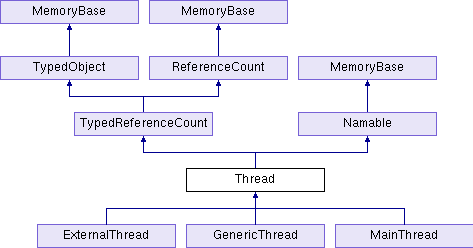
Classes | |
| class | PStatsCallback |
Public Member Functions | |
| virtual TypeHandle | force_init_type () |
| TypedReferenceCount * | get_current_task () const |
| int | get_pipeline_stage () const |
| PStatsCallback * | get_pstats_callback () const |
| Returns the PStats callback associated with this thread, or NULL if no callback has yet been associated with this thread. More... | |
| int | get_pstats_index () const |
| int | get_python_index () const |
| virtual TypeHandle | get_type () const |
| std::string | get_unique_id () const |
| bool | is_joinable () const |
| bool | is_started () const |
| void | join () |
| Blocks the calling process until the thread terminates. More... | |
| virtual void | output (std::ostream &out) const |
| void | output_blocker (std::ostream &out) const |
| Writes a description of the mutex or condition variable that this thread is blocked on. More... | |
| void | preempt () |
| Indicates that this thread should run as soon as possible, preemptying any other threads that may be scheduled to run. More... | |
| void | set_min_pipeline_stage (int min_pipeline_stage) |
| Sets this thread's pipeline stage number to at least the indicated value, unless it is already larger. More... | |
| void | set_pipeline_stage (int pipeline_stage) |
| void | set_pstats_callback (PStatsCallback *pstats_callback) |
| Stores a PStats callback to be associated with this thread. More... | |
| void | set_pstats_index (int pstats_index) |
| Stores a PStats index to be associated with this thread. More... | |
| void | set_python_index (int index) |
| Stores a Python index to be associated with this thread. More... | |
| bool | start (ThreadPriority priority, bool joinable) |
| Starts the thread executing. More... | |
 Public Member Functions inherited from TypedReferenceCount Public Member Functions inherited from TypedReferenceCount | |
| TypedReferenceCount (const TypedReferenceCount ©) | |
| void | operator= (const TypedReferenceCount ©) |
| Public Member Functions inherited from TypedObject | |
| TypedObject (const TypedObject ©)=default | |
| TypedObject * | as_typed_object () |
| Returns the object, upcast (if necessary) to a TypedObject pointer. More... | |
| const TypedObject * | as_typed_object () const |
| Returns the object, upcast (if necessary) to a TypedObject pointer. More... | |
| int | get_best_parent_from_Set (const std::set< int > &) const |
| int | get_type_index () const |
| Returns the internal index number associated with this object's TypeHandle, a unique number for each different type. More... | |
| bool | is_exact_type (TypeHandle handle) const |
| Returns true if the current object is the indicated type exactly. More... | |
| bool | is_of_type (TypeHandle handle) const |
| Returns true if the current object is or derives from the indicated type. More... | |
| TypedObject & | operator= (const TypedObject ©)=default |
| Public Member Functions inherited from ReferenceCount | |
| int | get_ref_count () const |
| WeakReferenceList * | get_weak_list () const |
| Returns the WeakReferenceList associated with this ReferenceCount object. More... | |
| bool | has_weak_list () const |
| Returns true if this particular ReferenceCount object has a WeakReferenceList created, false otherwise. More... | |
| void | local_object () |
| This function should be called, once, immediately after creating a new instance of some ReferenceCount-derived object on the stack. More... | |
| void | ref () const |
| Explicitly increments the reference count. More... | |
| bool | ref_if_nonzero () const |
| Atomically increases the reference count of this object if it is not zero. More... | |
| bool | test_ref_count_integrity () const |
| Does some easy checks to make sure that the reference count isn't completely bogus. More... | |
| bool | test_ref_count_nonzero () const |
| Does some easy checks to make sure that the reference count isn't zero, or completely bogus. More... | |
| virtual bool | unref () const |
| Explicitly decrements the reference count. More... | |
| WeakReferenceList * | weak_ref () |
| Adds the indicated PointerToVoid as a weak reference to this object. More... | |
| void | weak_unref () |
| Removes the indicated PointerToVoid as a weak reference to this object. More... | |
| Public Member Functions inherited from Namable | |
| Namable (const std::string &initial_name="") | |
| void | clear_name () |
| Resets the Namable's name to empty. More... | |
| const std::string & | get_name () const |
| bool | has_name () const |
| Returns true if the Namable has a nonempty name set, false if the name is empty. More... | |
| void | output (std::ostream &out) const |
| Outputs the Namable. More... | |
| void | set_name (const std::string &name) |
Static Public Member Functions | |
| static void | consider_yield () |
| Possibly suspends the current thread for the rest of the current epoch, if it has run for enough this epoch. More... | |
| static void | force_yield () |
| Suspends the current thread for the rest of the current epoch. More... | |
| static TypeHandle | get_class_type () |
| static int | get_current_pipeline_stage () |
| static Thread * | get_current_thread () |
| static Thread * | get_external_thread () |
| static Thread * | get_main_thread () |
| static void | init_type () |
| static bool | is_simple_threads () |
| static bool | is_threading_supported () |
| static bool | is_true_threads () |
| static void | prepare_for_exit () |
| Should be called by the main thread just before exiting the program, this blocks until any remaining thread cleanup has finished. More... | |
| static void | sleep (double seconds) |
| Suspends the current thread for at least the indicated amount of time. More... | |
| static void | write_status (std::ostream &out) |
| Static Public Member Functions inherited from TypedReferenceCount | |
| static TypeHandle | get_class_type () |
| static void | init_type () |
| Static Public Member Functions inherited from TypedObject | |
| static TypeHandle | get_class_type () |
| static void | init_type () |
| This function is declared non-inline to work around a compiler bug in g++ 2.96. More... | |
| Static Public Member Functions inherited from ReferenceCount | |
| static TypeHandle | get_class_type () |
| static void | init_type () |
| Static Public Member Functions inherited from Namable | |
| static TypeHandle | get_class_type () |
| static void | init_type () |
Public Attributes | |
| get_current_pipeline_stage | |
| Returns the integer pipeline stage associated with the current thread. More... | |
| get_current_task | |
| Returns the task currently executing on this thread (via the AsyncTaskManager), if any, or NULL if the thread is not currently servicing a task. More... | |
| get_current_thread | |
| Returns a pointer to the currently-executing Thread object. More... | |
| get_external_thread | |
| Returns a pointer to the "external" Thread object–this is a special Thread object that corresponds to any thread spawned outside of Panda's threading interface. More... | |
| get_main_thread | |
| Returns a pointer to the "main" Thread object–this is the Thread that started the whole process. More... | |
| get_pipeline_stage | |
| Returns the Pipeline stage number associated with this thread. More... | |
| get_pstats_index | |
| Returns the PStats index associated with this thread, or -1 if no index has yet been associated with this thread. More... | |
| get_python_index | |
| Returns the Python index associated with this thread, or -1 if no index has yet been associated with this thread. More... | |
| get_sync_name | |
| Returns the sync name of the thread. More... | |
| get_unique_id | |
| Returns a string that is guaranteed to be unique to this thread, across all processes on the machine, during at least the lifetime of this process. More... | |
| is_joinable | |
| Returns the value of joinable that was passed to the start() call. More... | |
| is_simple_threads | |
| Returns true if Panda is currently compiled for "simple threads", which is to say, cooperative context switching only, reducing the need for quite so many critical section protections. More... | |
| is_started | |
| Returns true if the thread has been started, false if it has not, or if join() has already been called. More... | |
| is_threading_supported | |
| Returns true if threading support has been compiled in and enabled, or false if no threading is available (and Thread::start() will always fail). More... | |
| is_true_threads | |
| Returns true if a real threading library is available that supports actual OS-implemented threads, or false if the only threading we can provide is simulated user-space threading. More... | |
| set_pipeline_stage | |
| Specifies the Pipeline stage number associated with this thread. More... | |
| Public Attributes inherited from TypedObject | |
| get_type | |
| Public Attributes inherited from ReferenceCount | |
| get_ref_count | |
| Returns the current reference count. More... | |
| Public Attributes inherited from Namable | |
| get_name | |
| set_name | |
Friends | |
| class | AsyncTask |
| class | ConditionVarDebug |
| class | ConditionVarFullDebug |
| class | MainThread |
| class | MutexDebug |
| class | ThreadDummyImpl |
| class | ThreadPosixImpl |
| class | ThreadSimpleImpl |
| class | ThreadWin32Impl |
Detailed Description
A thread; that is, a lightweight process.
This is an abstract base class; to use it, you must subclass from it and redefine thread_main().
The thread itself will keep a reference count on the Thread object while it is running; when the thread returns from its root function, the Thread object will automatically be destructed if no other pointers are referencing it.
Member Function Documentation
◆ consider_yield()
|
inlinestatic |
Possibly suspends the current thread for the rest of the current epoch, if it has run for enough this epoch.
This is especially important for the simple thread implementation, which relies on cooperative yields like this.
Definition at line 212 of file thread.I.
Referenced by PartGroup::check_hierarchy(), PNMReader::read_data(), BamReader::read_pointer(), and PNMWriter::write_data().
◆ force_yield()
|
inlinestatic |
Suspends the current thread for the rest of the current epoch.
Definition at line 201 of file thread.I.
Referenced by AsyncFuture::set_result(), and AsyncFuture::wait().
◆ get_pstats_callback()
|
inline |
Returns the PStats callback associated with this thread, or NULL if no callback has yet been associated with this thread.
This is used internally by the PStatClient; you should not need to call this directly.
◆ join()
|
inline |
◆ output_blocker()
| void Thread::output_blocker | ( | std::ostream & | out | ) | const |
Writes a description of the mutex or condition variable that this thread is blocked on.
Writes nothing if there is no blocker, or if we are not in DEBUG_THREADS mode.
Definition at line 142 of file thread.cxx.
◆ preempt()
|
inline |
◆ prepare_for_exit()
|
inlinestatic |
Should be called by the main thread just before exiting the program, this blocks until any remaining thread cleanup has finished.
Definition at line 283 of file thread.I.
Referenced by PandaFramework::close_framework().
◆ set_min_pipeline_stage()
|
inline |
Sets this thread's pipeline stage number to at least the indicated value, unless it is already larger.
See set_pipeline_stage().
Definition at line 77 of file thread.I.
References set_pipeline_stage.
◆ set_pstats_callback()
|
inline |
Stores a PStats callback to be associated with this thread.
This is used internally by the PStatClient; you should not need to call this directly.
◆ set_pstats_index()
|
inline |
Stores a PStats index to be associated with this thread.
This is used internally by the PStatClient; you should not need to call this directly.
◆ set_python_index()
|
inline |
◆ sleep()
|
inlinestatic |
Suspends the current thread for at least the indicated amount of time.
It might be suspended for longer.
Definition at line 192 of file thread.I.
Referenced by PStatServer::main_loop().
◆ start()
| bool Thread::start | ( | ThreadPriority | priority, |
| bool | joinable | ||
| ) |
Starts the thread executing.
It is only valid to call this once.
The thread will begin executing its thread_main() function, and will terminate when thread_main() returns.
priority is intended as a hint to the relative importance of this thread. This may be ignored by the thread implementation.
joinable should be set true if you intend to call join() to wait for the thread to terminate, or false if you don't care and you will never call join(). Note that the reference count on the Thread object is incremented while the thread itself is running, so if you just want to fire and forget a thread, you may pass joinable = false, and never store the Thread object. It will automatically destruct itself when it finishes.
The return value is true if the thread is successfully started, false otherwise.
Definition at line 184 of file thread.cxx.
Member Data Documentation
◆ get_current_pipeline_stage
|
inline |
Returns the integer pipeline stage associated with the current thread.
This is the same thing as get_current_thread()->get_pipeline_stage(), but it may be faster to retrieve in some contexts.
◆ get_current_task
|
inline |
Returns the task currently executing on this thread (via the AsyncTaskManager), if any, or NULL if the thread is not currently servicing a task.
◆ get_current_thread
|
inline |
Returns a pointer to the currently-executing Thread object.
If this is called from the main thread, this will return the same value as get_main_thread().
This will always return some valid Thread pointer. It will never return NULL, even if the current thread was spawned outside of Panda's threading system, although all non-Panda threads will return the exact same Thread pointer.
◆ get_external_thread
|
inline |
◆ get_main_thread
|
inline |
◆ get_pipeline_stage
|
inline |
Returns the Pipeline stage number associated with this thread.
The default stage is 0 if no stage is specified otherwise. See set_pipeline_stage().
Definition at line 105 of file thread.h.
Referenced by PandaNode::add_stashed(), NodePath::any_path(), PandaNodePipelineReader::check_cached(), CPT(), NodePath::get_hidden_ancestor(), PandaNode::get_net_collide_mask(), PandaNode::get_net_draw_control_mask(), PandaNode::get_net_draw_show_mask(), NodePath::get_stashed_ancestor(), NodePath::get_top(), NodePath::is_singleton(), NodePath::NodePath(), NodePathComponent::output(), PandaNode::remove_child(), PandaNode::remove_stashed(), SheetNode::reset_bound(), RopeNode::reset_bound(), PandaNode::stash_child(), and PandaNode::unstash_child().
◆ get_pstats_index
|
inline |
Returns the PStats index associated with this thread, or -1 if no index has yet been associated with this thread.
This is used internally by the PStatClient; you should not need to call this directly.
Definition at line 102 of file thread.h.
Referenced by PStatThread::PStatThread().
◆ get_python_index
|
inline |
◆ get_sync_name
|
inline |
◆ get_unique_id
|
inline |
◆ is_joinable
|
inline |
◆ is_simple_threads
|
inline |
Returns true if Panda is currently compiled for "simple threads", which is to say, cooperative context switching only, reducing the need for quite so many critical section protections.
This is not necessarily the opposite of "true threads", since one possible implementation of simple threads is via true threads with mutex protection to ensure only one runs at a time.
◆ is_started
|
inline |
◆ is_threading_supported
|
inline |
Returns true if threading support has been compiled in and enabled, or false if no threading is available (and Thread::start() will always fail).
◆ is_true_threads
|
inline |
◆ set_pipeline_stage
| void Thread::set_pipeline_stage |
Specifies the Pipeline stage number associated with this thread.
The default stage is 0 if no stage is specified otherwise.
This must be a value in the range [0 .. pipeline->get_num_stages() - 1]. It specifies the values that this thread observes for all pipelined data. Typically, an application thread will leave this at 0, but a render thread may set it to 1 or 2 (to operate on the previous frame's data, or the second previous frame's data).
Definition at line 105 of file thread.h.
Referenced by set_min_pipeline_stage().
The documentation for this class was generated from the following files:
- panda/src/pipeline/thread.h
- panda/src/pipeline/thread.cxx
- panda/src/pipeline/thread.I