A ClockObject keeps track of elapsed real time and discrete time. More...
#include "clockObject.h"
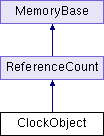
Public Types | |
| enum | Mode { M_normal, M_non_real_time, M_forced, M_degrade, M_slave, M_limited, M_integer, M_integer_limited } |
Public Member Functions | |
| ClockObject (Mode mode=M_normal) | |
| ClockObject (const ClockObject ©) | |
| double | calc_frame_rate_deviation (Thread *current_thread=Thread::get_current_thread()) const |
| Returns the standard deviation of the frame times of the frames rendered over the past get_average_frame_rate_interval() seconds. More... | |
| bool | check_errors (Thread *current_thread) |
| Returns true if a clock error was detected since the last time check_errors() was called. More... | |
| double | get_average_frame_rate (Thread *current_thread=Thread::get_current_thread()) const |
| double | get_average_frame_rate_interval () const |
| double | get_degrade_factor () const |
| double | get_dt (Thread *current_thread=Thread::get_current_thread()) const |
| int | get_frame_count (Thread *current_thread=Thread::get_current_thread()) const |
| double | get_frame_time (Thread *current_thread=Thread::get_current_thread()) const |
| double | get_long_time () const |
| double | get_max_dt () const |
| double | get_max_frame_duration (Thread *current_thread=Thread::get_current_thread()) const |
| Mode | get_mode () const |
| double | get_net_frame_rate (Thread *current_thread=Thread::get_current_thread()) const |
| Returns the average frame rate since the last reset. More... | |
| double | get_real_time () const |
| void | reset () |
| Simultaneously resets both the time and the frame count to zero. More... | |
| void | set_average_frame_rate_interval (double time) |
| void | set_degrade_factor (double degrade_factor) |
| void | set_dt (double dt) |
| void | set_frame_count (int frame_count, Thread *current_thread=Thread::get_current_thread()) |
| void | set_frame_rate (double frame_rate) |
| In non-real-time mode, sets the number of frames per second that we should appear to be running. More... | |
| void | set_frame_time (double time, Thread *current_thread=Thread::get_current_thread()) |
| void | set_max_dt (double max_dt) |
| void | set_mode (Mode mode) |
| void | set_real_time (double time) |
| void | sync_frame_time (Thread *current_thread=Thread::get_current_thread()) |
| Resets the frame time to the current real time. More... | |
| void | tick (Thread *current_thread=Thread::get_current_thread()) |
| Instructs the clock that a new frame has just begun. More... | |
 Public Member Functions inherited from ReferenceCount Public Member Functions inherited from ReferenceCount | |
| int | get_ref_count () const |
| WeakReferenceList * | get_weak_list () const |
| Returns the WeakReferenceList associated with this ReferenceCount object. More... | |
| bool | has_weak_list () const |
| Returns true if this particular ReferenceCount object has a WeakReferenceList created, false otherwise. More... | |
| void | local_object () |
| This function should be called, once, immediately after creating a new instance of some ReferenceCount-derived object on the stack. More... | |
| void | ref () const |
| Explicitly increments the reference count. More... | |
| bool | ref_if_nonzero () const |
| Atomically increases the reference count of this object if it is not zero. More... | |
| bool | test_ref_count_integrity () const |
| Does some easy checks to make sure that the reference count isn't completely bogus. More... | |
| bool | test_ref_count_nonzero () const |
| Does some easy checks to make sure that the reference count isn't zero, or completely bogus. More... | |
| virtual bool | unref () const |
| Explicitly decrements the reference count. More... | |
| WeakReferenceList * | weak_ref () |
| Adds the indicated PointerToVoid as a weak reference to this object. More... | |
| void | weak_unref () |
| Removes the indicated PointerToVoid as a weak reference to this object. More... | |
Static Public Member Functions | |
| static TypeHandle | get_class_type () |
| static ClockObject * | get_global_clock () |
| Returns a pointer to the global ClockObject. More... | |
| static void | init_type () |
| Static Public Member Functions inherited from ReferenceCount | |
| static TypeHandle | get_class_type () |
| static void | init_type () |
Public Attributes | |
| get_average_frame_rate | |
| Returns the average frame rate in number of frames per second over the last get_average_frame_rate_interval() seconds. More... | |
| get_average_frame_rate_interval | |
| Returns the interval of time (in seconds) over which get_average_frame_rate() averages the number of frames per second to compute the frame rate. More... | |
| get_degrade_factor | |
| In degrade mode, returns the ratio by which the performance is degraded. More... | |
| get_dt | |
| Returns the elapsed time for the previous frame: the number of seconds elapsed between the last two calls to tick(). More... | |
| get_frame_count | |
| Returns the number of times tick() has been called since the ClockObject was created, or since it was last reset. More... | |
| get_frame_time | |
| Returns the time in seconds as of the last time tick() was called (typically, this will be as of the start of the current frame). More... | |
| get_long_time | |
| Returns the actual number of seconds elapsed since the ClockObject was created, or since it was last reset. More... | |
| get_max_dt | |
| Returns the current maximum allowable time elapsed between any two frames. More... | |
| get_max_frame_duration | |
| Returns the maximum frame duration over the last get_average_frame_rate_interval() seconds. More... | |
| get_mode | |
| Returns the current mode of the clock. More... | |
| get_real_time | |
| Returns the actual number of seconds elapsed since the ClockObject was created, or since it was last reset. More... | |
| set_average_frame_rate_interval | |
| Specifies the interval of time (in seconds) over which get_average_frame_rate() averages the number of frames per second to compute the frame rate. More... | |
| set_degrade_factor | |
| In degrade mode, sets the ratio by which the performance is degraded. More... | |
| set_dt | |
| In non-real-time mode, sets the number of seconds that should appear to elapse between frames. More... | |
| set_frame_count | |
| Resets the number of frames counted to the indicated number. More... | |
| set_frame_time | |
| Changes the time as reported for the current frame to the indicated time. More... | |
| set_max_dt | |
| Sets a limit on the value returned by get_dt(). More... | |
| set_mode | |
| Changes the mode of the clock. More... | |
| set_real_time | |
| Resets the clock to the indicated time. More... | |
| Public Attributes inherited from ReferenceCount | |
| get_ref_count | |
| Returns the current reference count. More... | |
Detailed Description
A ClockObject keeps track of elapsed real time and discrete time.
In normal mode, get_frame_time() returns the time as of the last time tick() was called. This is the "discrete" time, and is usually used to get the time as of, for instance, the beginning of the current frame.
In other modes, as set by set_mode() or the clock-mode config variable, get_frame_time() may return other values to simulate different timing effects, for instance to perform non-real-time animation. See set_mode().
In all modes, get_real_time() always returns the elapsed real time in seconds since the ClockObject was constructed, or since it was last reset.
You can create your own ClockObject whenever you want to have your own local timer. There is also a default, global ClockObject intended to represent global time for the application; this is normally set up to tick every frame so that its get_frame_time() will return the time for the current frame.
Definition at line 58 of file clockObject.h.
Member Function Documentation
◆ calc_frame_rate_deviation()
| double ClockObject::calc_frame_rate_deviation | ( | Thread * | current_thread = Thread::get_current_thread() | ) | const |
Returns the standard deviation of the frame times of the frames rendered over the past get_average_frame_rate_interval() seconds.
This number gives an estimate of the chugginess of the frame rate; if it is large, there is a large variation in the frame rate; if is small, all of the frames are consistent in length.
A large value might also represent just a recent change in frame rate, for instance, because the camera has just rotated from looking at a simple scene to looking at a more complex scene.
Definition at line 321 of file clockObject.cxx.
◆ check_errors()
|
inline |
Returns true if a clock error was detected since the last time check_errors() was called.
A clock error means that something happened, an OS or BIOS bug, for instance, that makes the current value of the clock somewhat suspect, and an application may wish to resynchronize with any external clocks.
Definition at line 203 of file clockObject.I.
References TrueClock::get_error_count.
◆ get_global_clock()
|
inlinestatic |
Returns a pointer to the global ClockObject.
This is the ClockObject that most code should use for handling scene graph rendering and animation.
Definition at line 215 of file clockObject.I.
References AtomicAdjustDummyImpl::get_ptr().
Referenced by AdaptiveLru::begin_epoch(), BufferResidencyTracker::begin_frame(), GraphicsStateGuardian::begin_frame(), RecorderController::begin_playback(), RecorderController::begin_record(), Camera::cleanup_aux_scene_data(), SmoothMover::compute_smooth_position(), GeomCacheManager::evict_old_entries(), GraphicsStateGuardian::fetch_specified_part(), TimedCycle::fillin(), RocketSystemInterface::GetElapsedTime(), DisplayRegion::make_screenshot_filename(), SmoothMover::mark_position(), MouseWatcher::note_activity(), RecorderController::play_frame(), ClientBase::poll(), PGSliderBar::press(), PGEntry::press(), RecorderController::record_frame(), GraphicsEngine::render_frame(), PandaFramework::report_frame_rate(), PandaFramework::reset_frame_rate(), PGEntry::set_cursor_position(), PGEntry::set_focus(), SmoothMover::set_phony_timestamp(), CInterval::setup_resume(), CInterval::step_play(), PointerEventList::total_turns(), Character::update(), PartBundle::update(), AsyncFuture::wait(), and WinGraphicsWindow::window_proc().
◆ get_net_frame_rate()
|
inline |
Returns the average frame rate since the last reset.
This is simply the total number of frames divided by the total elapsed time. This reports the virtual frame rate if the clock is in (or has been in) M_non_real_time mode.
Definition at line 100 of file clockObject.I.
◆ reset()
|
inline |
Simultaneously resets both the time and the frame count to zero.
Definition at line 76 of file clockObject.I.
References set_frame_count, set_frame_time, and set_real_time.
◆ set_frame_rate()
| void ClockObject::set_frame_rate | ( | double | frame_rate | ) |
In non-real-time mode, sets the number of frames per second that we should appear to be running.
In forced mode or limited mode, sets our target frame rate. In normal mode, this has no effect.
Also see set_dt(), which is a different way to specify the same quantity.
Definition at line 254 of file clockObject.cxx.
◆ sync_frame_time()
| void ClockObject::sync_frame_time | ( | Thread * | current_thread = Thread::get_current_thread() | ) |
Resets the frame time to the current real time.
This is similar to tick(), except that it does not advance the frame counter and does not affect dt. This is intended to be used in the middle of a particularly long frame to compensate for the time that has already elapsed.
In non-real-time mode, this function has no effect (because in this mode all frames take the same length of time).
Definition at line 479 of file clockObject.cxx.
References get_real_time.
◆ tick()
| void ClockObject::tick | ( | Thread * | current_thread = Thread::get_current_thread() | ) |
Instructs the clock that a new frame has just begun.
In normal, real-time mode, get_frame_time() will henceforth report the time as of this instant as the current start-of-frame time. In non-real-time mode, get_frame_time() will be incremented by the value of dt.
Definition at line 346 of file clockObject.cxx.
Member Data Documentation
◆ get_average_frame_rate
| double ClockObject::get_average_frame_rate |
Returns the average frame rate in number of frames per second over the last get_average_frame_rate_interval() seconds.
This measures the virtual frame rate if the clock is in M_non_real_time mode.
Definition at line 118 of file clockObject.h.
◆ get_average_frame_rate_interval
|
inline |
Returns the interval of time (in seconds) over which get_average_frame_rate() averages the number of frames per second to compute the frame rate.
Definition at line 113 of file clockObject.h.
◆ get_degrade_factor
|
inline |
In degrade mode, returns the ratio by which the performance is degraded.
A value of 2.0 causes the clock to be slowed down by a factor of two (reducing performance to 1/2 what would be otherwise).
This has no effect if mode is not M_degrade.
Definition at line 107 of file clockObject.h.
◆ get_dt
|
inline |
Returns the elapsed time for the previous frame: the number of seconds elapsed between the last two calls to tick().
Definition at line 99 of file clockObject.h.
Referenced by GraphicsStateGuardian::fetch_specified_part().
◆ get_frame_count
|
inline |
Returns the number of times tick() has been called since the ClockObject was created, or since it was last reset.
This is generally the number of frames that have been rendered.
Definition at line 94 of file clockObject.h.
Referenced by AdaptiveLru::begin_epoch(), BufferResidencyTracker::begin_frame(), GraphicsStateGuardian::begin_frame(), RecorderController::begin_playback(), RecorderController::begin_record(), GeomCacheManager::evict_old_entries(), DisplayRegion::make_screenshot_filename(), RecorderController::play_frame(), RecorderController::record_frame(), GraphicsEngine::render_frame(), PandaFramework::report_frame_rate(), and PandaFramework::reset_frame_rate().
◆ get_frame_time
|
inline |
Returns the time in seconds as of the last time tick() was called (typically, this will be as of the start of the current frame).
This is generally the kind of time you want to ask for in most rendering and animation contexts, since it's important that all of the animation for a given frame remains in sync with each other.
Definition at line 91 of file clockObject.h.
Referenced by RecorderController::begin_playback(), RecorderController::begin_record(), Camera::cleanup_aux_scene_data(), GraphicsStateGuardian::fetch_specified_part(), SmoothMover::mark_position(), TimedCycle::next_element(), MouseWatcher::note_activity(), RecorderController::play_frame(), PGSliderBar::press(), PGEntry::press(), RecorderController::record_frame(), PandaFramework::report_frame_rate(), PandaFramework::reset_frame_rate(), PGEntry::set_cursor_position(), PGEntry::set_focus(), SmoothMover::set_phony_timestamp(), CInterval::setup_resume(), CInterval::step_play(), PointerEventList::total_turns(), Character::update(), and PartBundle::update().
◆ get_long_time
|
inline |
Returns the actual number of seconds elapsed since the ClockObject was created, or since it was last reset.
This is similar to get_real_time(), except that it uses the most accurate counter we have over a long period of time, and so it is less likely to drift. However, it may not be very precise for measuring short intervals. On Windows, for instace, this is only accurate to within about 55 milliseconds.
Definition at line 93 of file clockObject.h.
◆ get_max_dt
|
inline |
Returns the current maximum allowable time elapsed between any two frames.
See set_max_dt().
Definition at line 103 of file clockObject.h.
◆ get_max_frame_duration
| double ClockObject::get_max_frame_duration |
Returns the maximum frame duration over the last get_average_frame_rate_interval() seconds.
Definition at line 119 of file clockObject.h.
◆ get_mode
|
inline |
◆ get_real_time
|
inline |
Returns the actual number of seconds elapsed since the ClockObject was created, or since it was last reset.
This is useful for doing real timing measurements, e.g. for performance statistics.
This returns the most precise timer we have for short time intervals, but it may tend to drift over the long haul. If more accurate timekeeping is needed over a long period of time, use get_long_time() instead.
Definition at line 92 of file clockObject.h.
Referenced by PathFollow::do_follow(), TimedCycle::fillin(), RocketSystemInterface::GetElapsedTime(), PathFollow::start(), sync_frame_time(), AsyncFuture::wait(), and WinGraphicsWindow::window_proc().
◆ set_average_frame_rate_interval
|
inline |
Specifies the interval of time (in seconds) over which get_average_frame_rate() averages the number of frames per second to compute the frame rate.
Changing this does not necessarily immediately change the result of get_average_frame_rate(), until this interval of time has elapsed again.
Setting this to zero disables the computation of get_average_frame_rate().
Definition at line 113 of file clockObject.h.
◆ set_degrade_factor
|
inline |
In degrade mode, sets the ratio by which the performance is degraded.
A value of 2.0 causes the clock to be slowed down by a factor of two (reducing performance to 1/2 what would be otherwise).
This has no effect if mode is not M_degrade.
Definition at line 107 of file clockObject.h.
◆ set_dt
| void ClockObject::set_dt |
In non-real-time mode, sets the number of seconds that should appear to elapse between frames.
In forced mode or limited mode, sets our target dt. In normal mode, this has no effect.
Also see set_frame_rate(), which is a different way to specify the same quantity.
Definition at line 99 of file clockObject.h.
◆ set_frame_count
| void ClockObject::set_frame_count |
Resets the number of frames counted to the indicated number.
Also see reset(), set_real_time(), and set_frame_time().
Definition at line 94 of file clockObject.h.
Referenced by reset().
◆ set_frame_time
| void ClockObject::set_frame_time |
Changes the time as reported for the current frame to the indicated time.
Normally, the way to adjust the frame time is via tick(); this function is provided only for occasional special adjustments.
Definition at line 91 of file clockObject.h.
Referenced by reset().
◆ set_max_dt
|
inline |
Sets a limit on the value returned by get_dt().
If this value is less than zero, no limit is imposed; otherwise, this is the maximum value that will ever be returned by get_dt(), regardless of how much time has actually elapsed between frames.
This limit is only imposed in real-time mode; in non-real-time mode, the dt is fixed anyway and max_dt is ignored.
This is generally used to guarantee reasonable behavior even in the presence of a very slow or chuggy frame rame.
Definition at line 103 of file clockObject.h.
◆ set_mode
| void ClockObject::set_mode |
Changes the mode of the clock.
Normally, the clock is in mode M_normal. In this mode, each call to tick() will set the value returned by get_frame_time() to the current real time; thus, the clock simply reports time advancing.
Other possible modes:
M_non_real_time - the clock ignores real time completely; at each call to tick(), it pretends that exactly dt seconds have elapsed since the last call to tick(). You may set the value of dt with set_dt() or set_frame_rate().
M_limited - the clock will run as fast as it can, as in M_normal, but will not run faster than the rate specified by set_frame_rate(). If the application would run faster than this rate, the clock will slow down the application.
M_integer - the clock will run as fast as it can, but the rate will be constrained to be an integer multiple or divisor of the rate specified by set_frame_rate(). The clock will slow down the application a bit to guarantee this.
M_integer_limited - a combination of M_limited and M_integer; the clock will not run faster than set_frame_rate(), and if it runs slower, it will run at a integer divisor of that rate.
M_forced - the clock forces the application to run at the rate specified by set_frame_rate(). If the application would run faster than this rate, the clock will slow down the application; if the application would run slower than this rate, the clock slows down time so that the application believes it is running at the given rate.
M_degrade - the clock runs at real time, but the application is slowed down by a set factor of its frame rate, specified by set_degrade_factor().
M_slave - the clock does not advance, but relies on the user to call set_frame_time() and/or set_frame_count() each frame.
Definition at line 77 of file clockObject.h.
◆ set_real_time
| void ClockObject::set_real_time |
Resets the clock to the indicated time.
This changes only the real time of the clock as reported by get_real_time(), but does not immediately change the time reported by get_frame_time()–that will change after the next call to tick(). Also see reset(), set_frame_time(), and set_frame_count().
Definition at line 92 of file clockObject.h.
Referenced by reset().
The documentation for this class was generated from the following files:
- panda/src/putil/clockObject.h
- panda/src/putil/clockObject.cxx
- panda/src/putil/clockObject.I