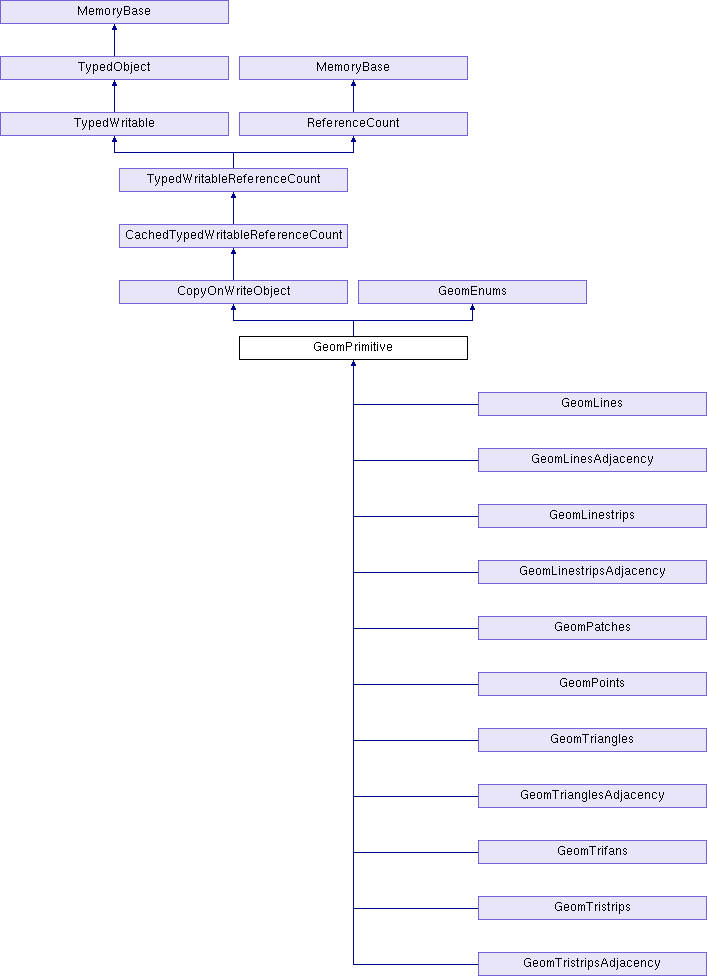
This is an abstract base class for a family of classes that represent the fundamental geometry primitives that may be stored in a Geom. More...
#include "geomPrimitive.h"
Public Member Functions | |
| GeomPrimitive (UsageHint usage_hint) | |
| GeomPrimitive (const GeomPrimitive ©) | |
| void | add_consecutive_vertices (int start, int num_vertices) |
| Adds a consecutive sequence of vertices, beginning at start, to the primitive. More... | |
| void | add_next_vertices (int num_vertices) |
| Adds the next n vertices in sequence, beginning from the last vertex added to the primitive + 1. More... | |
| void | add_vertex (int vertex) |
| Adds the indicated vertex to the list of vertex indices used by the graphics primitive type. More... | |
| void | add_vertices (int v1, int v2) |
| void | add_vertices (int v1, int v2, int v3) |
| Adds several vertices in a row. More... | |
| void | add_vertices (int v1, int v2, int v3, int v4) |
| Adds several vertices in a row. More... | |
| void | calc_sphere_radius (const LPoint3 ¢er, PN_stdfloat &sq_radius, bool &found_any, const GeomVertexData *vertex_data, Thread *current_thread) const |
| Expands radius so that a sphere with the given center point fits all of the vertices. More... | |
| void | calc_tight_bounds (LPoint3 &min_point, LPoint3 &max_point, PN_stdfloat &sq_center_dist, bool &found_any, const GeomVertexData *vertex_data, bool got_mat, const LMatrix4 &mat, const InternalName *column_name, Thread *current_thread) const |
| Expands min_point and max_point to include all of the vertices in the Geom, if any (or the data of any point type, for instance, texture coordinates– based on the column name). More... | |
| bool | check_valid (const GeomVertexData *vertex_data) const |
| Verifies that the primitive only references vertices that actually exist within the indicated GeomVertexData. More... | |
| bool | check_valid (const GeomVertexDataPipelineReader *data_reader) const |
| void | clear_minmax () |
| Undoes a previous call to set_minmax(), and allows the minimum and maximum values to be recomputed normally. More... | |
| void | clear_vertices () |
| Removes all of the vertices and primitives from the object, so they can be re-added. More... | |
| bool | close_primitive () |
| Indicates that the previous n calls to add_vertex(), since the last call to close_primitive(), have fully defined a new primitive. More... | |
| CPT (GeomPrimitive) decompose() const | |
| CPT (GeomPrimitive) rotate() const | |
| CPT (GeomPrimitive) doubleside() const | |
| CPT (GeomPrimitive) reverse() const | |
| CPT (GeomPrimitive) match_shade_model(ShadeModel shade_model) const | |
| CPT (GeomPrimitive) make_points() const | |
| CPT (GeomPrimitive) make_lines() const | |
| CPT (GeomPrimitive) make_patches() const | |
| virtual | CPT (GeomPrimitive) make_adjacency() const |
| CPT (GeomVertexArrayData) get_vertices() const | |
| CPT (GeomVertexArrayDataHandle) get_vertices_handle(Thread *current_thread) const | |
| CPT (GeomVertexArrayData) get_mins() const | |
| CPT (GeomVertexArrayData) get_maxs() const | |
| virtual bool | draw (GraphicsStateGuardianBase *gsg, const GeomPrimitivePipelineReader *reader, bool force) const =0 |
| virtual void | finalize (BamReader *manager) |
| Called by the BamReader to perform any final actions needed for setting up the object after all objects have been read and all pointers have been completed. More... | |
| virtual TypeHandle | force_init_type () |
| int | get_data_size_bytes () const |
| CPTA_int | get_ends () const |
| Returns a const pointer to the primitive ends array so application code can read it directly. More... | |
| int | get_first_vertex () const |
| Returns the first vertex number referenced by the primitive. More... | |
| virtual int | get_geom_rendering () const |
| const GeomVertexArrayFormat * | get_index_format () const |
| Returns a registered format appropriate for using to store the index table. More... | |
| int | get_index_stride () const |
| NumericType | get_index_type () const |
| int | get_max_vertex () const |
| Returns the maximum vertex index number used by all the primitives in this object. More... | |
| virtual int | get_min_num_vertices_per_primitive () const |
| int | get_min_vertex () const |
| Returns the minimum vertex index number used by all the primitives in this object. More... | |
| UpdateSeq | get_modified () const |
| int | get_num_bytes () const |
| int | get_num_faces () const |
| Returns the number of triangles or other fundamental type (such as line segments) represented by all the primitives in this object. More... | |
| int | get_num_primitives () const |
| Returns the number of individual primitives stored within this object. More... | |
| virtual int | get_num_unused_vertices_per_primitive () const |
| int | get_num_used_vertices () const |
| Returns the number of vertices used by all of the primitives. More... | |
| int | get_num_vertices () const |
| virtual int | get_num_vertices_per_primitive () const |
| int | get_primitive_end (int n) const |
| Returns the element within the _vertices list at which the nth primitive ends. More... | |
| int | get_primitive_max_vertex (int n) const |
| Returns the maximum vertex index number used by the nth primitive in this object. More... | |
| int | get_primitive_min_vertex (int n) const |
| Returns the minimum vertex index number used by the nth primitive in this object. More... | |
| int | get_primitive_num_faces (int n) const |
| Returns the number of triangles or other fundamental type (such as line segments) represented by the nth primitive in this object. More... | |
| int | get_primitive_num_vertices (int n) const |
| Returns the number of vertices used by the nth primitive. More... | |
| int | get_primitive_start (int n) const |
| Returns the element within the _vertices list at which the nth primitive starts. More... | |
| virtual PrimitiveType | get_primitive_type () const =0 |
| ShadeModel | get_shade_model () const |
| int | get_strip_cut_index () const |
| virtual TypeHandle | get_type () const |
| UsageHint | get_usage_hint () const |
| int | get_vertex (int i) const |
| bool | is_composite () const |
| Returns true if the primitive is a composite primitive such as a tristrip or trifan, or false if it is a fundamental primitive such as a collection of triangles. More... | |
| bool | is_indexed () const |
| Returns true if the primitive is indexed, false otherwise. More... | |
| bool | is_prepared (PreparedGraphicsObjects *prepared_objects) const |
| Returns true if the data has already been prepared or enqueued for preparation on the indicated GSG, false otherwise. More... | |
| void | make_indexed () |
| Converts the primitive from nonindexed form to indexed form. More... | |
| void | make_nonindexed (GeomVertexData *dest, const GeomVertexData *source) |
| Converts the primitive from indexed to nonindexed by duplicating vertices as necessary into the indicated dest GeomVertexData. More... | |
| PTA_int | modify_ends () |
| Returns a modifiable pointer to the primitive ends array, so application code can directly fiddle with this data. More... | |
| void | offset_vertices (int offset) |
| Adds the indicated offset to all vertices used by the primitive. More... | |
| void | offset_vertices (int offset, int begin_row, int end_row) |
| Adds the indicated offset to the indicated segment of vertices used by the primitive. More... | |
| void | operator= (const GeomPrimitive ©) |
| The copy assignment operator is not pipeline-safe. More... | |
| virtual void | output (std::ostream &out) const |
| void | pack_vertices (GeomVertexData *dest, const GeomVertexData *source) |
| Packs the vertices used by the primitive from the indicated source array onto the end of the indicated destination array. More... | |
| void | prepare (PreparedGraphicsObjects *prepared_objects) |
| Indicates that the data should be enqueued to be prepared in the indicated prepared_objects at the beginning of the next frame. More... | |
| IndexBufferContext * | prepare_now (PreparedGraphicsObjects *prepared_objects, GraphicsStateGuardianBase *gsg) |
| Creates a context for the data on the particular GSG, if it does not already exist. More... | |
| virtual | PT (GeomPrimitive) make_copy() const =0 |
| PT (GeomVertexArrayData) modify_vertices(int num_vertices | |
| PT (GeomVertexArrayDataHandle) modify_vertices_handle(Thread *current_thread) | |
| PT (GeomVertexArrayData) make_index_data() const | |
| bool | release (PreparedGraphicsObjects *prepared_objects) |
| Frees the data context only on the indicated object, if it exists there. More... | |
| int | release_all () |
| Frees the context allocated on all objects for which the data has been declared. More... | |
| bool | request_resident (Thread *current_thread=Thread::get_current_thread()) const |
| void | reserve_num_vertices (int num_vertices) |
| This ensures that enough memory space for n vertices is allocated, so that you may increase the number of vertices to n without causing a new memory allocation. More... | |
| void | set_ends (PTA_int ends) |
| Completely replaces the primitive ends array with a new table. More... | |
| void | set_index_type (NumericType index_type) |
| Changes the numeric type of the index column. More... | |
| void | set_minmax (int min_vertex, int max_vertex, GeomVertexArrayData *mins, GeomVertexArrayData *maxs) |
| Explicitly specifies the minimum and maximum vertices, as well as the lists of per-component min and max. More... | |
| void | set_nonindexed_vertices (int first_vertex, int num_vertices) |
| Sets the primitive up as a nonindexed primitive, using the indicated vertex range. More... | |
| void | set_shade_model (ShadeModel shade_model) |
| Changes the ShadeModel hint for this primitive. More... | |
| void | set_usage_hint (UsageHint usage_hint) |
| Changes the UsageHint hint for this primitive. More... | |
| void | set_vertices (const GeomVertexArrayData *vertices, int num_vertices=-1) |
| Completely replaces the vertex index list with a new table. More... | |
| virtual void | write (std::ostream &out, int indent_level) const |
| virtual void | write_datagram (BamWriter *manager, Datagram &dg) |
| Writes the contents of this object to the datagram for shipping out to a Bam file. More... | |
 Public Member Functions inherited from CopyOnWriteObject Public Member Functions inherited from CopyOnWriteObject | |
| CopyOnWriteObject (const CopyOnWriteObject ©) | |
| void | operator= (const CopyOnWriteObject ©) |
| Public Member Functions inherited from CachedTypedWritableReferenceCount | |
| void | cache_ref () const |
| Explicitly increments the cache reference count and the normal reference count simultaneously. More... | |
| void | cache_ref_only () const |
| Decrements the cache reference count without affecting the normal reference count. More... | |
| bool | cache_unref () const |
| Explicitly decrements the cache reference count and the normal reference count simultaneously. More... | |
| int | get_cache_ref_count () const |
| bool | test_ref_count_integrity () const |
| Does some easy checks to make sure that the reference count isn't completely bogus. More... | |
| Public Member Functions inherited from TypedWritableReferenceCount | |
| TypedWritableReferenceCount (const TypedWritableReferenceCount ©) | |
| virtual ReferenceCount * | as_reference_count () |
| Returns the pointer cast to a ReferenceCount pointer, if it is in fact of that type. More... | |
| void | operator= (const TypedWritableReferenceCount ©) |
| Public Member Functions inherited from TypedWritable | |
| TypedWritable (const TypedWritable ©) | |
| virtual int | complete_pointers (TypedWritable **p_list, BamReader *manager) |
| Receives an array of pointers, one for each time manager->read_pointer() was called in fillin(). More... | |
| vector_uchar | encode_to_bam_stream () const |
| Converts the TypedWritable object into a single stream of data using a BamWriter, and returns that data as a bytes object. More... | |
| bool | encode_to_bam_stream (vector_uchar &data, BamWriter *writer=nullptr) const |
| Converts the TypedWritable object into a single stream of data using a BamWriter, and stores that data in the indicated string. More... | |
| UpdateSeq | get_bam_modified () const |
| Returns the current bam_modified counter. More... | |
| void | mark_bam_modified () |
| Increments the bam_modified counter, so that this object will be invalidated and retransmitted on any open bam streams. More... | |
| void | operator= (const TypedWritable ©) |
| virtual bool | require_fully_complete () const |
| Some objects require all of their nested pointers to have been completed before the objects themselves can be completed. More... | |
| virtual void | update_bam_nested (BamWriter *manager) |
| Called by the BamWriter when this object has not itself been modified recently, but it should check its nested objects for updates. More... | |
| Public Member Functions inherited from TypedObject | |
| TypedObject (const TypedObject ©)=default | |
| TypedObject * | as_typed_object () |
| Returns the object, upcast (if necessary) to a TypedObject pointer. More... | |
| const TypedObject * | as_typed_object () const |
| Returns the object, upcast (if necessary) to a TypedObject pointer. More... | |
| int | get_best_parent_from_Set (const std::set< int > &) const |
| int | get_type_index () const |
| Returns the internal index number associated with this object's TypeHandle, a unique number for each different type. More... | |
| bool | is_exact_type (TypeHandle handle) const |
| Returns true if the current object is the indicated type exactly. More... | |
| bool | is_of_type (TypeHandle handle) const |
| Returns true if the current object is or derives from the indicated type. More... | |
| TypedObject & | operator= (const TypedObject ©)=default |
| Public Member Functions inherited from ReferenceCount | |
| int | get_ref_count () const |
| WeakReferenceList * | get_weak_list () const |
| Returns the WeakReferenceList associated with this ReferenceCount object. More... | |
| bool | has_weak_list () const |
| Returns true if this particular ReferenceCount object has a WeakReferenceList created, false otherwise. More... | |
| void | local_object () |
| This function should be called, once, immediately after creating a new instance of some ReferenceCount-derived object on the stack. More... | |
| void | ref () const |
| Explicitly increments the reference count. More... | |
| bool | ref_if_nonzero () const |
| Atomically increases the reference count of this object if it is not zero. More... | |
| bool | test_ref_count_integrity () const |
| Does some easy checks to make sure that the reference count isn't completely bogus. More... | |
| bool | test_ref_count_nonzero () const |
| Does some easy checks to make sure that the reference count isn't zero, or completely bogus. More... | |
| virtual bool | unref () const |
| Explicitly decrements the reference count. More... | |
| WeakReferenceList * | weak_ref () |
| Adds the indicated PointerToVoid as a weak reference to this object. More... | |
| void | weak_unref () |
| Removes the indicated PointerToVoid as a weak reference to this object. More... | |
Static Public Member Functions | |
| static TypeHandle | get_class_type () |
| static const GeomVertexArrayFormat * | get_index_format (NumericType index_type) |
| Returns a registered GeomVertexArrayFormat of the indicated unsigned integer numeric type for storing index values. More... | |
| static void | init_type () |
| Static Public Member Functions inherited from CopyOnWriteObject | |
| static TypeHandle | get_class_type () |
| static void | init_type () |
| Static Public Member Functions inherited from CachedTypedWritableReferenceCount | |
| static TypeHandle | get_class_type () |
| static void | init_type () |
| Static Public Member Functions inherited from TypedWritableReferenceCount | |
| static TypeHandle | get_class_type () |
| static void | init_type () |
| static | PT (TypedWritableReferenceCount) decode_from_bam_stream(vector_uchar data |
| Static Public Member Functions inherited from TypedWritable | |
| static bool | decode_raw_from_bam_stream (TypedWritable *&ptr, ReferenceCount *&ref_ptr, vector_uchar data, BamReader *reader=nullptr) |
| Reads the bytes created by a previous call to encode_to_bam_stream(), and extracts the single object on those bytes. More... | |
| static TypeHandle | get_class_type () |
| static void | init_type () |
| Static Public Member Functions inherited from TypedObject | |
| static TypeHandle | get_class_type () |
| static void | init_type () |
| This function is declared non-inline to work around a compiler bug in g++ 2.96. More... | |
| Static Public Member Functions inherited from ReferenceCount | |
| static TypeHandle | get_class_type () |
| static void | init_type () |
Public Attributes | |
| get_data_size_bytes | |
| Returns the number of bytes stored in the vertices array. More... | |
| get_geom_rendering | |
| Returns the set of GeomRendering bits that represent the rendering properties required to properly render this primitive. More... | |
| get_index_stride | |
| A convenience function to return the gap between successive index numbers, in bytes, of the index data. More... | |
| get_index_type | |
| Returns the numeric type of the index column. More... | |
| get_maxs | |
| get_min_num_vertices_per_primitive | |
| Returns the minimum number of vertices that must be added before close_primitive() may legally be called. More... | |
| get_mins | |
| get_modified | |
| Returns a sequence number which is guaranteed to change at least every time the vertex index array is modified. More... | |
| get_num_bytes | |
| get_num_unused_vertices_per_primitive | |
| Returns the number of vertices that are added between primitives that aren't, strictly speaking, part of the primitives themselves. More... | |
| get_num_vertices | |
| Returns the number of indices used by all the primitives in this object. More... | |
| get_num_vertices_per_primitive | |
| If the primitive type is a simple type in which all primitives have the same number of vertices, like triangles, returns the number of vertices per primitive. More... | |
| get_primitive_type | |
| get_shade_model | |
| Returns the ShadeModel hint for this primitive. More... | |
| get_strip_cut_index | |
| Returns the index of the indicated type that is reserved for use as a strip cut index, if enabled for the primitive. More... | |
| get_usage_hint | |
| Returns the usage hint for this primitive. More... | |
| get_vertex | |
| Returns the ith vertex index in the table. More... | |
| Public Attributes inherited from CachedTypedWritableReferenceCount | |
| get_cache_ref_count | |
| Returns the current reference count. More... | |
| Public Attributes inherited from TypedWritableReferenceCount | |
| static BamReader * | reader = nullptr) |
| Public Attributes inherited from TypedObject | |
| get_type | |
| Public Attributes inherited from ReferenceCount | |
| get_ref_count | |
| Returns the current reference count. More... | |
Friends | |
| class | Geom |
| class | GeomPrimitivePipelineReader |
| class | PreparedGraphicsObjects |
Additional Inherited Members | |
| Public Types inherited from GeomEnums | |
| enum | AnimationType { AT_none, AT_panda, AT_hardware } |
| enum | Contents { C_other, C_point, C_clip_point, C_vector, C_texcoord, C_color, C_index, C_morph_delta, C_matrix, C_normal } |
| enum | GeomRendering { GR_indexed_point = 0x00001, GR_indexed_other = 0x10000, GR_indexed_bits = 0x10001, GR_point = 0x00002, GR_point_uniform_size = 0x00004, GR_per_point_size = 0x00008, GR_point_perspective = 0x00010, GR_point_aspect_ratio = 0x00020, GR_point_scale = 0x00040, GR_point_rotate = 0x00080, GR_point_sprite = 0x00100, GR_point_sprite_tex_matrix = 0x00200, GR_point_bits = 0x003fe, GR_triangle_strip = 0x00400, GR_triangle_fan = 0x00800, GR_line_strip = 0x01000, GR_composite_bits = 0x01c00, GR_strip_cut_index = 0x20000, GR_flat_first_vertex = 0x02000, GR_flat_last_vertex = 0x04000, GR_shade_model_bits = 0x06000, GR_render_mode_wireframe = 0x40000, GR_render_mode_point = 0x80000, GR_adjacency = 0x100000 } |
| enum | NumericType { NT_uint8, NT_uint16, NT_uint32, NT_packed_dcba, NT_packed_dabc, NT_float32, NT_float64, NT_stdfloat, NT_int8, NT_int16, NT_int32, NT_packed_ufloat } |
| enum | PrimitiveType { PT_none, PT_polygons, PT_lines, PT_points, PT_patches } |
| enum | ShadeModel { SM_uniform, SM_smooth, SM_flat_first_vertex, SM_flat_last_vertex } |
| enum | UsageHint { UH_client, UH_stream, UH_dynamic, UH_static, UH_unspecified } |
| Static Public Attributes inherited from TypedWritable | |
| static TypedWritable *const | Null = nullptr |
Detailed Description
This is an abstract base class for a family of classes that represent the fundamental geometry primitives that may be stored in a Geom.
They all have in common the fact that they are defined by tables of vertex data stored in a GeomVertexData object. Each GeomPrimitive object contains an ordered list of integers, which index into the vertex array defined by the GeomVertexData and define the particular vertices of the GeomVertexData that are used for this primitive.
The meaning of a given arrangement of vertices is defined by each individual primitive type; for instance, a GeomTriangle renders a triangle from each three consecutive vertices, while a GeomTriangleStrip renders a strip of (n - 2) connected triangles from each sequence of n vertices.
Definition at line 56 of file geomPrimitive.h.
Member Function Documentation
◆ add_consecutive_vertices()
| void GeomPrimitive::add_consecutive_vertices | ( | int | start, |
| int | num_vertices | ||
| ) |
Adds a consecutive sequence of vertices, beginning at start, to the primitive.
Don't call this in a downstream thread unless you don't mind it blowing away other changes you might have recently made in an upstream thread.
Definition at line 241 of file geomPrimitive.cxx.
References get_num_primitives(), get_num_vertices, and get_primitive_end().
Referenced by add_next_vertices().
◆ add_next_vertices()
| void GeomPrimitive::add_next_vertices | ( | int | num_vertices | ) |
Adds the next n vertices in sequence, beginning from the last vertex added to the primitive + 1.
This is most useful when you are building up a primitive and a GeomVertexData at the same time, and you just want the primitive to reference the first n vertices from the data, then the next n, and so on.
Definition at line 308 of file geomPrimitive.cxx.
References add_consecutive_vertices(), get_num_vertices, and get_vertex.
◆ add_vertex()
| void GeomPrimitive::add_vertex | ( | int | vertex | ) |
Adds the indicated vertex to the list of vertex indices used by the graphics primitive type.
To define a primitive, you must call add_vertex() for each vertex of the new primitive, and then call close_primitive() after you have specified the last vertex of each primitive.
Don't call this in a downstream thread unless you don't mind it blowing away other changes you might have recently made in an upstream thread.
Definition at line 161 of file geomPrimitive.cxx.
References get_num_primitives(), get_num_vertices, and get_primitive_end().
Referenced by add_vertices().
◆ add_vertices() [1/2]
|
inline |
Adds several vertices in a row.
Definition at line 368 of file geomPrimitive.I.
References add_vertex().
◆ add_vertices() [2/2]
|
inline |
Adds several vertices in a row.
Definition at line 378 of file geomPrimitive.I.
References add_vertex().
◆ calc_sphere_radius()
| void GeomPrimitive::calc_sphere_radius | ( | const LPoint3 & | center, |
| PN_stdfloat & | sq_radius, | ||
| bool & | found_any, | ||
| const GeomVertexData * | vertex_data, | ||
| Thread * | current_thread | ||
| ) | const |
Expands radius so that a sphere with the given center point fits all of the vertices.
The center point is assumed to already have been transformed by the matrix, if one is given.
Definition at line 1750 of file geomPrimitive.cxx.
References GeomVertexReader::has_column().
◆ calc_tight_bounds()
| void GeomPrimitive::calc_tight_bounds | ( | LPoint3 & | min_point, |
| LPoint3 & | max_point, | ||
| PN_stdfloat & | sq_center_dist, | ||
| bool & | found_any, | ||
| const GeomVertexData * | vertex_data, | ||
| bool | got_mat, | ||
| const LMatrix4 & | mat, | ||
| const InternalName * | column_name, | ||
| Thread * | current_thread | ||
| ) | const |
Expands min_point and max_point to include all of the vertices in the Geom, if any (or the data of any point type, for instance, texture coordinates– based on the column name).
found_any is set true if any points are found. It is the caller's responsibility to initialize min_point, max_point, and found_any before calling this function. It also sets sq_center_dist, which is the square of the maximum distance of the points to the center. This can be useful when deciding whether a sphere volume might be more appropriate.
Definition at line 1589 of file geomPrimitive.cxx.
◆ check_valid()
|
inline |
Verifies that the primitive only references vertices that actually exist within the indicated GeomVertexData.
Returns true if the primitive appears to be valid, false otherwise.
Definition at line 224 of file geomPrimitive.I.
◆ clear_minmax()
| void GeomPrimitive::clear_minmax | ( | ) |
Undoes a previous call to set_minmax(), and allows the minimum and maximum values to be recomputed normally.
This method is intended for low-level usage only. There are higher-level methods for more common usage. We recommend you do not use this method directly. If you do, be sure you know what you are doing!
Definition at line 1318 of file geomPrimitive.cxx.
◆ clear_vertices()
| void GeomPrimitive::clear_vertices | ( | ) |
Removes all of the vertices and primitives from the object, so they can be re-added.
Don't call this in a downstream thread unless you don't mind it blowing away other changes you might have recently made in an upstream thread.
Definition at line 405 of file geomPrimitive.cxx.
References Geom::get_next_modified().
◆ close_primitive()
| bool GeomPrimitive::close_primitive | ( | ) |
Indicates that the previous n calls to add_vertex(), since the last call to close_primitive(), have fully defined a new primitive.
Returns true if successful, false otherwise.
Don't call this in a downstream thread unless you don't mind it blowing away other changes you might have recently made in an upstream thread.
Definition at line 355 of file geomPrimitive.cxx.
References get_num_unused_vertices_per_primitive, get_num_vertices, and get_num_vertices_per_primitive.
◆ finalize()
|
virtual |
Called by the BamReader to perform any final actions needed for setting up the object after all objects have been read and all pointers have been completed.
Reimplemented from TypedWritable.
Definition at line 2105 of file geomPrimitive.cxx.
References GeomVertexArrayData::get_usage_hint, and set_usage_hint().
◆ get_ends()
|
inline |
Returns a const pointer to the primitive ends array so application code can read it directly.
Do not attempt to modify the returned array; use modify_ends() or set_ends() for this.
Note that simple primitive types, like triangles, do not have a ends array: since all the primitives have the same number of vertices, it is not needed.
This method is intended for low-level usage only. There are higher-level methods for more common usage. We recommend you do not use this method directly. If you do, be sure you know what you are doing!
Definition at line 314 of file geomPrimitive.I.
◆ get_first_vertex()
|
inline |
Returns the first vertex number referenced by the primitive.
This is particularly important in the case of a nonindexed primitive, in which case get_first_vertex() and get_num_vertices() completely define the extent of the vertex range.
Definition at line 98 of file geomPrimitive.I.
◆ get_index_format() [1/2]
|
static |
Returns a registered GeomVertexArrayFormat of the indicated unsigned integer numeric type for storing index values.
Definition at line 1475 of file geomPrimitive.cxx.
◆ get_index_format() [2/2]
|
inline |
Returns a registered format appropriate for using to store the index table.
Definition at line 389 of file geomPrimitive.I.
References get_index_type.
◆ get_max_vertex()
|
inline |
Returns the maximum vertex index number used by all the primitives in this object.
Definition at line 192 of file geomPrimitive.I.
References GeomPrimitivePipelineReader::check_minmax().
◆ get_min_vertex()
|
inline |
Returns the minimum vertex index number used by all the primitives in this object.
Definition at line 181 of file geomPrimitive.I.
References GeomPrimitivePipelineReader::check_minmax().
◆ get_num_faces()
|
inline |
Returns the number of triangles or other fundamental type (such as line segments) represented by all the primitives in this object.
Definition at line 147 of file geomPrimitive.I.
References get_min_num_vertices_per_primitive, get_num_primitives(), get_num_unused_vertices_per_primitive, get_num_vertices, and get_num_vertices_per_primitive.
◆ get_num_primitives()
|
inline |
Returns the number of individual primitives stored within this object.
All primitives are the same type.
Definition at line 126 of file geomPrimitive.I.
References get_num_vertices, and get_num_vertices_per_primitive.
Referenced by add_consecutive_vertices(), add_vertex(), get_num_faces(), and get_num_used_vertices().
◆ get_num_used_vertices()
| int GeomPrimitive::get_num_used_vertices | ( | ) | const |
Returns the number of vertices used by all of the primitives.
This is the same as summing get_primitive_num_vertices(n) for n in get_num_primitives(). It is like get_num_vertices except that it excludes all of the degenerate vertices and strip-cut indices.
Definition at line 719 of file geomPrimitive.cxx.
References get_num_primitives(), get_num_unused_vertices_per_primitive, and get_num_vertices.
◆ get_primitive_end()
| int GeomPrimitive::get_primitive_end | ( | int | n | ) | const |
Returns the element within the _vertices list at which the nth primitive ends.
This is one past the last valid element for the nth primitive.
Definition at line 667 of file geomPrimitive.cxx.
References get_num_vertices_per_primitive.
Referenced by add_consecutive_vertices(), and add_vertex().
◆ get_primitive_max_vertex()
| int GeomPrimitive::get_primitive_max_vertex | ( | int | n | ) | const |
Returns the maximum vertex index number used by the nth primitive in this object.
Definition at line 753 of file geomPrimitive.cxx.
References is_indexed().
◆ get_primitive_min_vertex()
| int GeomPrimitive::get_primitive_min_vertex | ( | int | n | ) | const |
Returns the minimum vertex index number used by the nth primitive in this object.
Definition at line 735 of file geomPrimitive.cxx.
References is_indexed().
◆ get_primitive_num_faces()
|
inline |
Returns the number of triangles or other fundamental type (such as line segments) represented by the nth primitive in this object.
Definition at line 166 of file geomPrimitive.I.
References get_min_num_vertices_per_primitive, get_num_vertices_per_primitive, and get_primitive_num_vertices().
◆ get_primitive_num_vertices()
| int GeomPrimitive::get_primitive_num_vertices | ( | int | n | ) | const |
Returns the number of vertices used by the nth primitive.
This is the same thing as get_primitive_end(n) - get_primitive_start(n).
Definition at line 690 of file geomPrimitive.cxx.
References get_num_vertices_per_primitive.
Referenced by get_primitive_num_faces().
◆ get_primitive_start()
| int GeomPrimitive::get_primitive_start | ( | int | n | ) | const |
Returns the element within the _vertices list at which the nth primitive starts.
If i is one more than the highest valid primitive vertex, the return value will be one more than the last valid vertex. Thus, it is generally true that the vertices used by a particular primitive i are the set get_primitive_start(n) <= vi < get_primitive_start(n + 1) (although this range also includes the unused vertices between primitives).
Definition at line 640 of file geomPrimitive.cxx.
References get_num_unused_vertices_per_primitive, and get_num_vertices_per_primitive.
◆ is_composite()
|
inline |
Returns true if the primitive is a composite primitive such as a tristrip or trifan, or false if it is a fundamental primitive such as a collection of triangles.
Definition at line 74 of file geomPrimitive.I.
References get_num_vertices_per_primitive.
◆ is_indexed()
|
inline |
Returns true if the primitive is indexed, false otherwise.
An indexed primitive stores a table of index numbers into its GeomVertexData, so that it can reference the vertices in any order. A nonindexed primitive, on the other hand, stores only the first vertex number and number of vertices used, so that it can only reference the vertices consecutively.
Definition at line 86 of file geomPrimitive.I.
Referenced by get_primitive_max_vertex(), get_primitive_min_vertex(), offset_vertices(), pack_vertices(), and prepare().
◆ is_prepared()
| bool GeomPrimitive::is_prepared | ( | PreparedGraphicsObjects * | prepared_objects | ) | const |
Returns true if the data has already been prepared or enqueued for preparation on the indicated GSG, false otherwise.
Definition at line 1387 of file geomPrimitive.cxx.
References PreparedGraphicsObjects::is_index_buffer_queued().
◆ make_indexed()
| void GeomPrimitive::make_indexed | ( | ) |
Converts the primitive from nonindexed form to indexed form.
This will simply create an index table that is numbered consecutively from get_first_vertex(); it does not automatically collapse together identical vertices that may have been split apart by a previous call to make_nonindexed().
Don't call this in a downstream thread unless you don't mind it blowing away other changes you might have recently made in an upstream thread.
Definition at line 624 of file geomPrimitive.cxx.
◆ make_nonindexed()
| void GeomPrimitive::make_nonindexed | ( | GeomVertexData * | dest, |
| const GeomVertexData * | source | ||
| ) |
Converts the primitive from indexed to nonindexed by duplicating vertices as necessary into the indicated dest GeomVertexData.
Note: does not support primitives with strip cut indices.
Definition at line 539 of file geomPrimitive.cxx.
Referenced by pack_vertices().
◆ modify_ends()
| PTA_int GeomPrimitive::modify_ends | ( | ) |
Returns a modifiable pointer to the primitive ends array, so application code can directly fiddle with this data.
Use with caution, since there are no checks that the data will be left in a stable state.
Note that simple primitive types, like triangles, do not have a ends array: since all the primitives have the same number of vertices, it is not needed.
Don't call this in a downstream thread unless you don't mind it blowing away other changes you might have recently made in an upstream thread.
This method is intended for low-level usage only. There are higher-level methods for more common usage. We recommend you do not use this method directly. If you do, be sure you know what you are doing!
Definition at line 1242 of file geomPrimitive.cxx.
References Geom::get_next_modified().
◆ offset_vertices() [1/2]
| void GeomPrimitive::offset_vertices | ( | int | offset | ) |
Adds the indicated offset to all vertices used by the primitive.
Don't call this in a downstream thread unless you don't mind it blowing away other changes you might have recently made in an upstream thread.
Definition at line 430 of file geomPrimitive.cxx.
References is_indexed().
◆ offset_vertices() [2/2]
| void GeomPrimitive::offset_vertices | ( | int | offset, |
| int | begin_row, | ||
| int | end_row | ||
| ) |
Adds the indicated offset to the indicated segment of vertices used by the primitive.
Unlike the other version of offset_vertices, this makes the geometry indexed if it isn't already.
Don't call this in a downstream thread unless you don't mind it blowing away other changes you might have recently made in an upstream thread.
Definition at line 477 of file geomPrimitive.cxx.
◆ operator=()
| void GeomPrimitive::operator= | ( | const GeomPrimitive & | copy | ) |
The copy assignment operator is not pipeline-safe.
This will completely obliterate all stages of the pipeline, so don't do it for a GeomPrimitive that is actively being used for rendering.
Definition at line 86 of file geomPrimitive.cxx.
◆ pack_vertices()
| void GeomPrimitive::pack_vertices | ( | GeomVertexData * | dest, |
| const GeomVertexData * | source | ||
| ) |
Packs the vertices used by the primitive from the indicated source array onto the end of the indicated destination array.
Definition at line 571 of file geomPrimitive.cxx.
References GeomVertexData::get_num_rows(), get_num_vertices, get_strip_cut_index, is_indexed(), and make_nonindexed().
◆ prepare()
| void GeomPrimitive::prepare | ( | PreparedGraphicsObjects * | prepared_objects | ) |
Indicates that the data should be enqueued to be prepared in the indicated prepared_objects at the beginning of the next frame.
This will ensure the data is already loaded into the GSG if it is expected to be rendered soon.
Use this function instead of prepare_now() to preload datas from a user interface standpoint.
Definition at line 1376 of file geomPrimitive.cxx.
References PreparedGraphicsObjects::enqueue_index_buffer(), and is_indexed().
◆ prepare_now()
| IndexBufferContext * GeomPrimitive::prepare_now | ( | PreparedGraphicsObjects * | prepared_objects, |
| GraphicsStateGuardianBase * | gsg | ||
| ) |
Creates a context for the data on the particular GSG, if it does not already exist.
Returns the new (or old) IndexBufferContext. This assumes that the GraphicsStateGuardian is the currently active rendering context and that it is ready to accept new datas. If this is not necessarily the case, you should use prepare() instead.
Normally, this is not called directly except by the GraphicsStateGuardian; a data does not need to be explicitly prepared by the user before it may be rendered.
Definition at line 1408 of file geomPrimitive.cxx.
◆ release()
| bool GeomPrimitive::release | ( | PreparedGraphicsObjects * | prepared_objects | ) |
Frees the data context only on the indicated object, if it exists there.
Returns true if it was released, false if it had not been prepared.
Definition at line 1430 of file geomPrimitive.cxx.
References PreparedGraphicsObjects::dequeue_index_buffer(), and PreparedGraphicsObjects::release_index_buffer().
◆ release_all()
| int GeomPrimitive::release_all | ( | ) |
Frees the context allocated on all objects for which the data has been declared.
Returns the number of contexts which have been freed.
Definition at line 1448 of file geomPrimitive.cxx.
References PreparedGraphicsObjects::release_index_buffer().
◆ reserve_num_vertices()
| void GeomPrimitive::reserve_num_vertices | ( | int | num_vertices | ) |
This ensures that enough memory space for n vertices is allocated, so that you may increase the number of vertices to n without causing a new memory allocation.
This is a performance optimization only; it is especially useful when you know ahead of time that you will be adding n vertices to the primitive.
Note that the total you specify here should also include implicit vertices which may be added at each close_primitive() call, according to get_num_unused_vertices_per_primitive().
Note also that making this call will implicitly make the primitive indexed if it is not already, which could result in a performance *penalty*. If you would prefer not to lose the nonindexed nature of your existing GeomPrimitives, check is_indexed() before making this call.
Definition at line 333 of file geomPrimitive.cxx.
◆ set_ends()
| void GeomPrimitive::set_ends | ( | PTA_int | ends | ) |
Completely replaces the primitive ends array with a new table.
Chances are good that you should also replace the vertices list with set_vertices() at the same time.
Note that simple primitive types, like triangles, do not have a ends array: since all the primitives have the same number of vertices, it is not needed.
Don't call this in a downstream thread unless you don't mind it blowing away other changes you might have recently made in an upstream thread.
This method is intended for low-level usage only. There are higher-level methods for more common usage. We recommend you do not use this method directly. If you do, be sure you know what you are doing!
Definition at line 1273 of file geomPrimitive.cxx.
◆ set_index_type()
| void GeomPrimitive::set_index_type | ( | GeomPrimitive::NumericType | index_type | ) |
Changes the numeric type of the index column.
Normally, this should be either NT_uint16 or NT_uint32.
The index type must be large enough to include all of the index values in the primitive. It may be automatically elevated, if necessary, to a larger index type, by a subsequent call to add_index() that names an index value that does not fit in the index type you specify.
Don't call this in a downstream thread unless you don't mind it blowing away other changes you might have recently made in an upstream thread.
Definition at line 142 of file geomPrimitive.cxx.
◆ set_minmax()
| void GeomPrimitive::set_minmax | ( | int | min_vertex, |
| int | max_vertex, | ||
| GeomVertexArrayData * | mins, | ||
| GeomVertexArrayData * | maxs | ||
| ) |
Explicitly specifies the minimum and maximum vertices, as well as the lists of per-component min and max.
Use this method with extreme caution. It's generally better to let the GeomPrimitive compute these explicitly, unless for some reason you can do it faster and you absolutely need the speed improvement.
Note that any modification to the vertex array will normally cause this to be recomputed, unless you set it immediately again.
This method is intended for low-level usage only. There are higher-level methods for more common usage. We recommend you do not use this method directly. If you do, be sure you know what you are doing!
Definition at line 1297 of file geomPrimitive.cxx.
References Geom::get_next_modified().
◆ set_nonindexed_vertices()
| void GeomPrimitive::set_nonindexed_vertices | ( | int | first_vertex, |
| int | num_vertices | ||
| ) |
Sets the primitive up as a nonindexed primitive, using the indicated vertex range.
Don't call this in a downstream thread unless you don't mind it blowing away other changes you might have recently made in an upstream thread.
This method is intended for low-level usage only. There are higher-level methods for more common usage. We recommend you do not use this method directly. If you do, be sure you know what you are doing!
Definition at line 1211 of file geomPrimitive.cxx.
◆ set_shade_model()
|
inline |
Changes the ShadeModel hint for this primitive.
This is different from the ShadeModelAttrib that might also be applied from the scene graph. This does not affect the shade model that is in effect when rendering, but rather serves as a hint to the renderer to tell it how the per-vertex colors and normals on this primitive are applied.
Don't call this in a downstream thread unless you don't mind it blowing away other changes you might have recently made in an upstream thread.
Definition at line 36 of file geomPrimitive.I.
◆ set_usage_hint()
| void GeomPrimitive::set_usage_hint | ( | GeomPrimitive::UsageHint | usage_hint | ) |
Changes the UsageHint hint for this primitive.
See get_usage_hint().
Don't call this in a downstream thread unless you don't mind it blowing away other changes you might have recently made in an upstream thread.
Definition at line 119 of file geomPrimitive.cxx.
References Geom::get_next_modified().
Referenced by finalize().
◆ set_vertices()
| void GeomPrimitive::set_vertices | ( | const GeomVertexArrayData * | vertices, |
| int | num_vertices = -1 |
||
| ) |
Completely replaces the vertex index list with a new table.
Chances are good that you should also replace the ends list with set_ends() at the same time.
If num_vertices is not -1, it specifies an artificial limit to the number of vertices in the array. Otherwise, all of the vertices in the array will be used.
Don't call this in a downstream thread unless you don't mind it blowing away other changes you might have recently made in an upstream thread.
This method is intended for low-level usage only. There are higher-level methods for more common usage. We recommend you do not use this method directly. If you do, be sure you know what you are doing!
Definition at line 1185 of file geomPrimitive.cxx.
References GeomVertexArrayData::get_array_format.
◆ write_datagram()
Writes the contents of this object to the datagram for shipping out to a Bam file.
Reimplemented from TypedWritable.
Reimplemented in GeomPatches.
Definition at line 2093 of file geomPrimitive.cxx.
References BamWriter::write_cdata(), and TypedWritable::write_datagram().
Referenced by GeomPatches::write_datagram().
Member Data Documentation
◆ get_data_size_bytes
|
inline |
Returns the number of bytes stored in the vertices array.
Definition at line 143 of file geomPrimitive.h.
Referenced by PreparedGraphicsObjects::release_index_buffer().
◆ get_geom_rendering
| int GeomPrimitive::get_geom_rendering |
Returns the set of GeomRendering bits that represent the rendering properties required to properly render this primitive.
Definition at line 73 of file geomPrimitive.h.
◆ get_index_stride
|
inline |
A convenience function to return the gap between successive index numbers, in bytes, of the index data.
This method is intended for low-level usage only. There are higher-level methods for more common usage. We recommend you do not use this method directly. If you do, be sure you know what you are doing!
Definition at line 175 of file geomPrimitive.h.
◆ get_index_type
|
inline |
Returns the numeric type of the index column.
Normally, this will be either NT_uint16 or NT_uint32.
Definition at line 85 of file geomPrimitive.h.
Referenced by get_index_format().
◆ get_min_num_vertices_per_primitive
| int GeomPrimitive::get_min_num_vertices_per_primitive |
Returns the minimum number of vertices that must be added before close_primitive() may legally be called.
This method is intended for low-level usage only. There are higher-level methods for more common usage. We recommend you do not use this method directly. If you do, be sure you know what you are doing!
Definition at line 195 of file geomPrimitive.h.
Referenced by get_num_faces(), and get_primitive_num_faces().
◆ get_modified
|
inline |
Returns a sequence number which is guaranteed to change at least every time the vertex index array is modified.
Definition at line 144 of file geomPrimitive.h.
◆ get_num_unused_vertices_per_primitive
| int GeomPrimitive::get_num_unused_vertices_per_primitive |
Returns the number of vertices that are added between primitives that aren't, strictly speaking, part of the primitives themselves.
This is used, for instance, to define degenerate triangles to connect otherwise disconnected triangle strips.
This method is intended for low-level usage only. There are higher-level methods for more common usage. We recommend you do not use this method directly. If you do, be sure you know what you are doing!
Definition at line 196 of file geomPrimitive.h.
Referenced by close_primitive(), get_num_faces(), get_num_used_vertices(), and get_primitive_start().
◆ get_num_vertices
|
inline |
Returns the number of indices used by all the primitives in this object.
Definition at line 99 of file geomPrimitive.h.
Referenced by add_consecutive_vertices(), add_next_vertices(), add_vertex(), close_primitive(), get_num_faces(), get_num_primitives(), get_num_used_vertices(), and pack_vertices().
◆ get_num_vertices_per_primitive
| int GeomPrimitive::get_num_vertices_per_primitive |
If the primitive type is a simple type in which all primitives have the same number of vertices, like triangles, returns the number of vertices per primitive.
If the primitive type is a more complex type in which different primitives might have different numbers of vertices, for instance a triangle strip, returns 0.
This method is intended for low-level usage only. There are higher-level methods for more common usage. We recommend you do not use this method directly. If you do, be sure you know what you are doing!
Definition at line 194 of file geomPrimitive.h.
Referenced by close_primitive(), get_num_faces(), get_num_primitives(), get_primitive_end(), get_primitive_num_faces(), get_primitive_num_vertices(), get_primitive_start(), and is_composite().
◆ get_shade_model
|
inline |
Returns the ShadeModel hint for this primitive.
This is intended as a hint to the renderer to tell it how the per-vertex colors and normals are applied.
Definition at line 77 of file geomPrimitive.h.
◆ get_strip_cut_index
|
inline |
Returns the index of the indicated type that is reserved for use as a strip cut index, if enabled for the primitive.
If relevant, returns the index value that may be used in some cases to signify the end of a primitive.
When the renderer encounters this index, it will restart the primitive. This is guaranteed not to point to an actual vertex.
This is typically the highest value that the numeric type can store.
Definition at line 176 of file geomPrimitive.h.
Referenced by pack_vertices().
◆ get_usage_hint
|
inline |
Returns the usage hint for this primitive.
See geomEnums.h. This has nothing to do with the usage hint associated with the primitive's vertices; this only specifies how often the vertex indices that define the primitive will be modified.
It is perfectly legal (and, in fact, common) for a GeomPrimitive to have UH_static on itself, while referencing vertex data with UH_dynamic. This means that the vertices themselves will be animated, but the primitive will always reference the same set of vertices from the pool.
Definition at line 81 of file geomPrimitive.h.
Referenced by PreparedGraphicsObjects::release_index_buffer().
◆ get_vertex
|
inline |
Returns the ith vertex index in the table.
Definition at line 99 of file geomPrimitive.h.
Referenced by add_next_vertices().
The documentation for this class was generated from the following files:
- panda/src/gobj/geomPrimitive.h
- panda/src/gobj/geomPrimitive.cxx
- panda/src/gobj/geomPrimitive.I