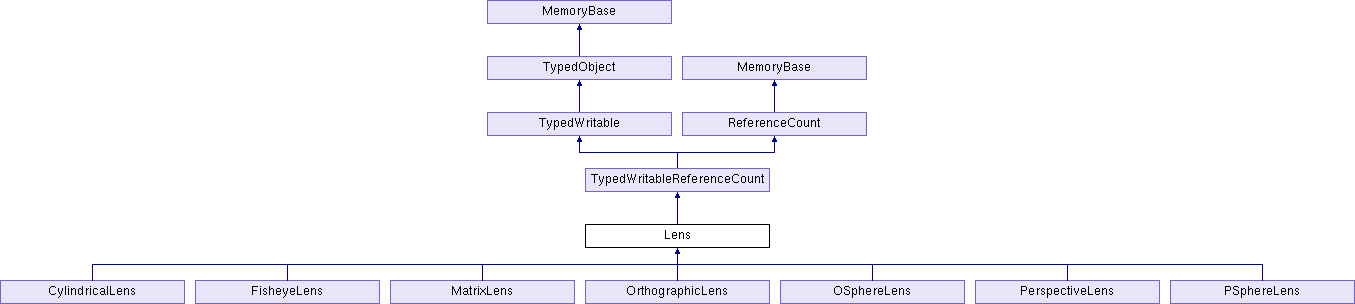
A base class for any number of different kinds of lenses, linear and otherwise. More...
#include "lens.h"
Public Member Functions | |
| Lens (const Lens ©) | |
| void | clear () |
| Resets all lens parameters to their initial default settings. More... | |
| void | clear_custom_film_mat () |
| Disables the lens custom_film_mat correction. More... | |
| void | clear_keystone () |
| Disables the lens keystone correction. More... | |
| void | clear_view_mat () |
| Resets the lens transform to identity. More... | |
| bool | extrude (const LPoint2 &point2d, LPoint3 &near_point, LPoint3 &far_point) const |
| Given a 2-d point in the range (-1,1) in both dimensions, where (0,0) is the center of the lens and (-1,-1) is the lower-left corner, compute the corresponding vector in space that maps to this point, if such a vector can be determined. More... | |
| bool | extrude (const LPoint3 &point2d, LPoint3 &near_point, LPoint3 &far_point) const |
| Given a 2-d point in the range (-1,1) in both dimensions, where (0,0) is the center of the lens and (-1,-1) is the lower-left corner, compute the corresponding vector in space that maps to this point, if such a vector can be determined. More... | |
| bool | extrude_depth (const LPoint3 &point2d, LPoint3 &point3d) const |
| Uses the depth component of the 3-d result from project() to compute the original point in 3-d space corresponding to a particular point on the lens. More... | |
| bool | extrude_vec (const LPoint2 &point2d, LVector3 &vec3d) const |
| Given a 2-d point in the range (-1,1) in both dimensions, where (0,0) is the center of the lens and (-1,-1) is the lower-left corner, compute the vector that corresponds to the view direction. More... | |
| bool | extrude_vec (const LPoint3 &point2d, LVector3 &vec3d) const |
| Given a 2-d point in the range (-1,1) in both dimensions, where (0,0) is the center of the lens and (-1,-1) is the lower-left corner, compute the vector that corresponds to the view direction. More... | |
| virtual TypeHandle | force_init_type () |
| PN_stdfloat | get_aspect_ratio () const |
| const std::string & | get_change_event () const |
| PN_stdfloat | get_convergence_distance () const |
| CoordinateSystem | get_coordinate_system () const |
| const LMatrix4 & | get_custom_film_mat () const |
| Returns the custom_film_mat specified for the lens. More... | |
| PN_stdfloat | get_far () const |
| const LMatrix4 & | get_film_mat () const |
| Returns the matrix that transforms from a point behind the lens to a point on the film. More... | |
| const LMatrix4 & | get_film_mat_inv () const |
| Returns the matrix that transforms from a point on the film to a point behind the lens. More... | |
| const LVector2 & | get_film_offset () const |
| const LVecBase2 & | get_film_size () const |
| PN_stdfloat | get_focal_length () const |
| const LVecBase2 & | get_fov () const |
| PN_stdfloat | get_hfov () const |
| Returns the horizontal component of fov only. More... | |
| PN_stdfloat | get_interocular_distance () const |
| const LVecBase2 & | get_keystone () const |
| UpdateSeq | get_last_change () const |
| Returns the UpdateSeq that is incremented whenever the lens properties are changed. More... | |
| const LMatrix4 & | get_lens_mat () const |
| Returns the matrix that transforms from a point in front of the lens to a point in space. More... | |
| const LMatrix4 & | get_lens_mat_inv () const |
| Returns the matrix that transforms from a point in space to a point in front of the lens. More... | |
| PN_stdfloat | get_min_fov () const |
| PN_stdfloat | get_near () const |
| LPoint3 | get_nodal_point () const |
| const LMatrix4 & | get_projection_mat (StereoChannel channel=SC_mono) const |
| Returns the complete transformation matrix from a 3-d point in space to a point on the film, if such a matrix exists, or the identity matrix if the lens is nonlinear. More... | |
| const LMatrix4 & | get_projection_mat_inv (StereoChannel channel=SC_mono) const |
| Returns the matrix that transforms from a 2-d point on the film to a 3-d vector in space, if such a matrix exists. More... | |
| virtual TypeHandle | get_type () const |
| const LVector3 & | get_up_vector () const |
| Returns the axis perpendicular to the camera's view vector that indicates the "up" direction. More... | |
| PN_stdfloat | get_vfov () const |
| Returns the vertical component of fov only. More... | |
| const LVecBase3 & | get_view_hpr () const |
| const LMatrix4 & | get_view_mat () const |
| const LVector3 & | get_view_vector () const |
| Returns the axis along which the lens is facing. More... | |
| virtual bool | is_linear () const |
| Returns true if the lens represents a linear projection (e.g. More... | |
| virtual bool | is_orthographic () const |
| Returns true if the lens represents a orthographic projection (i.e. More... | |
| virtual bool | is_perspective () const |
| Returns true if the lens represents a perspective projection (i.e. More... | |
| void | operator= (const Lens ©) |
| virtual void | output (std::ostream &out) const |
| bool | project (const LPoint3 &point3d, LPoint3 &point2d) const |
| Given a 3-d point in space, determine the 2-d point this maps to, in the range (-1,1) in both dimensions, where (0,0) is the center of the lens and (-1,-1) is the lower-left corner. More... | |
| bool | project (const LPoint3 &point3d, LPoint2 &point2d) const |
| Given a 3-d point in space, determine the 2-d point this maps to, in the range (-1,1) in both dimensions, where (0,0) is the center of the lens and (-1,-1) is the lower-left corner. More... | |
| virtual | PT (Lens) make_copy() const =0 |
| virtual | PT (Geom) make_geometry() |
| virtual | PT (BoundingVolume) make_bounds() const |
| void | recompute_all () |
| Forces all internal parameters of the Lens to be recomputed. More... | |
| void | set_aspect_ratio (PN_stdfloat aspect_ratio) |
| void | set_change_event (const std::string &event) |
| void | set_convergence_distance (PN_stdfloat convergence_distance) |
| void | set_coordinate_system (CoordinateSystem cs) |
| void | set_custom_film_mat (const LMatrix4 &custom_film_mat) |
| Specifies a custom matrix to transform the points on the film after they have been converted into nominal film space (-1 . More... | |
| void | set_far (PN_stdfloat far_distance) |
| void | set_film_offset (PN_stdfloat x, PN_stdfloat y) |
| void | set_film_offset (const LVecBase2 &film_offset) |
| void | set_film_size (PN_stdfloat width) |
| void | set_film_size (PN_stdfloat width, PN_stdfloat height) |
| void | set_film_size (const LVecBase2 &film_size) |
| void | set_focal_length (PN_stdfloat focal_length) |
| void | set_fov (PN_stdfloat fov) |
| void | set_fov (PN_stdfloat hfov, PN_stdfloat vfov) |
| void | set_fov (const LVecBase2 &fov) |
| void | set_frustum_from_corners (const LVecBase3 &ul, const LVecBase3 &ur, const LVecBase3 &ll, const LVecBase3 &lr, int flags) |
| Sets up the lens to use the frustum defined by the four indicated points. More... | |
| void | set_interocular_distance (PN_stdfloat interocular_distance) |
| void | set_keystone (const LVecBase2 &keystone) |
| void | set_min_fov (PN_stdfloat min_fov) |
| void | set_near (PN_stdfloat near_distance) |
| void | set_near_far (PN_stdfloat near_distance, PN_stdfloat far_distance) |
| Simultaneously changes the near and far planes. More... | |
| void | set_view_hpr (PN_stdfloat h, PN_stdfloat p, PN_stdfloat r) |
| void | set_view_hpr (const LVecBase3 &view_hpr) |
| void | set_view_mat (const LMatrix4 &view_mat) |
| void | set_view_vector (PN_stdfloat x, PN_stdfloat y, PN_stdfloat z, PN_stdfloat i, PN_stdfloat j, PN_stdfloat k) |
| Specifies the direction in which the lens is facing by giving an axis to look along, and a perpendicular (or at least non-parallel) up axis. More... | |
| void | set_view_vector (const LVector3 &view_vector, const LVector3 &up_vector) |
| Specifies the direction in which the lens is facing by giving an axis to look along, and a perpendicular (or at least non-parallel) up axis. More... | |
| virtual void | write (std::ostream &out, int indent_level=0) const |
| virtual void | write_datagram (BamWriter *manager, Datagram &dg) |
| Writes the contents of this object to the datagram for shipping out to a Bam file. More... | |
 Public Member Functions inherited from TypedWritableReferenceCount Public Member Functions inherited from TypedWritableReferenceCount | |
| TypedWritableReferenceCount (const TypedWritableReferenceCount ©) | |
| virtual ReferenceCount * | as_reference_count () |
| Returns the pointer cast to a ReferenceCount pointer, if it is in fact of that type. More... | |
| void | operator= (const TypedWritableReferenceCount ©) |
| Public Member Functions inherited from TypedWritable | |
| TypedWritable (const TypedWritable ©) | |
| virtual int | complete_pointers (TypedWritable **p_list, BamReader *manager) |
| Receives an array of pointers, one for each time manager->read_pointer() was called in fillin(). More... | |
| vector_uchar | encode_to_bam_stream () const |
| Converts the TypedWritable object into a single stream of data using a BamWriter, and returns that data as a bytes object. More... | |
| bool | encode_to_bam_stream (vector_uchar &data, BamWriter *writer=nullptr) const |
| Converts the TypedWritable object into a single stream of data using a BamWriter, and stores that data in the indicated string. More... | |
| virtual void | finalize (BamReader *manager) |
| Called by the BamReader to perform any final actions needed for setting up the object after all objects have been read and all pointers have been completed. More... | |
| UpdateSeq | get_bam_modified () const |
| Returns the current bam_modified counter. More... | |
| void | mark_bam_modified () |
| Increments the bam_modified counter, so that this object will be invalidated and retransmitted on any open bam streams. More... | |
| void | operator= (const TypedWritable ©) |
| virtual bool | require_fully_complete () const |
| Some objects require all of their nested pointers to have been completed before the objects themselves can be completed. More... | |
| virtual void | update_bam_nested (BamWriter *manager) |
| Called by the BamWriter when this object has not itself been modified recently, but it should check its nested objects for updates. More... | |
| Public Member Functions inherited from TypedObject | |
| TypedObject (const TypedObject ©)=default | |
| TypedObject * | as_typed_object () |
| Returns the object, upcast (if necessary) to a TypedObject pointer. More... | |
| const TypedObject * | as_typed_object () const |
| Returns the object, upcast (if necessary) to a TypedObject pointer. More... | |
| int | get_best_parent_from_Set (const std::set< int > &) const |
| int | get_type_index () const |
| Returns the internal index number associated with this object's TypeHandle, a unique number for each different type. More... | |
| bool | is_exact_type (TypeHandle handle) const |
| Returns true if the current object is the indicated type exactly. More... | |
| bool | is_of_type (TypeHandle handle) const |
| Returns true if the current object is or derives from the indicated type. More... | |
| TypedObject & | operator= (const TypedObject ©)=default |
| Public Member Functions inherited from ReferenceCount | |
| int | get_ref_count () const |
| WeakReferenceList * | get_weak_list () const |
| Returns the WeakReferenceList associated with this ReferenceCount object. More... | |
| bool | has_weak_list () const |
| Returns true if this particular ReferenceCount object has a WeakReferenceList created, false otherwise. More... | |
| void | local_object () |
| This function should be called, once, immediately after creating a new instance of some ReferenceCount-derived object on the stack. More... | |
| void | ref () const |
| Explicitly increments the reference count. More... | |
| bool | ref_if_nonzero () const |
| Atomically increases the reference count of this object if it is not zero. More... | |
| bool | test_ref_count_integrity () const |
| Does some easy checks to make sure that the reference count isn't completely bogus. More... | |
| bool | test_ref_count_nonzero () const |
| Does some easy checks to make sure that the reference count isn't zero, or completely bogus. More... | |
| virtual bool | unref () const |
| Explicitly decrements the reference count. More... | |
| WeakReferenceList * | weak_ref () |
| Adds the indicated PointerToVoid as a weak reference to this object. More... | |
| void | weak_unref () |
| Removes the indicated PointerToVoid as a weak reference to this object. More... | |
Static Public Member Functions | |
| static TypeHandle | get_class_type () |
| static PN_stdfloat | get_default_far () |
| Returns the default far plane distance that will be assigned to each newly- created lens. More... | |
| static PN_stdfloat | get_default_near () |
| Returns the default near plane distance that will be assigned to each newly-created lens. More... | |
| static void | init_type () |
| Static Public Member Functions inherited from TypedWritableReferenceCount | |
| static TypeHandle | get_class_type () |
| static void | init_type () |
| static | PT (TypedWritableReferenceCount) decode_from_bam_stream(vector_uchar data |
| Static Public Member Functions inherited from TypedWritable | |
| static bool | decode_raw_from_bam_stream (TypedWritable *&ptr, ReferenceCount *&ref_ptr, vector_uchar data, BamReader *reader=nullptr) |
| Reads the bytes created by a previous call to encode_to_bam_stream(), and extracts the single object on those bytes. More... | |
| static TypeHandle | get_class_type () |
| static void | init_type () |
| Static Public Member Functions inherited from TypedObject | |
| static TypeHandle | get_class_type () |
| static void | init_type () |
| This function is declared non-inline to work around a compiler bug in g++ 2.96. More... | |
| Static Public Member Functions inherited from ReferenceCount | |
| static TypeHandle | get_class_type () |
| static void | init_type () |
Public Attributes | |
| get_aspect_ratio | |
| Returns the aspect ratio of the Lens. More... | |
| get_change_event | |
| Returns the name of the event that will be generated whenever any properties of this particular Lens have changed. More... | |
| get_convergence_distance | |
| See set_convergence_distance(). More... | |
| get_coordinate_system | |
| Returns the coordinate system that all 3-d computations are performed within for this Lens. More... | |
| get_far | |
| Returns the position of the far plane (or cylinder, sphere, whatever). More... | |
| get_film_offset | |
| Returns the horizontal and vertical offset amounts of this Lens. More... | |
| get_film_size | |
| Returns the horizontal and vertical film size of the virtual film. More... | |
| get_focal_length | |
| Returns the focal length of the lens. More... | |
| get_fov | |
| Returns the horizontal and vertical film size of the virtual film. More... | |
| get_interocular_distance | |
| See set_interocular_distance(). More... | |
| get_keystone | |
| Returns the keystone correction specified for the lens. More... | |
| get_min_fov | |
| Returns the field of view of the narrowest dimension of the window. More... | |
| get_near | |
| Returns the position of the near plane (or cylinder, sphere, whatever). More... | |
| get_nodal_point | |
| Returns the center point of the lens: the point from which the lens is viewing. More... | |
| get_view_hpr | |
| Returns the direction in which the lens is facing. More... | |
| get_view_mat | |
| Returns the direction in which the lens is facing. More... | |
| set_aspect_ratio | |
| Sets the aspect ratio of the lens. More... | |
| set_change_event | |
| Sets the name of the event that will be generated whenever any properties of the Lens have changed. More... | |
| set_convergence_distance | |
| Sets the distance between between the camera plane and the point in the distance that the left and right eyes are both looking at. More... | |
| set_coordinate_system | |
| Specifies the coordinate system that all 3-d computations are performed within for this Lens. More... | |
| set_far | |
| Defines the position of the far plane (or cylinder, sphere, whatever). More... | |
| set_film_offset | |
| Sets the horizontal and vertical offset amounts of this Lens. More... | |
| set_film_size | |
| Sets the horizontal size of the film without changing its shape. More... | |
| set_focal_length | |
| Sets the focal length of the lens. More... | |
| set_fov | |
| Sets the horizontal field of view of the lens without changing the aspect ratio. More... | |
| set_interocular_distance | |
| Sets the distance between the left and right eyes of a stereo camera. More... | |
| set_keystone | |
| Indicates the ratio of keystone correction to perform on the lens, in each of three axes. More... | |
| set_min_fov | |
| Sets the field of view of the smallest dimension of the window. More... | |
| set_near | |
| Defines the position of the near plane (or cylinder, sphere, whatever). More... | |
| set_view_hpr | |
| Sets the direction in which the lens is facing. More... | |
| set_view_mat | |
| Sets an arbitrary transformation on the lens. More... | |
| Public Attributes inherited from TypedWritableReferenceCount | |
| static BamReader * | reader = nullptr) |
| Public Attributes inherited from TypedObject | |
| get_type | |
| Public Attributes inherited from ReferenceCount | |
| get_ref_count | |
| Returns the current reference count. More... | |
Additional Inherited Members | |
| Static Public Attributes inherited from TypedWritable | |
| static TypedWritable *const | Null = nullptr |
Detailed Description
A base class for any number of different kinds of lenses, linear and otherwise.
Presently, this includes perspective and orthographic lenses.
A Lens object is the main part of a Camera node, which defines the fundamental interface to point-of-view for rendering. Lenses are also used in other contexts, however; for instance, a Spotlight is also defined using a lens.
Member Function Documentation
◆ clear()
| void Lens::clear | ( | ) |
◆ clear_custom_film_mat()
| void Lens::clear_custom_film_mat | ( | ) |
◆ clear_keystone()
| void Lens::clear_keystone | ( | ) |
◆ clear_view_mat()
| void Lens::clear_view_mat | ( | ) |
◆ extrude() [1/2]
|
inline |
Given a 2-d point in the range (-1,1) in both dimensions, where (0,0) is the center of the lens and (-1,-1) is the lower-left corner, compute the corresponding vector in space that maps to this point, if such a vector can be determined.
The vector is returned by indicating the points on the near plane and far plane that both map to the indicated 2-d point.
Returns true if the vector is defined, or false otherwise.
Definition at line 24 of file lens.I.
Referenced by CollisionRay::set_from_lens(), and CollisionSegment::set_from_lens().
◆ extrude() [2/2]
|
inline |
Given a 2-d point in the range (-1,1) in both dimensions, where (0,0) is the center of the lens and (-1,-1) is the lower-left corner, compute the corresponding vector in space that maps to this point, if such a vector can be determined.
The vector is returned by indicating the points on the near plane and far plane that both map to the indicated 2-d point.
The z coordinate of the 2-d point is ignored.
Returns true if the vector is defined, or false otherwise.
◆ extrude_depth()
|
inline |
◆ extrude_vec() [1/2]
|
inline |
Given a 2-d point in the range (-1,1) in both dimensions, where (0,0) is the center of the lens and (-1,-1) is the lower-left corner, compute the vector that corresponds to the view direction.
This will be parallel to the normal on the surface (the far plane) corresponding to the lens shape at this point.
See the comment block on Lens::extrude_vec_impl() for a more in-depth comment on the meaning of this vector.
Returns true if the vector is defined, or false otherwise.
◆ extrude_vec() [2/2]
|
inline |
Given a 2-d point in the range (-1,1) in both dimensions, where (0,0) is the center of the lens and (-1,-1) is the lower-left corner, compute the vector that corresponds to the view direction.
This will be parallel to the normal on the surface (the far plane) corresponding to the lens shape at this point.
See the comment block on Lens::extrude_vec_impl() for a more in-depth comment on the meaning of this vector.
The z coordinate of the 2-d point is ignored.
Returns true if the vector is defined, or false otherwise.
◆ get_custom_film_mat()
|
inline |
◆ get_default_far()
|
static |
◆ get_default_near()
|
static |
◆ get_film_mat()
|
inline |
◆ get_film_mat_inv()
|
inline |
◆ get_hfov()
|
inline |
◆ get_last_change()
|
inline |
◆ get_lens_mat()
|
inline |
◆ get_lens_mat_inv()
|
inline |
◆ get_projection_mat()
|
inline |
Returns the complete transformation matrix from a 3-d point in space to a point on the film, if such a matrix exists, or the identity matrix if the lens is nonlinear.
Definition at line 563 of file lens.I.
Referenced by ShadowSource::set_perspective_lens().
◆ get_projection_mat_inv()
|
inline |
◆ get_up_vector()
| const LVector3 & Lens::get_up_vector | ( | ) | const |
Returns the axis perpendicular to the camera's view vector that indicates the "up" direction.
Definition at line 227 of file lens.cxx.
References CycleDataReader< CycleDataType >::p().
◆ get_vfov()
|
inline |
◆ get_view_vector()
| const LVector3 & Lens::get_view_vector | ( | ) | const |
Returns the axis along which the lens is facing.
Definition at line 214 of file lens.cxx.
References CycleDataReader< CycleDataType >::p().
◆ is_linear()
|
virtual |
Returns true if the lens represents a linear projection (e.g.
PerspectiveLens, OrthographicLens), and therefore there is a valid matrix returned by get_projection_mat(), or false otherwise.
Reimplemented in MatrixLens, OrthographicLens, and PerspectiveLens.
Definition at line 540 of file lens.cxx.
Referenced by CPT().
◆ is_orthographic()
|
virtual |
Returns true if the lens represents a orthographic projection (i.e.
it is a OrthographicLens), false otherwise.
Reimplemented in OrthographicLens.
◆ is_perspective()
|
virtual |
Returns true if the lens represents a perspective projection (i.e.
it is a PerspectiveLens), false otherwise.
Reimplemented in PerspectiveLens.
◆ project() [1/2]
|
inline |
Given a 3-d point in space, determine the 2-d point this maps to, in the range (-1,1) in both dimensions, where (0,0) is the center of the lens and (-1,-1) is the lower-left corner.
The z coordinate will also be set to a value in the range (-1, 1), where 1 represents a point on the near plane, and -1 represents a point on the far plane.
Returns true if the 3-d point is in front of the lens and within the viewing frustum (in which case point2d is filled in), or false otherwise (in which case point2d will be filled in with something, which may or may not be meaningful).
Definition at line 131 of file lens.I.
Referenced by PT().
◆ project() [2/2]
|
inline |
Given a 3-d point in space, determine the 2-d point this maps to, in the range (-1,1) in both dimensions, where (0,0) is the center of the lens and (-1,-1) is the lower-left corner.
Returns true if the 3-d point is in front of the lens and within the viewing frustum (in which case point2d is filled in), or false otherwise (in which case point2d will be filled in with something, which may or may not be meaningful).
◆ recompute_all()
| void Lens::recompute_all | ( | ) |
◆ set_custom_film_mat()
| void Lens::set_custom_film_mat | ( | const LMatrix4 & | custom_film_mat | ) |
Specifies a custom matrix to transform the points on the film after they have been converted into nominal film space (-1 .
. 1 in U and V). This can be used to introduce arbitrary scales, rotations, or other linear transforms to the media plane. This is normally a 2-d matrix, but a full 4x4 matrix may be specified. This is applied on top of any film size, lens shift, and/or keystone correction.
◆ set_frustum_from_corners()
| void Lens::set_frustum_from_corners | ( | const LVecBase3 & | ul, |
| const LVecBase3 & | ur, | ||
| const LVecBase3 & | ll, | ||
| const LVecBase3 & | lr, | ||
| int | flags | ||
| ) |
Sets up the lens to use the frustum defined by the four indicated points.
This is most useful for a PerspectiveLens, but it may be called for other kinds of lenses as well.
The frustum will be rooted at the origin (or by whatever translation might have been specified in a previous call to set_view_mat).
It is legal for the four points not to be arranged in a rectangle; if this is the case, the frustum will be fitted as tightly as possible to cover all four points.
The flags parameter contains the union of one or more of the following bits to control the behavior of this function:
FC_roll - If this is included, the camera may be rotated so that its up vector is perpendicular to the top line. Otherwise, the standard up vector is used.
FC_camera_plane - This allows the camera plane to be adjusted to be as nearly perpendicular to the center of the frustum as possible. Without this bit, the orientation camera plane is defined by position of the four points (which should all be coplanar). With this bit, the camera plane is arbitarary, and may be chosen so that the four points do not themselves lie in the camera plane (but the points will still be within the frustum).
FC_off_axis - This allows the resulting frustum to be off-axis to get the tightest possible fit. Without this bit, the viewing axis will be centered within the frustum, but there may be more wasted space along the edges.
FC_aspect_ratio - This allows the frustum to be scaled non-proportionately in the vertical and horizontal dimensions, if necessary, to get a tighter fit. Without this bit, the current aspect ratio will be preserved.
FC_shear - This allows the frustum to be sheared, if necessary, to get the tightest possible fit. This may result in a parallelogram-based frustum, which will give a slanted appearance to the rendered image. Without this bit, the frustum will be rectangle-based.
In general, if 0 is passed in as the value for flags, the generated frustum will be a loose fit but sane; if -1 is passed in, it will be a tighter fit and possibly screwy.
◆ set_near_far()
|
inline |
Simultaneously changes the near and far planes.
Definition at line 419 of file lens.I.
Referenced by ShadowSource::set_perspective_lens().
◆ set_view_vector() [1/2]
|
inline |
Specifies the direction in which the lens is facing by giving an axis to look along, and a perpendicular (or at least non-parallel) up axis.
See also set_view_hpr().
Definition at line 442 of file lens.I.
Referenced by ShadowSource::set_perspective_lens().
◆ set_view_vector() [2/2]
| void Lens::set_view_vector | ( | const LVector3 & | view_vector, |
| const LVector3 & | up_vector | ||
| ) |
Specifies the direction in which the lens is facing by giving an axis to look along, and a perpendicular (or at least non-parallel) up axis.
See also set_view_hpr().
◆ write_datagram()
Writes the contents of this object to the datagram for shipping out to a Bam file.
Reimplemented from TypedWritable.
Reimplemented in MatrixLens.
Definition at line 1852 of file lens.cxx.
References BamWriter::write_cdata(), and TypedWritable::write_datagram().
Referenced by MatrixLens::write_datagram().
Member Data Documentation
◆ get_aspect_ratio
|
inline |
Returns the aspect ratio of the Lens.
This is determined based on the indicated film size; see set_film_size().
◆ get_change_event
|
inline |
◆ get_convergence_distance
|
inline |
◆ get_coordinate_system
|
inline |
◆ get_far
|
inline |
◆ get_film_offset
|
inline |
Returns the horizontal and vertical offset amounts of this Lens.
See set_film_offset().
◆ get_film_size
|
inline |
Returns the horizontal and vertical film size of the virtual film.
See set_film_size().
◆ get_focal_length
|
inline |
Returns the focal length of the lens.
This may have been set explicitly by a previous call to set_focal_length(), or it may be computed based on the lens' fov and film_size. For certain kinds of lenses, the focal length has no meaning.
◆ get_fov
|
inline |
Returns the horizontal and vertical film size of the virtual film.
See set_fov().
Definition at line 101 of file lens.h.
Referenced by get_hfov(), and get_vfov().
◆ get_interocular_distance
|
inline |
◆ get_keystone
|
inline |
◆ get_min_fov
| PN_stdfloat Lens::get_min_fov |
Returns the field of view of the narrowest dimension of the window.
See set_min_fov().
◆ get_near
|
inline |
◆ get_nodal_point
| LPoint3 Lens::get_nodal_point |
◆ get_view_hpr
| const LVecBase3 & Lens::get_view_hpr |
◆ get_view_mat
|
inline |
◆ set_aspect_ratio
|
inline |
◆ set_change_event
|
inline |
Sets the name of the event that will be generated whenever any properties of the Lens have changed.
If this is not set for a particular lens, no event will be generated.
The event is thrown with one parameter, the lens itself. This can be used to automatically track changes to camera fov, etc. in the application.
◆ set_convergence_distance
|
inline |
Sets the distance between between the camera plane and the point in the distance that the left and right eyes are both looking at.
This distance is used to apply a stereo effect when the lens is rendered on a stereo display region. It only has an effect on a PerspectiveLens.
This parameter must be greater than 0, but may be as large as you like. It controls the distance at which the two stereo images will appear to converge, which is a normal property of stereo vision. Normally this should be set to the distance from the camera to the area of interest in your scene. Anything beyond this distance will appear to go into the screen, and anything closer will appear to come out of the screen. If you want to simulate parallel stereo, set this to infinity.
Note that this creates an off-axis frustum, which means that the lenses are still pointing in the same direction, which is usually more desirable than the more naive toe-in approach, where the two lenses are simply tilted toward each other.
Prior to Panda3D 1.9.0, the convergence was being calculated incorrectly. It has since been corrected. To restore the legacy behavior you can set the stereo-lens-old-convergence variable to true.
Also see set_interocular_distance(), which relates.
◆ set_coordinate_system
| void Lens::set_coordinate_system |
◆ set_far
|
inline |
◆ set_film_offset
|
inline |
Sets the horizontal and vertical offset amounts of this Lens.
These are both in the same units specified in set_film_size().
This can be used to establish an off-axis lens.
Definition at line 87 of file lens.h.
Referenced by ShadowSource::set_perspective_lens().
◆ set_film_size
|
inline |
Sets the horizontal size of the film without changing its shape.
Sets the size and shape of the "film" within the lens.
The aspect ratio remains unchanged; this computes the vertical size of the film to automatically maintain the aspect ratio.
This both establishes the units used by calls like set_focal_length(), and establishes the aspect ratio of the frame.
In a physical camera, the field of view of a lens is determined by the lens' focal length and by the size of the film area exposed by the lens. For instance, a 35mm camera exposes a rectangle on the film about 24mm x 36mm, which means a 50mm lens gives about a 40-degree horizontal field of view.
In the virtual camera, you may set the film size to any units here, and specify a focal length in the same units to simulate the same effect. Or, you may ignore this parameter, and specify the field of view and aspect ratio of the lens directly.
Definition at line 82 of file lens.h.
Referenced by WindowFramework::get_render_2d().
◆ set_focal_length
|
inline |
Sets the focal length of the lens.
This may adjust the field-of-view correspondingly, and is an alternate way to specify field of view.
For certain kinds of lenses (e.g. OrthographicLens), the focal length has no meaning.
◆ set_fov
|
inline |
Sets the horizontal field of view of the lens without changing the aspect ratio.
Sets the field of view of the lens in both dimensions.
The vertical field of view is adjusted to maintain the same aspect ratio.
This establishes both the field of view and the aspect ratio of the lens. This is one way to specify the field of view of a lens; set_focal_length() is another way.
For certain kinds of lenses (like OrthoLens), the field of view has no meaning.
This establishes both the field of view and the aspect ratio of the lens. This is one way to specify the field of view of a lens; set_focal_length() is another way.
For certain kinds of lenses (like OrthographicLens), the field of view has no meaning.
◆ set_interocular_distance
|
inline |
Sets the distance between the left and right eyes of a stereo camera.
This distance is used to apply a stereo effect when the lens is rendered on a stereo display region. It only has an effect on a PerspectiveLens.
The left eye and the right eye are each offset along the X axis by half of this distance, so that this parameter specifies the total distance between them.
Also see set_convergence_distance(), which relates.
◆ set_keystone
| void Lens::set_keystone |
Indicates the ratio of keystone correction to perform on the lens, in each of three axes.
This will build a special non-affine scale factor into the projection matrix that will compensate for keystoning of a projected image; this can be used to compensate for a projector that for physical reasons cannot be aimed directly at its screen.
The default value is taken from the default-keystone Config variable. 0, 0 indicates no keystone correction; specify a small value (usually in the range -1 .. 1) in either the x or y position to generate a keystone correction in that axis.
◆ set_min_fov
| void Lens::set_min_fov |
Sets the field of view of the smallest dimension of the window.
If the window is wider than it is tall, this specifies the vertical field of view; if it is taller than it is wide, this specifies the horizontal field of view.
In many cases, this is preferable to setting either the horizontal or vertical field of view explicitly. Setting this parameter means that pulling the window wider will widen the field of view, which is usually what you expect to happen.
◆ set_near
|
inline |
◆ set_view_hpr
|
inline |
Sets the direction in which the lens is facing.
Normally, this is down the forward axis (usually the Y axis), but it may be rotated. This is only one way of specifying the rotation; you may also specify an explicit vector in which to look, or you may give a complete transformation matrix.
◆ set_view_mat
|
inline |
Sets an arbitrary transformation on the lens.
This replaces the individual transformation components like set_view_hpr().
Setting a transformation here will have a slightly different effect than putting one on the LensNode that contains this lens. In particular, lighting and other effects computations will still be performed on the lens in its untransformed (facing forward) position, but the actual projection matrix will be transformed by this matrix.
The documentation for this class was generated from the following files: