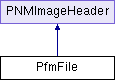
Defines a pfm file, a 2-d table of floating-point numbers, either 3-component or 1-component, or with a special extension, 2- or 4-component. More...
#include "pfmFile.h"
Public Member Functions | |
| PfmFile (const PfmFile ©) | |
| void | add_sub_image (const PfmFile ©, int xto, int yto, int xfrom=0, int yfrom=0, int x_size=-1, int y_size=-1, float pixel_scale=1.0) |
| Behaves like copy_sub_image(), except the copy pixels are added to the pixels of the destination, after scaling by the specified pixel_scale. More... | |
| void | apply_1d_lut (int channel, const PfmFile &lut, PN_float32 x_scale=1.0) |
| Assumes that lut is an X by 1, 1-component PfmFile whose X axis maps points to target points. More... | |
| void | apply_crop (int x_begin, int x_end, int y_begin, int y_end) |
| Reduces the PFM file to the cells in the rectangle bounded by (x_begin, x_end, y_begin, y_end), where the _end cells are not included. More... | |
| void | apply_exponent (float gray_exponent) |
| Adjusts each channel of the image by raising the corresponding component value to the indicated exponent, such that L' = L ^ exponent. More... | |
| void | apply_exponent (float gray_exponent, float alpha_exponent) |
| Adjusts each channel of the image by raising the corresponding component value to the indicated exponent, such that L' = L ^ exponent. More... | |
| void | apply_exponent (float c0_exponent, float c1_exponent, float c2_exponent) |
| Adjusts each channel of the image by raising the corresponding component value to the indicated exponent, such that L' = L ^ exponent. More... | |
| void | apply_exponent (float c0_exponent, float c1_exponent, float c2_exponent, float c3_exponent) |
| Adjusts each channel of the image by raising the corresponding component value to the indicated exponent, such that L' = L ^ exponent. More... | |
| void | apply_mask (const PfmFile &other) |
| Wherever there is missing data in the other PfmFile, set this the corresponding point in this PfmFile to missing as well, so that this PfmFile has only points where both files have points. More... | |
| void | box_filter_from (float radius, const PfmFile ©) |
| Makes a resized copy of the indicated image into this one using the indicated filter. More... | |
| bool | calc_autocrop (int &x_begin, int &x_end, int &y_begin, int &y_end) const |
| Computes the minimum range of x and y across the PFM file that include all points. More... | |
| bool | calc_autocrop (LVecBase4f &range) const |
| Computes the minimum range of x and y across the PFM file that include all points. More... | |
| bool | calc_autocrop (LVecBase4d &range) const |
| Computes the minimum range of x and y across the PFM file that include all points. More... | |
| bool | calc_average_point (LPoint3f &result, PN_float32 x, PN_float32 y, PN_float32 radius) const |
| Computes the unweighted average point of all points within the box centered at (x, y) with the indicated Manhattan-distance radius. More... | |
| bool | calc_bilinear_point (LPoint3f &result, PN_float32 x, PN_float32 y) const |
| Computes the weighted average of the four nearest points to the floating- point index (x, y). More... | |
| bool | calc_min_max (LVecBase3f &min_points, LVecBase3f &max_points) const |
| Calculates the minimum and maximum x, y, and z depth component values, representing the bounding box of depth values, and places them in the indicated vectors. More... | |
| bool | calc_tight_bounds (LPoint3f &min_point, LPoint3f &max_point) const |
| Calculates the minimum and maximum vertices of all points within the table. More... | |
| void | clear () |
| Eliminates all data in the file. More... | |
| void | clear (int x_size, int y_size, int num_channels) |
| Resets to an empty table with a specific size. More... | |
| void | clear_no_data_value () |
| Removes the special value that means "no data" when it appears in the pfm file. More... | |
| void | clear_to_texcoords (int x_size, int y_size) |
| Replaces this PfmFile with a new PfmFile of size x_size x y_size x 3, containing the x y 0 values in the range 0 . More... | |
| void | compute_sample_point (LPoint3f &result, PN_float32 x, PN_float32 y, PN_float32 sample_radius) const |
| void | copy_channel (int to_channel, const PfmFile &other, int from_channel) |
| Copies just the specified channel values from the indicated PfmFile (which could be same as this PfmFile) into the specified channel of this one. More... | |
| void | copy_channel_masked (int to_channel, const PfmFile &other, int from_channel) |
| Copies just the specified channel values from the indicated PfmFile, but only where the other file has a data point. More... | |
| void | copy_sub_image (const PfmFile ©, int xto, int yto, int xfrom=0, int yfrom=0, int x_size=-1, int y_size=-1) |
| void | divide_sub_image (const PfmFile ©, int xto, int yto, int xfrom=0, int yfrom=0, int x_size=-1, int y_size=-1, float pixel_scale=1.0) |
| Behaves like copy_sub_image(), except the copy pixels are divided into the pixels of the destination, after scaling by the specified pixel_scale. More... | |
| void | fill (PN_float32 value) |
| Fills the table with all of the same value. More... | |
| void | fill (const LPoint2f &value) |
| Fills the table with all of the same value. More... | |
| void | fill (const LPoint3f &value) |
| Fills the table with all of the same value. More... | |
| void | fill (const LPoint4f &value) |
| Fills the table with all of the same value. More... | |
| void | fill_channel (int channel, PN_float32 value) |
| Fills the indicated channel with all of the same value, leaving the other channels unchanged. More... | |
| void | fill_channel_masked (int channel, PN_float32 value) |
| Fills the indicated channel with all of the same value, but only where the table already has a data point. More... | |
| void | fill_channel_masked_nan (int channel) |
| Fills the indicated channel with NaN, but only where the table already has a data point. More... | |
| void | fill_channel_nan (int channel) |
| Fills the indicated channel with NaN, leaving the other channels unchanged. More... | |
| void | fill_nan () |
| Fills the table with all NaN. More... | |
| void | fill_no_data_value () |
| Fills the table with the current no_data value, so that the table is empty. More... | |
| void | flip (bool flip_x, bool flip_y, bool transpose) |
| Reverses, transposes, and/or rotates the table in-place according to the specified parameters. More... | |
| void | forward_distort (const PfmFile &dist, PN_float32 scale_factor=1.0) |
| Applies the distortion indicated in the supplied dist map to the current map. More... | |
| void | gamma_correct (float from_gamma, float to_gamma) |
| void | gamma_correct_alpha (float from_gamma, float to_gamma) |
| Assuming the image was constructed with a gamma curve of from_gamma in the alpha channel, converts it to an image with a gamma curve of to_gamma in the alpha channel. More... | |
| void | gaussian_filter_from (float radius, const PfmFile ©) |
| Makes a resized copy of the indicated image into this one using the indicated filter. More... | |
| PN_float32 | get_channel (int x, int y, int c) const |
| Returns the cth channel of the point value at the indicated point. More... | |
| const LPoint4f & | get_no_data_value () const |
| If has_no_data_value() returns true, this returns the particular "no data" value. More... | |
| const LPoint3f & | get_point (int x, int y) const |
| Returns the 3-component point value at the indicated point. More... | |
| PN_float32 | get_point1 (int x, int y) const |
| Returns the 1-component point value at the indicated point. More... | |
| const LPoint2f & | get_point2 (int x, int y) const |
| Returns the 2-component point value at the indicated point. More... | |
| const LPoint3f & | get_point3 (int x, int y) const |
| Returns the 3-component point value at the indicated point. More... | |
| const LPoint4f & | get_point4 (int x, int y) const |
| Returns the 4-component point value at the indicated point. More... | |
| PN_float32 | get_scale () const |
| const vector_float & | get_table () const |
| This is a very low-level function that returns a read-only reference to the internal table of floating-point numbers. More... | |
| bool | has_no_data_threshold () const |
| Returns whether a "no data" threshold value has been established by set_no_data_threshold(). More... | |
| bool | has_no_data_value () const |
| Returns whether a "no data" value has been established by set_no_data_value(). More... | |
| bool | has_point (int x, int y) const |
| Returns true if there is a valid point at x, y. More... | |
| void | indirect_1d_lookup (const PfmFile &index_image, int channel, const PfmFile &pixel_values) |
| index_image is a WxH 1-channel image, while pixel_values is an Nx1 image with any number of channels. More... | |
| bool | is_column_empty (int x, int y_begin, int y_end) const |
| Returns true if all of the points on column x, from [y_begin, y_end), are the no_data value, or false if any one of these points has a value. More... | |
| bool | is_row_empty (int y, int x_begin, int x_end) const |
| Returns true if all of the points on row y, in the range [x_begin, x_end), are the no_data value, or false if any one of these points has a value. More... | |
| bool | is_valid () const |
| bool | load (const PNMImage &pnmimage) |
| Fills the PfmFile with the data from the indicated PNMImage, converted to floating-point values. More... | |
| void | merge (const PfmFile &other) |
| Wherever there is missing data in this PfmFile (that is, wherever has_point() returns false), copy data from the other PfmFile, which must be exactly the same dimensions as this one. More... | |
| LPoint3f & | modify_point (int x, int y) |
| Returns a modifiable 3-component point value at the indicated point. More... | |
| LPoint2f & | modify_point2 (int x, int y) |
| Returns a modifiable 2-component point value at the indicated point. More... | |
| LPoint3f & | modify_point3 (int x, int y) |
| Returns a modifiable 3-component point value at the indicated point. More... | |
| LPoint4f & | modify_point4 (int x, int y) |
| Returns a modifiable 4-component point value at the indicated point. More... | |
| void | mult_sub_image (const PfmFile ©, int xto, int yto, int xfrom=0, int yfrom=0, int x_size=-1, int y_size=-1, float pixel_scale=1.0) |
| Behaves like copy_sub_image(), except the copy pixels are multiplied to the pixels of the destination, after scaling by the specified pixel_scale. More... | |
| void | operator *= (float multiplier) |
| Multiplies every point value in the image by a constant floating-point multiplier value. More... | |
| void | operator= (const PfmFile ©) |
| void | output (std::ostream &out) const |
| PT (BoundingHexahedron) compute_planar_bounds(const LPoint2f ¢er | |
| PT (BoundingHexahedron) compute_planar_bounds(const LPoint2d ¢er | |
| int | pull_spot (const LPoint4f &delta, float xc, float yc, float xr, float yr, float exponent) |
| Applies delta * t to the point values within radius (xr, yr) distance of (xc, yc). More... | |
| void | quick_filter_from (const PfmFile ©) |
| Resizes from the given image, with a fixed radius of 0.5. More... | |
| bool | read (const Filename &fullpath) |
| Reads the PFM data from the indicated file, returning true on success, false on failure. More... | |
| bool | read (std::istream &in, const Filename &fullpath=Filename()) |
| Reads the PFM data from the indicated stream, returning true on success, false on failure. More... | |
| bool | read (PNMReader *reader) |
| Reads the PFM data using the indicated PNMReader. More... | |
| void | resize (int new_x_size, int new_y_size) |
| Applies a simple filter to resample the pfm file in-place to the indicated size. More... | |
| void | reverse_distort (const PfmFile &dist, PN_float32 scale_factor=1.0) |
| Applies the distortion indicated in the supplied dist map to the current map. More... | |
| void | reverse_rows () |
| Performs an in-place reversal of the row (y) data. More... | |
| void | set_channel (int x, int y, int c, PN_float32 value) |
| Replaces the cth channel of the point value at the indicated point. More... | |
| void | set_no_data_chan4 (bool chan4) |
| Sets the no_data_chan4 flag. More... | |
| void | set_no_data_nan (int num_channels) |
| Sets the no_data_nan flag. More... | |
| void | set_no_data_threshold (const LPoint4f &no_data_value) |
| Sets the special threshold value. More... | |
| void | set_no_data_threshold (const LPoint4d &no_data_value) |
| Sets the special threshold value. More... | |
| void | set_no_data_value (const LPoint4f &no_data_value) |
| Sets the special value that means "no data" when it appears in the pfm file. More... | |
| void | set_no_data_value (const LPoint4d &no_data_value) |
| Sets the special value that means "no data" when it appears in the pfm file. More... | |
| void | set_point (int x, int y, const LVecBase3f &point) |
| Replaces the 3-component point value at the indicated point. More... | |
| void | set_point (int x, int y, const LVecBase3d &point) |
| Replaces the 3-component point value at the indicated point. More... | |
| void | set_point1 (int x, int y, PN_float32 point) |
| Replaces the 1-component point value at the indicated point. More... | |
| void | set_point2 (int x, int y, const LVecBase2f &point) |
| Replaces the 2-component point value at the indicated point. More... | |
| void | set_point2 (int x, int y, const LVecBase2d &point) |
| Replaces the 2-component point value at the indicated point. More... | |
| void | set_point3 (int x, int y, const LVecBase3f &point) |
| Replaces the 3-component point value at the indicated point. More... | |
| void | set_point3 (int x, int y, const LVecBase3d &point) |
| Replaces the 3-component point value at the indicated point. More... | |
| void | set_point4 (int x, int y, const LVecBase4f &point) |
| Replaces the 4-component point value at the indicated point. More... | |
| void | set_point4 (int x, int y, const LVecBase4d &point) |
| Replaces the 4-component point value at the indicated point. More... | |
| void | set_scale (PN_float32 scale) |
| void | set_zero_special (bool zero_special) |
| Sets the zero_special flag. More... | |
| bool | store (PNMImage &pnmimage) const |
| Copies the data to the indicated PNMImage, converting to RGB values. More... | |
| bool | store_mask (PNMImage &pnmimage) const |
| Stores 1 or 0 values into the indicated PNMImage, according to has_point() for each pixel. More... | |
| bool | store_mask (PNMImage &pnmimage, const LVecBase4f &min_point, const LVecBase4f &max_point) const |
| Stores 1 or 0 values into the indicated PNMImage, according to has_point() for each pixel. More... | |
| void | swap_table (vector_float &table) |
| This is a very low-level function that completely exchanges the PfmFile's internal table of floating-point numbers with whatever you supply. More... | |
| bool | write (const Filename &fullpath) |
| Writes the PFM data to the indicated file, returning true on success, false on failure. More... | |
| bool | write (std::ostream &out, const Filename &fullpath=Filename()) |
| Writes the PFM data to the indicated stream, returning true on success, false on failure. More... | |
| bool | write (PNMWriter *writer) |
| Writes the PFM data using the indicated PNMWriter. More... | |
| void | xform (const LMatrix4f &transform) |
| Applies the indicated transform matrix to all points in-place. More... | |
| void | xform (const LMatrix4d &transform) |
| Applies the indicated transform matrix to all points in-place. More... | |
 Public Member Functions inherited from PNMImageHeader Public Member Functions inherited from PNMImageHeader | |
| PNMImageHeader (const PNMImageHeader ©) | |
| ColorSpace | get_color_space () const |
| ColorType | get_color_type () const |
| Returns the image type of the image, as an enumerated value. More... | |
| std::string | get_comment () const |
| xelval | get_maxval () const |
| int | get_num_channels () const |
| LVecBase2i | get_size () const |
| PNMFileType * | get_type () const |
| int | get_x_size () const |
| Returns the number of pixels in the X direction. More... | |
| int | get_y_size () const |
| Returns the number of pixels in the Y direction. More... | |
| bool | has_alpha () const |
| Returns true if the image includes an alpha channel, false otherwise. More... | |
| bool | has_type () const |
| bool | is_grayscale () const |
| Returns false if the image is a full-color image, and has red, green, and blue components; true if it is a grayscale image and has only a gray component. More... | |
| PNMReader * | make_reader (const Filename &filename, PNMFileType *type=nullptr, bool report_unknown_type=true) const |
| Returns a newly-allocated PNMReader of the suitable type for reading from the indicated image filename, or NULL if the filename cannot be read for some reason. More... | |
| PNMReader * | make_reader (std::istream *file, bool owns_file=true, const Filename &filename=Filename(), std::string magic_number=std::string(), PNMFileType *type=nullptr, bool report_unknown_type=true) const |
| Returns a newly-allocated PNMReader of the suitable type for reading from the already-opened image file, or NULL if the file cannot be read for some reason. More... | |
| PNMWriter * | make_writer (const Filename &filename, PNMFileType *type=nullptr) const |
| Returns a newly-allocated PNMWriter of the suitable type for writing an image to the indicated filename, or NULL if the filename cannot be written for some reason. More... | |
| PNMWriter * | make_writer (std::ostream *file, bool owns_file=true, const Filename &filename=Filename(), PNMFileType *type=nullptr) const |
| Returns a newly-allocated PNMWriter of the suitable type for writing to the already-opened image file, or NULL if the file cannot be written for some reason. More... | |
| void | operator= (const PNMImageHeader ©) |
| void | output (std::ostream &out) const |
| bool | read_header (const Filename &filename, PNMFileType *type=nullptr, bool report_unknown_type=true) |
| Opens up the image file and tries to read its header information to determine its size, number of channels, etc. More... | |
| bool | read_header (std::istream &data, const std::string &filename=std::string(), PNMFileType *type=nullptr, bool report_unknown_type=true) |
| Reads the image header information only from the indicated stream. More... | |
| void | set_comment (const std::string &comment) |
| void | set_type (PNMFileType *type) |
| Sets the file type of this PNMImage. More... | |
Public Attributes | |
| PN_float32 PN_float32 bool points_only | const |
| get_scale | |
| The "scale" is reported in the pfm header and is probably meaningless. More... | |
| is_valid | |
| PN_float32 | point_dist |
| PN_float32 PN_float32 | sample_radius |
| set_scale | |
| The "scale" is reported in the pfm header and is probably meaningless. More... | |
| Public Attributes inherited from PNMImageHeader | |
| get_color_space | |
| Returns the color space that the image is encoded in, or CS_unspecified if unknown. More... | |
| get_comment | |
| Gets the user comment from the file. More... | |
| get_maxval | |
| Returns the maximum channel value allowable for any pixel in this image; for instance, 255 for a typical 8-bit-per-channel image. More... | |
| get_num_channels | |
| Returns the number of channels in the image. More... | |
| get_size | |
| Returns the number of pixels in each direction. More... | |
| get_type | |
| If the file type is known (e.g. More... | |
| has_type | |
| Returns true if the PNMImageHeader knows what type it is, false otherwise. More... | |
| set_comment | |
| Writes a user comment string to the image (header). More... | |
Friends | |
| class | PfmVizzer |
Additional Inherited Members | |
| Public Types inherited from PNMImageHeader | |
| enum | ColorType { CT_invalid = 0, CT_grayscale = 1, CT_two_channel = 2, CT_color = 3, CT_four_channel = 4 } |
| typedef pmap< PixelSpec, int > | HistMap |
| typedef pvector< PixelSpec > | Palette |
| typedef pvector< PixelSpecCount > | PixelCount |
| Static Public Member Functions inherited from PNMImageHeader | |
| static bool | has_alpha (ColorType color_type) |
| This static variant of has_alpha() returns true if the indicated image type includes an alpha channel, false otherwise. More... | |
| static bool | is_grayscale (ColorType color_type) |
| This static variant of is_grayscale() returns true if the indicated image type represents a grayscale image, false otherwise. More... | |
| static bool | read_magic_number (std::istream *file, std::string &magic_number, int num_bytes) |
| Ensures that the first n bytes of the file are read into magic_number. More... | |
Detailed Description
Defines a pfm file, a 2-d table of floating-point numbers, either 3-component or 1-component, or with a special extension, 2- or 4-component.
Member Function Documentation
◆ add_sub_image()
| void PfmFile::add_sub_image | ( | const PfmFile & | copy, |
| int | xto, | ||
| int | yto, | ||
| int | xfrom = 0, |
||
| int | yfrom = 0, |
||
| int | x_size = -1, |
||
| int | y_size = -1, |
||
| float | pixel_scale = 1.0 |
||
| ) |
Behaves like copy_sub_image(), except the copy pixels are added to the pixels of the destination, after scaling by the specified pixel_scale.
Definition at line 1965 of file pfmFile.cxx.
References get_point1(), get_point2(), get_point3(), get_point4(), has_point(), set_point1(), set_point2(), set_point3(), and set_point4().
◆ apply_1d_lut()
| void PfmFile::apply_1d_lut | ( | int | channel, |
| const PfmFile & | lut, | ||
| PN_float32 | x_scale = 1.0 |
||
| ) |
Assumes that lut is an X by 1, 1-component PfmFile whose X axis maps points to target points.
For each point in this pfm file, computes: p(u, v)[channel] = lut(p(u, v)[channel] * x_scale, 0)[0]
Definition at line 1438 of file pfmFile.cxx.
References calc_bilinear_point(), get_channel(), has_point(), and set_channel().
◆ apply_crop()
| void PfmFile::apply_crop | ( | int | x_begin, |
| int | x_end, | ||
| int | y_begin, | ||
| int | y_end | ||
| ) |
Reduces the PFM file to the cells in the rectangle bounded by (x_begin, x_end, y_begin, y_end), where the _end cells are not included.
Definition at line 1551 of file pfmFile.cxx.
Referenced by PfmTrans::process_pfm().
◆ apply_exponent() [1/4]
|
inline |
Adjusts each channel of the image by raising the corresponding component value to the indicated exponent, such that L' = L ^ exponent.
Definition at line 508 of file pfmFile.I.
Referenced by apply_exponent(), and gamma_correct_alpha().
◆ apply_exponent() [2/4]
|
inline |
Adjusts each channel of the image by raising the corresponding component value to the indicated exponent, such that L' = L ^ exponent.
Definition at line 517 of file pfmFile.I.
References apply_exponent().
◆ apply_exponent() [3/4]
|
inline |
Adjusts each channel of the image by raising the corresponding component value to the indicated exponent, such that L' = L ^ exponent.
For a grayscale image, the blue_exponent value is used for the grayscale value, and red_exponent and green_exponent are unused.
Definition at line 528 of file pfmFile.I.
References apply_exponent().
◆ apply_exponent() [4/4]
| void PfmFile::apply_exponent | ( | float | c0_exponent, |
| float | c1_exponent, | ||
| float | c2_exponent, | ||
| float | c3_exponent | ||
| ) |
Adjusts each channel of the image by raising the corresponding component value to the indicated exponent, such that L' = L ^ exponent.
Definition at line 2296 of file pfmFile.cxx.
◆ apply_mask()
| void PfmFile::apply_mask | ( | const PfmFile & | other | ) |
Wherever there is missing data in the other PfmFile, set this the corresponding point in this PfmFile to missing as well, so that this PfmFile has only points where both files have points.
The point is set to "missing" by setting it the no_data_value.
Definition at line 1490 of file pfmFile.cxx.
◆ box_filter_from()
| void PfmFile::box_filter_from | ( | float | width, |
| const PfmFile & | copy | ||
| ) |
Makes a resized copy of the indicated image into this one using the indicated filter.
The image to be copied is squashed and stretched to match the dimensions of the current image, applying the appropriate filter to perform the stretching.
Definition at line 654 of file pnm-image-filter.cxx.
◆ calc_autocrop() [1/3]
| bool PfmFile::calc_autocrop | ( | int & | x_begin, |
| int & | x_end, | ||
| int & | y_begin, | ||
| int & | y_end | ||
| ) | const |
Computes the minimum range of x and y across the PFM file that include all points.
If there are no points with no_data_value in the grid–that is, all points are included–then this will return (0, get_x_size(), 0, get_y_size()).
Definition at line 775 of file pfmFile.cxx.
References is_row_empty().
Referenced by calc_autocrop(), and PfmTrans::process_pfm().
◆ calc_autocrop() [2/3]
|
inline |
Computes the minimum range of x and y across the PFM file that include all points.
If there are no points with no_data_value in the grid–that is, all points are included–then this will return (0, get_x_size(), 0, get_y_size()).
Definition at line 343 of file pfmFile.I.
References calc_autocrop().
◆ calc_autocrop() [3/3]
|
inline |
Computes the minimum range of x and y across the PFM file that include all points.
If there are no points with no_data_value in the grid–that is, all points are included–then this will return (0, get_x_size(), 0, get_y_size()).
Definition at line 357 of file pfmFile.I.
References calc_autocrop().
◆ calc_average_point()
| bool PfmFile::calc_average_point | ( | LPoint3f & | result, |
| PN_float32 | x, | ||
| PN_float32 | y, | ||
| PN_float32 | radius | ||
| ) | const |
Computes the unweighted average point of all points within the box centered at (x, y) with the indicated Manhattan-distance radius.
Missing points are assigned the value of their nearest neighbor. Returns true if successful, or false if the point value cannot be determined.
Definition at line 607 of file pfmFile.cxx.
References has_point().
◆ calc_bilinear_point()
| bool PfmFile::calc_bilinear_point | ( | LPoint3f & | result, |
| PN_float32 | x, | ||
| PN_float32 | y | ||
| ) | const |
Computes the weighted average of the four nearest points to the floating- point index (x, y).
Returns true if the point has any contributors, false if the point is unknown.
Definition at line 689 of file pfmFile.cxx.
References get_point(), and has_point().
Referenced by apply_1d_lut(), and PT().
◆ calc_min_max()
| bool PfmFile::calc_min_max | ( | LVecBase3f & | min_depth, |
| LVecBase3f & | max_depth | ||
| ) | const |
Calculates the minimum and maximum x, y, and z depth component values, representing the bounding box of depth values, and places them in the indicated vectors.
Returns true if successful, false if the mesh contains no points.
Definition at line 737 of file pfmFile.cxx.
References get_point(), and has_point().
◆ calc_tight_bounds()
| bool PfmFile::calc_tight_bounds | ( | LPoint3f & | min_point, |
| LPoint3f & | max_point | ||
| ) | const |
Calculates the minimum and maximum vertices of all points within the table.
Assumes the table contains 3-D points.
The return value is true if any points in the table, or false if none are.
Definition at line 1646 of file pfmFile.cxx.
References get_point(), and has_point().
◆ clear() [1/2]
| void PfmFile::clear | ( | ) |
Eliminates all data in the file.
Definition at line 77 of file pfmFile.cxx.
References clear_no_data_value().
Referenced by clear_to_texcoords(), indirect_1d_lookup(), load(), PfmVizzer::make_displacement(), read(), and resize().
◆ clear() [2/2]
| void PfmFile::clear | ( | int | x_size, |
| int | y_size, | ||
| int | num_channels | ||
| ) |
Resets to an empty table with a specific size.
The case of num_channels == 0 is allowed only in the case that x_size and y_size are also == 0; and this makes an empty (and invalid) PfmFile.
Definition at line 92 of file pfmFile.cxx.
◆ clear_no_data_value()
|
inline |
Removes the special value that means "no data" when it appears in the pfm file.
All points will thus be considered valid.
Definition at line 421 of file pfmFile.I.
Referenced by clear(), set_no_data_chan4(), and set_zero_special().
◆ clear_to_texcoords()
| void PfmFile::clear_to_texcoords | ( | int | x_size, |
| int | y_size | ||
| ) |
Replaces this PfmFile with a new PfmFile of size x_size x y_size x 3, containing the x y 0 values in the range 0 .
. 1 according to the x y index.
Definition at line 1582 of file pfmFile.cxx.
References clear().
◆ copy_channel()
| void PfmFile::copy_channel | ( | int | to_channel, |
| const PfmFile & | other, | ||
| int | from_channel | ||
| ) |
Copies just the specified channel values from the indicated PfmFile (which could be same as this PfmFile) into the specified channel of this one.
Definition at line 1513 of file pfmFile.cxx.
◆ copy_channel_masked()
| void PfmFile::copy_channel_masked | ( | int | to_channel, |
| const PfmFile & | other, | ||
| int | from_channel | ||
| ) |
Copies just the specified channel values from the indicated PfmFile, but only where the other file has a data point.
Definition at line 1531 of file pfmFile.cxx.
◆ divide_sub_image()
| void PfmFile::divide_sub_image | ( | const PfmFile & | copy, |
| int | xto, | ||
| int | yto, | ||
| int | xfrom = 0, |
||
| int | yfrom = 0, |
||
| int | x_size = -1, |
||
| int | y_size = -1, |
||
| float | pixel_scale = 1.0 |
||
| ) |
Behaves like copy_sub_image(), except the copy pixels are divided into the pixels of the destination, after scaling by the specified pixel_scale.
dest(x, y) = dest(x, y) / (copy(x, y) * pixel_scale).
Definition at line 2094 of file pfmFile.cxx.
References get_point1(), and has_point().
◆ fill() [1/4]
|
inline |
Fills the table with all of the same value.
Definition at line 316 of file pfmFile.I.
Referenced by fill(), fill_no_data_value(), and resize().
◆ fill() [2/4]
|
inline |
◆ fill() [3/4]
|
inline |
◆ fill() [4/4]
| void PfmFile::fill | ( | const LPoint4f & | value | ) |
Fills the table with all of the same value.
Definition at line 483 of file pfmFile.cxx.
◆ fill_channel()
| void PfmFile::fill_channel | ( | int | channel, |
| PN_float32 | value | ||
| ) |
Fills the indicated channel with all of the same value, leaving the other channels unchanged.
Definition at line 550 of file pfmFile.cxx.
◆ fill_channel_masked()
| void PfmFile::fill_channel_masked | ( | int | channel, |
| PN_float32 | value | ||
| ) |
Fills the indicated channel with all of the same value, but only where the table already has a data point.
Leaves empty points unchanged.
Definition at line 574 of file pfmFile.cxx.
◆ fill_channel_masked_nan()
| void PfmFile::fill_channel_masked_nan | ( | int | channel | ) |
Fills the indicated channel with NaN, but only where the table already has a data point.
Leaves empty points unchanged.
Definition at line 595 of file pfmFile.cxx.
◆ fill_channel_nan()
| void PfmFile::fill_channel_nan | ( | int | channel | ) |
Fills the indicated channel with NaN, leaving the other channels unchanged.
Definition at line 564 of file pfmFile.cxx.
◆ fill_nan()
| void PfmFile::fill_nan | ( | ) |
Fills the table with all NaN.
Definition at line 531 of file pfmFile.cxx.
◆ fill_no_data_value()
| void PfmFile::fill_no_data_value | ( | ) |
Fills the table with the current no_data value, so that the table is empty.
Definition at line 541 of file pfmFile.cxx.
References fill().
◆ flip()
| void PfmFile::flip | ( | bool | flip_x, |
| bool | flip_y, | ||
| bool | transpose | ||
| ) |
Reverses, transposes, and/or rotates the table in-place according to the specified parameters.
If flip_x is true, the x axis is reversed; if flip_y is true, the y axis is reversed. Then, if transpose is true, the x and y axes are exchanged. These parameters can be used to select any combination of 90-degree or 180-degree rotations and flips.
Definition at line 1174 of file pfmFile.cxx.
Referenced by PfmTrans::process_pfm().
◆ forward_distort()
| void PfmFile::forward_distort | ( | const PfmFile & | dist, |
| PN_float32 | scale_factor = 1.0 |
||
| ) |
Applies the distortion indicated in the supplied dist map to the current map.
The dist map is understood to be a mapping of points in the range 0..1 in the first two dimensions.
The operation can be expressed symbolically as:
this(u, v) = this(dist(u, v))
If scale_factor is not 1, it should be a value > 1, and it specifies the factor to upscale the working table while processing, to reduce artifacts from integer truncation.
By convention, the y axis is inverted in the distortion map relative to the coordinates here. A y value of 0 in the distortion map corresponds with a v value of 1 in this file.
Definition at line 1305 of file pfmFile.cxx.
◆ gamma_correct_alpha()
|
inline |
Assuming the image was constructed with a gamma curve of from_gamma in the alpha channel, converts it to an image with a gamma curve of to_gamma in the alpha channel.
Does not affect the RGB channels.
Definition at line 499 of file pfmFile.I.
References apply_exponent().
◆ gaussian_filter_from()
| void PfmFile::gaussian_filter_from | ( | float | width, |
| const PfmFile & | copy | ||
| ) |
Makes a resized copy of the indicated image into this one using the indicated filter.
The image to be copied is squashed and stretched to match the dimensions of the current image, applying the appropriate filter to perform the stretching.
Definition at line 665 of file pnm-image-filter.cxx.
◆ get_channel()
|
inline |
Returns the cth channel of the point value at the indicated point.
Definition at line 52 of file pfmFile.I.
Referenced by apply_1d_lut(), and indirect_1d_lookup().
◆ get_no_data_value()
|
inline |
If has_no_data_value() returns true, this returns the particular "no data" value.
◆ get_point()
|
inline |
Returns the 3-component point value at the indicated point.
In a 1-channel image, the channel value is in the x component.
Definition at line 158 of file pfmFile.I.
References get_point3().
Referenced by calc_bilinear_point(), PfmVizzer::calc_max_u_displacement(), PfmVizzer::calc_max_v_displacement(), calc_min_max(), and calc_tight_bounds().
◆ get_point1()
|
inline |
Returns the 1-component point value at the indicated point.
Definition at line 74 of file pfmFile.I.
Referenced by add_sub_image(), divide_sub_image(), and mult_sub_image().
◆ get_point2()
|
inline |
Returns the 2-component point value at the indicated point.
In a 1-channel image, the channel value is in the x component.
Definition at line 96 of file pfmFile.I.
Referenced by add_sub_image(), and mult_sub_image().
◆ get_point3()
|
inline |
Returns the 3-component point value at the indicated point.
In a 1-channel image, the channel value is in the x component.
Definition at line 193 of file pfmFile.I.
Referenced by add_sub_image(), get_point(), and mult_sub_image().
◆ get_point4()
|
inline |
Returns the 4-component point value at the indicated point.
In a 1-channel image, the channel value is in the x component.
Definition at line 255 of file pfmFile.I.
Referenced by add_sub_image(), and mult_sub_image().
◆ get_table()
|
inline |
◆ has_no_data_threshold()
|
inline |
Returns whether a "no data" threshold value has been established by set_no_data_threshold().
◆ has_no_data_value()
|
inline |
Returns whether a "no data" value has been established by set_no_data_value().
◆ has_point()
|
inline |
Returns true if there is a valid point at x, y.
This always returns true unless a "no data" value has been set, in which case it returns false if the point at x, y is the "no data" value.
Definition at line 44 of file pfmFile.I.
Referenced by add_sub_image(), apply_1d_lut(), calc_average_point(), calc_bilinear_point(), PfmVizzer::calc_max_u_displacement(), PfmVizzer::calc_max_v_displacement(), calc_min_max(), calc_tight_bounds(), divide_sub_image(), mult_sub_image(), and store_mask().
◆ indirect_1d_lookup()
| void PfmFile::indirect_1d_lookup | ( | const PfmFile & | index_image, |
| int | channel, | ||
| const PfmFile & | pixel_values | ||
| ) |
index_image is a WxH 1-channel image, while pixel_values is an Nx1 image with any number of channels.
Typically pixel_values will be a 256x1 image.
Fills the PfmFile with a new image the same width and height as index_image, with the same number of channels as pixel_values.
Each pixel of the new image is computed with the formula:
new_image(x, y) = pixel_values(index_image(x, y)[channel], 0)
At present, no interpolation is performed; the nearest value in pixel_values is discovered. This may change in the future.
Definition at line 2249 of file pfmFile.cxx.
References clear(), get_channel(), PNMImageHeader::get_num_channels, PNMImageHeader::get_x_size(), and PNMImageHeader::get_y_size().
◆ is_column_empty()
| bool PfmFile::is_column_empty | ( | int | x, |
| int | y_begin, | ||
| int | y_end | ||
| ) | const |
Returns true if all of the points on column x, from [y_begin, y_end), are the no_data value, or false if any one of these points has a value.
Definition at line 834 of file pfmFile.cxx.
◆ is_row_empty()
| bool PfmFile::is_row_empty | ( | int | y, |
| int | x_begin, | ||
| int | x_end | ||
| ) | const |
Returns true if all of the points on row y, in the range [x_begin, x_end), are the no_data value, or false if any one of these points has a value.
Definition at line 813 of file pfmFile.cxx.
Referenced by calc_autocrop().
◆ load()
| bool PfmFile::load | ( | const PNMImage & | pnmimage | ) |
Fills the PfmFile with the data from the indicated PNMImage, converted to floating-point values.
Definition at line 287 of file pfmFile.cxx.
References clear(), PNMImage::get_alpha(), PNMImage::get_gray(), PNMImageHeader::get_num_channels, PNMImageHeader::get_x_size(), PNMImage::get_xel(), PNMImage::get_xel_a(), PNMImageHeader::get_y_size(), and PNMImage::is_valid().
Referenced by read(), and PNMImage::write().
◆ merge()
| void PfmFile::merge | ( | const PfmFile & | other | ) |
Wherever there is missing data in this PfmFile (that is, wherever has_point() returns false), copy data from the other PfmFile, which must be exactly the same dimensions as this one.
Definition at line 1461 of file pfmFile.cxx.
◆ modify_point()
|
inline |
Returns a modifiable 3-component point value at the indicated point.
Definition at line 184 of file pfmFile.I.
References modify_point3().
◆ modify_point2()
|
inline |
Returns a modifiable 2-component point value at the indicated point.
Definition at line 143 of file pfmFile.I.
Referenced by mult_sub_image().
◆ modify_point3()
|
inline |
Returns a modifiable 3-component point value at the indicated point.
Definition at line 240 of file pfmFile.I.
Referenced by modify_point(), and mult_sub_image().
◆ modify_point4()
|
inline |
Returns a modifiable 4-component point value at the indicated point.
Definition at line 302 of file pfmFile.I.
Referenced by mult_sub_image().
◆ mult_sub_image()
| void PfmFile::mult_sub_image | ( | const PfmFile & | copy, |
| int | xto, | ||
| int | yto, | ||
| int | xfrom = 0, |
||
| int | yfrom = 0, |
||
| int | x_size = -1, |
||
| int | y_size = -1, |
||
| float | pixel_scale = 1.0 |
||
| ) |
Behaves like copy_sub_image(), except the copy pixels are multiplied to the pixels of the destination, after scaling by the specified pixel_scale.
Definition at line 2029 of file pfmFile.cxx.
References get_point1(), get_point2(), get_point3(), get_point4(), has_point(), modify_point2(), modify_point3(), modify_point4(), and set_point1().
◆ operator *=()
| void PfmFile::operator *= | ( | float | multiplier | ) |
Multiplies every point value in the image by a constant floating-point multiplier value.
Definition at line 2174 of file pfmFile.cxx.
◆ pull_spot()
| int PfmFile::pull_spot | ( | const LPoint4f & | delta, |
| float | xc, | ||
| float | yc, | ||
| float | xr, | ||
| float | yr, | ||
| float | exponent | ||
| ) |
Applies delta * t to the point values within radius (xr, yr) distance of (xc, yc).
The t value is scaled from 1.0 at the center to 0.0 at radius (xr, yr), and this scale follows the specified exponent. Returns the number of points affected.
Definition at line 1610 of file pfmFile.cxx.
◆ quick_filter_from()
| void PfmFile::quick_filter_from | ( | const PfmFile & | from | ) |
Resizes from the given image, with a fixed radius of 0.5.
This is a very specialized and simple algorithm that doesn't handle dropping below the Nyquist rate very well, but is quite a bit faster than the more general box_filter(), above.
Definition at line 998 of file pfmFile.cxx.
References PNMImageHeader::get_x_size(), and PNMImageHeader::get_y_size().
◆ read() [1/3]
| bool PfmFile::read | ( | const Filename & | fullpath | ) |
Reads the PFM data from the indicated file, returning true on success, false on failure.
This can also handle reading a standard image file supported by PNMImage; it will be quietly converted to a floating-point type.
Definition at line 121 of file pfmFile.cxx.
Referenced by read().
◆ read() [2/3]
Reads the PFM data from the indicated stream, returning true on success, false on failure.
This can also handle reading a standard image file supported by PNMImage; it will be quietly converted to a floating-point type.
Definition at line 153 of file pfmFile.cxx.
References clear(), PNMImageHeader::make_reader(), and read().
◆ read() [3/3]
| bool PfmFile::read | ( | PNMReader * | reader | ) |
Reads the PFM data using the indicated PNMReader.
The PNMReader is always deleted upon completion, whether successful or not.
Definition at line 168 of file pfmFile.cxx.
References clear(), PNMReader::is_floating_point(), PNMReader::is_valid(), load(), PNMImage::read(), and PNMReader::read_pfm().
◆ resize()
| void PfmFile::resize | ( | int | new_x_size, |
| int | new_y_size | ||
| ) |
Applies a simple filter to resample the pfm file in-place to the indicated size.
Don't confuse this with applying a scale to all of the points via xform().
Definition at line 956 of file pfmFile.cxx.
References clear(), and fill().
Referenced by PfmTrans::process_pfm().
◆ reverse_distort()
| void PfmFile::reverse_distort | ( | const PfmFile & | dist, |
| PN_float32 | scale_factor = 1.0 |
||
| ) |
Applies the distortion indicated in the supplied dist map to the current map.
The dist map is understood to be a mapping of points in the range 0..1 in the first two dimensions.
The operation can be expressed symbolically as:
this(u, v) = dist(this(u, v))
If scale_factor is not 1, it should be a value > 1, and it specifies the factor to upscale the working table while processing, to reduce artifacts from integer truncation.
By convention, the y axis in inverted in the distortion map relative to the coordinates here. A y value of 0 in the distortion map corresponds with a v value of 1 in this file.
Definition at line 1378 of file pfmFile.cxx.
◆ reverse_rows()
| void PfmFile::reverse_rows | ( | ) |
Performs an in-place reversal of the row (y) data.
Definition at line 1146 of file pfmFile.cxx.
◆ set_channel()
|
inline |
Replaces the cth channel of the point value at the indicated point.
Definition at line 63 of file pfmFile.I.
Referenced by apply_1d_lut().
◆ set_no_data_chan4()
|
inline |
Sets the no_data_chan4 flag.
When this flag is true, and the pfm file has 4 channels, then a negative value in the fourth channel indicates no data. When it is false, all points are valid.
This is a special case of set_no_data_value().
Definition at line 387 of file pfmFile.I.
References clear_no_data_value().
◆ set_no_data_nan()
| void PfmFile::set_no_data_nan | ( | int | num_channels | ) |
Sets the no_data_nan flag.
When num_channels is nonzero, then a NaN value in any of the first num_channels channels indicates no data for that point. If num_channels is zero, then all points are valid.
This is a special case of set_no_data_value().
Definition at line 858 of file pfmFile.cxx.
Referenced by PfmTrans::process_pfm().
◆ set_no_data_threshold() [1/2]
| void PfmFile::set_no_data_threshold | ( | const LPoint4f & | no_data_value | ) |
Sets the special threshold value.
Points that are below this value in all components are considered "no value".
Definition at line 925 of file pfmFile.cxx.
Referenced by set_no_data_threshold().
◆ set_no_data_threshold() [2/2]
|
inline |
Sets the special threshold value.
Points that are below this value in all components are considered "no value".
Definition at line 412 of file pfmFile.I.
References set_no_data_threshold().
◆ set_no_data_value() [1/2]
| void PfmFile::set_no_data_value | ( | const LPoint4f & | no_data_value | ) |
Sets the special value that means "no data" when it appears in the pfm file.
Definition at line 895 of file pfmFile.cxx.
Referenced by set_no_data_value(), and set_zero_special().
◆ set_no_data_value() [2/2]
|
inline |
Sets the special value that means "no data" when it appears in the pfm file.
Definition at line 403 of file pfmFile.I.
References set_no_data_value().
◆ set_point() [1/2]
|
inline |
Replaces the 3-component point value at the indicated point.
In a 1-channel image, the channel value is in the x component.
Definition at line 167 of file pfmFile.I.
References set_point3().
◆ set_point() [2/2]
|
inline |
Replaces the 3-component point value at the indicated point.
In a 1-channel image, the channel value is in the x component.
Definition at line 176 of file pfmFile.I.
References set_point3().
◆ set_point1()
|
inline |
Replaces the 1-component point value at the indicated point.
Definition at line 84 of file pfmFile.I.
Referenced by add_sub_image(), and mult_sub_image().
◆ set_point2() [1/2]
|
inline |
Replaces the 2-component point value at the indicated point.
In a 1-channel image, the channel value is in the x component.
Definition at line 107 of file pfmFile.I.
Referenced by add_sub_image(), and set_point2().
◆ set_point2() [2/2]
|
inline |
Replaces the 2-component point value at the indicated point.
In a 1-channel image, the channel value is in the x component.
Definition at line 135 of file pfmFile.I.
References set_point2().
◆ set_point3() [1/2]
|
inline |
Replaces the 3-component point value at the indicated point.
In a 1-channel image, the channel value is in the x component.
Definition at line 204 of file pfmFile.I.
Referenced by add_sub_image(), set_point(), and set_point3().
◆ set_point3() [2/2]
|
inline |
Replaces the 3-component point value at the indicated point.
In a 1-channel image, the channel value is in the x component.
Definition at line 232 of file pfmFile.I.
References set_point3().
◆ set_point4() [1/2]
|
inline |
Replaces the 4-component point value at the indicated point.
In a 1-channel image, the channel value is in the x component.
Definition at line 266 of file pfmFile.I.
Referenced by add_sub_image(), and set_point4().
◆ set_point4() [2/2]
|
inline |
Replaces the 4-component point value at the indicated point.
In a 1-channel image, the channel value is in the x component.
Definition at line 294 of file pfmFile.I.
References set_point4().
◆ set_zero_special()
|
inline |
Sets the zero_special flag.
When this flag is true, values of (0, 0, 0) in the pfm file are treated as a special case, and are not processed.
This is a special case of set_no_data_value().
Definition at line 371 of file pfmFile.I.
References clear_no_data_value(), and set_no_data_value().
Referenced by PfmBba::process_pfm(), and PfmTrans::process_pfm().
◆ store()
| bool PfmFile::store | ( | PNMImage & | pnmimage | ) | const |
Copies the data to the indicated PNMImage, converting to RGB values.
Definition at line 360 of file pfmFile.cxx.
References PNMImage::clear(), PNMImageHeader::get_num_channels, PNMImageHeader::get_x_size(), and PNMImageHeader::get_y_size().
Referenced by PNMImage::read(), and write().
◆ store_mask() [1/2]
| bool PfmFile::store_mask | ( | PNMImage & | pnmimage | ) | const |
Stores 1 or 0 values into the indicated PNMImage, according to has_point() for each pixel.
Each valid point gets a 1 value; each nonexistent point gets a 0 value.
Definition at line 426 of file pfmFile.cxx.
References PNMImage::clear(), PNMImageHeader::get_x_size(), PNMImageHeader::get_y_size(), has_point(), and PNMImage::set_gray().
◆ store_mask() [2/2]
| bool PfmFile::store_mask | ( | PNMImage & | pnmimage, |
| const LVecBase4f & | min_point, | ||
| const LVecBase4f & | max_point | ||
| ) | const |
Stores 1 or 0 values into the indicated PNMImage, according to has_point() for each pixel.
Each valid point gets a 1 value; each nonexistent point gets a 0 value.
This flavor of store_mask also checks whether the valid points are within the specified min/max range. Any valid points without the condition min_point[c] <= value[c] <= max_point[c], for any c, are stored with a 0 in the mask.
Definition at line 452 of file pfmFile.cxx.
References PNMImage::clear(), PNMImageHeader::get_x_size(), PNMImageHeader::get_y_size(), has_point(), and PNMImage::set_gray().
◆ swap_table()
|
inline |
◆ write() [1/3]
| bool PfmFile::write | ( | const Filename & | fullpath | ) |
Writes the PFM data to the indicated file, returning true on success, false on failure.
If the type implied by the filename extension supports floating-point, the data will be written directly; otherwise, the floating-point data will be quietly converted to the appropriate integer type.
Definition at line 204 of file pfmFile.cxx.
References Filename::open_write().
Referenced by write().
◆ write() [2/3]
Writes the PFM data to the indicated stream, returning true on success, false on failure.
Definition at line 232 of file pfmFile.cxx.
References PNMImageHeader::make_writer(), and write().
◆ write() [3/3]
| bool PfmFile::write | ( | PNMWriter * | writer | ) |
Writes the PFM data using the indicated PNMWriter.
The PNMWriter is always deleted upon completion, whether successful or not.
Definition at line 251 of file pfmFile.cxx.
References PNMWriter::copy_header_from(), PNMImage::get_alpha_array(), PNMImage::get_array(), store(), PNMWriter::supports_floating_point(), PNMWriter::write_data(), and PNMWriter::write_pfm().
◆ xform() [1/2]
| void PfmFile::xform | ( | const LMatrix4f & | transform | ) |
Applies the indicated transform matrix to all points in-place.
Definition at line 1222 of file pfmFile.cxx.
Referenced by xform().
◆ xform() [2/2]
|
inline |
Member Data Documentation
◆ get_scale
|
inline |
◆ set_scale
|
inline |
The documentation for this class was generated from the following files:
- panda/src/pnmimage/pfmFile.h
- panda/src/pnmimage/pfmFile.cxx
- panda/src/pnmimage/pfmFile.I
- panda/src/pnmimage/pnm-image-filter.cxx