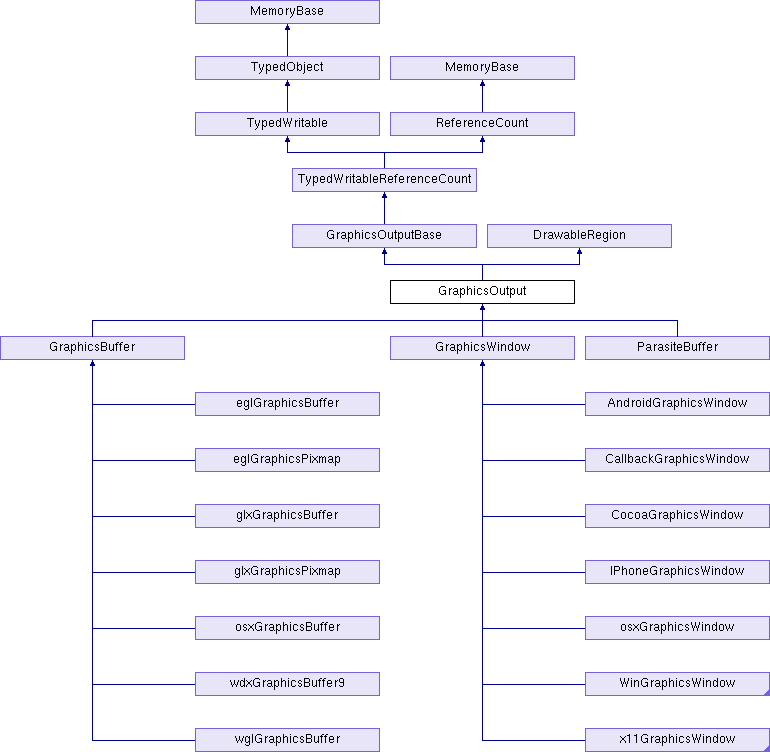
This is a base class for the various different classes that represent the result of a frame of rendering. More...
#include "graphicsOutput.h"
Public Types | |
| enum | FrameMode { FM_render, FM_parasite, FM_refresh } |
| enum | RenderTextureMode { RTM_none, RTM_bind_or_copy, RTM_copy_texture, RTM_copy_ram, RTM_triggered_copy_texture, RTM_triggered_copy_ram, RTM_bind_layered } |
 Public Types inherited from DrawableRegion Public Types inherited from DrawableRegion | |
| enum | RenderTexturePlane { RTP_stencil =0, RTP_depth_stencil =1, RTP_color, RTP_aux_rgba_0, RTP_aux_rgba_1, RTP_aux_rgba_2, RTP_aux_rgba_3, RTP_aux_hrgba_0, RTP_aux_hrgba_1, RTP_aux_hrgba_2, RTP_aux_hrgba_3, RTP_aux_float_0, RTP_aux_float_1, RTP_aux_float_2, RTP_aux_float_3, RTP_depth, RTP_COUNT } |
Public Member Functions | |
| void | add_render_texture (Texture *tex, RenderTextureMode mode, RenderTexturePlane bitplane=RTP_COUNT) |
| Creates a new Texture object, suitable for rendering the contents of this buffer into, and appends it to the list of render textures. More... | |
| virtual void | begin_flip () |
| This function will be called within the draw thread after end_frame() has been called on all windows, to initiate the exchange of the front and back buffers. More... | |
| virtual bool | begin_frame (FrameMode mode, Thread *current_thread) |
| This function will be called within the draw thread before beginning rendering for a given frame. More... | |
| void | change_scenes (DisplayRegionPipelineReader *new_dr) |
| Called by the GraphicsEngine when the window is about to change to another DisplayRegion. More... | |
| virtual void | clear (Thread *current_thread) |
| Clears the entire framebuffer before rendering, according to the settings of get_color_clear_active() and get_depth_clear_active() (inherited from DrawableRegion). More... | |
| void | clear_child_sort () |
| Resets the sort value of future offscreen buffers created by make_texture_sort() to the default value. More... | |
| void | clear_delete_flag () |
| Resets the delete flag, so the GraphicsOutput will not be automatically deleted before the beginning of the next frame. More... | |
| virtual void | clear_pipe () |
| Sets the window's _pipe pointer to NULL; this is generally called only as a precursor to deleting the window. More... | |
| void | clear_render_textures () |
| If the GraphicsOutput is currently rendering to a texture, then all textures are dissociated from the GraphicsOuput. More... | |
| int | count_textures () const |
| If the GraphicsOutput is set to render into a texture, returns the number of textures that are being rendered into. More... | |
| virtual void | end_flip () |
| This function will be called within the draw thread after begin_flip() has been called on all windows, to finish the exchange of the front and back buffers. More... | |
| virtual void | end_frame (FrameMode mode, Thread *current_thread) |
| This function will be called within the draw thread after rendering is completed for a given frame. More... | |
| virtual bool | flip_ready () const |
| Returns true if a frame has been rendered and needs to be flipped, false otherwise. More... | |
| virtual TypeHandle | force_init_type () |
| int | get_child_sort () const |
| PStatCollector & | get_clear_window_pcollector () |
| Returns a PStatCollector for timing the clear operation for just this GraphicsOutput. More... | |
| PStatCollector & | get_cull_window_pcollector () |
| Returns a PStatCollector for timing the cull operation for just this GraphicsOutput. More... | |
| bool | get_delete_flag () const |
| Returns the current setting of the delete flag. More... | |
| PStatCollector & | get_draw_window_pcollector () |
| Returns a PStatCollector for timing the draw operation for just this GraphicsOutput. More... | |
| GraphicsEngine * | get_engine () const |
| const FrameBufferProperties & | get_fb_properties () const |
| Returns the framebuffer properties of the window. More... | |
| LVecBase2i | get_fb_size () const |
| int | get_fb_x_size () const |
| Returns the internal width of the window or buffer. More... | |
| int | get_fb_y_size () const |
| Returns the internal height of the window or buffer. More... | |
| GraphicsStateGuardian * | get_gsg () const |
| virtual GraphicsOutput * | get_host () |
| This is normally called only from within make_texture_buffer(). More... | |
| bool | get_inverted () const |
| unsigned int | get_left_eye_color_mask () const |
| Returns the color mask in effect when rendering a left-eye view in red_blue stereo mode. More... | |
| const std::string & | get_name () const |
| int | get_num_active_display_regions () const |
| int | get_num_display_regions () const |
| bool | get_one_shot () const |
| DisplayRegion * | get_overlay_display_region () const |
| Returns the special "overlay" DisplayRegion that is created for each window or buffer. More... | |
| GraphicsPipe * | get_pipe () const |
| bool | get_red_blue_stereo () const |
| Returns whether red-blue stereo mode is in effect for this particular window. More... | |
| unsigned int | get_right_eye_color_mask () const |
| Returns the color mask in effect when rendering a right-eye view in red_blue stereo mode. More... | |
| RenderTextureMode | get_rtm_mode (int i=0) const |
| Returns the RenderTextureMode associated with the nth render-texture. More... | |
| const LVecBase4 & | get_sbs_left_dimensions () const |
| Returns the effective sub-region of the window for displaying the left channel, if side-by-side stereo mode is in effect for the window. More... | |
| LVecBase2i | get_sbs_left_size () const |
| int | get_sbs_left_x_size () const |
| If side-by-side stereo is enabled, this returns the pixel width of the left eye, based on scaling get_x_size() by get_sbs_left_dimensions(). More... | |
| int | get_sbs_left_y_size () const |
| If side-by-side stereo is enabled, this returns the pixel height of the left eye, based on scaling get_y_size() by get_sbs_left_dimensions(). More... | |
| const LVecBase4 & | get_sbs_right_dimensions () const |
| Returns the effective sub-region of the window for displaying the right channel, if side-by-side stereo mode is in effect for the window. More... | |
| LVecBase2i | get_sbs_right_size () const |
| int | get_sbs_right_x_size () const |
| If side-by-side stereo is enabled, this returns the pixel width of the right eye, based on scaling get_x_size() by get_sbs_right_dimensions(). More... | |
| int | get_sbs_right_y_size () const |
| If side-by-side stereo is enabled, this returns the pixel height of the right eye, based on scaling get_y_size() by get_sbs_right_dimensions(). More... | |
| bool | get_screenshot (PNMImage &image) |
| Captures the most-recently rendered image from the framebuffer into the indicated PNMImage. More... | |
| bool | get_side_by_side_stereo () const |
| Returns whether side-by-side stereo mode is in effect for this particular window. More... | |
| const LVecBase2i & | get_size () const |
| int | get_sort () const |
| virtual bool | get_supports_render_texture () const |
| bool | get_swap_eyes () const |
| virtual Texture * | get_texture (int i=0) const |
| Returns the nth texture into which the GraphicsOutput renders. More... | |
| NodePath | get_texture_card () |
| Returns a PandaNode containing a square polygon. More... | |
| RenderTexturePlane | get_texture_plane (int i=0) const |
| Returns the RenderTexturePlane associated with the nth render-texture. More... | |
| virtual TypeHandle | get_type () const |
| int | get_x_size () const |
| Returns the visible width of the window or buffer, if it is known. More... | |
| int | get_y_size () const |
| Returns the visible height of the window or buffer, if it is known. More... | |
| bool | has_size () const |
| Returns true if the size of the window/frame buffer is known, false otherwise. More... | |
| bool | has_texture () const |
| Returns true if the GraphicsOutput is rendering into any textures at all. More... | |
| virtual bool | is_active () const |
| bool | is_nonzero_size () const |
| Returns true if the output has a nonzero size in both X and Y, or false if it is zero (and therefore invalid). More... | |
| bool | is_stereo () const |
| Returns Returns true if this window can render stereo DisplayRegions, either through red-blue stereo (see set_red_blue_stereo()) or through true hardware stereo rendering. More... | |
| bool | is_valid () const |
| Returns true if the output is fully created and ready for rendering, false otherwise. More... | |
| GraphicsOutput * | make_cube_map (const std::string &name, int size, NodePath &camera_rig, DrawMask camera_mask=PandaNode::get_all_camera_mask(), bool to_ram=false, FrameBufferProperties *fbp=nullptr) |
| This is similar to make_texture_buffer() in that it allocates a separate buffer suitable for rendering to a texture that can be assigned to geometry in this window, but in this case, the buffer is set up to render the six faces of a cube map. More... | |
| DisplayRegion * | make_display_region () |
| Creates a new DisplayRegion that covers the entire window. More... | |
| DisplayRegion * | make_display_region (PN_stdfloat l, PN_stdfloat r, PN_stdfloat b, PN_stdfloat t) |
| Creates a new DisplayRegion that covers the indicated sub-rectangle within the window. More... | |
| DisplayRegion * | make_display_region (const LVecBase4 &dimensions) |
| Creates a new DisplayRegion that covers the indicated sub-rectangle within the window. More... | |
| DisplayRegion * | make_mono_display_region () |
| Creates a new DisplayRegion that covers the entire window. More... | |
| DisplayRegion * | make_mono_display_region (PN_stdfloat l, PN_stdfloat r, PN_stdfloat b, PN_stdfloat t) |
| Creates a new DisplayRegion that covers the entire window. More... | |
| DisplayRegion * | make_mono_display_region (const LVecBase4 &dimensions) |
| Creates a new DisplayRegion that covers the indicated sub-rectangle within the window. More... | |
| StereoDisplayRegion * | make_stereo_display_region () |
| Creates a new DisplayRegion that covers the entire window. More... | |
| StereoDisplayRegion * | make_stereo_display_region (PN_stdfloat l, PN_stdfloat r, PN_stdfloat b, PN_stdfloat t) |
| Creates a new DisplayRegion that covers the entire window. More... | |
| StereoDisplayRegion * | make_stereo_display_region (const LVecBase4 &dimensions) |
| Creates a new DisplayRegion that covers the indicated sub-rectangle within the window. More... | |
| GraphicsOutput * | make_texture_buffer (const std::string &name, int x_size, int y_size, Texture *tex=nullptr, bool to_ram=false, FrameBufferProperties *fbp=nullptr) |
| bool | operator< (const GraphicsOutput &other) const |
| The sorting operator is used to order the GraphicsOutput object in order by their sort number, so that they will render in the correct order in the GraphicsEngine. More... | |
| virtual void | process_events () |
| Do whatever processing in the window thread is appropriate for this output object each frame. More... | |
| PT (DisplayRegion) get_display_region(int n) const | |
| PT (DisplayRegion) get_active_display_region(int n) const | |
| PT (Texture) get_screenshot() | |
| virtual void | ready_flip () |
| This function will be called within the draw thread after end_frame() has been called on all windows, to initiate the exchange of the front and back buffers. More... | |
| void | remove_all_display_regions () |
| Removes all display regions from the window, except the default one that is created with the window. More... | |
| bool | remove_display_region (DisplayRegion *display_region) |
| Removes the indicated DisplayRegion from the window, and destructs it if there are no other references. More... | |
| virtual void | request_close () |
| This is called by the GraphicsEngine to request that the window (or whatever) close itself or, in general, make itself invalid, at the next call to process_events(). More... | |
| virtual void | request_open () |
| This is called by the GraphicsEngine to request that the window (or whatever) open itself or, in general, make itself valid, at the next call to process_events(). More... | |
| virtual void | reset_window (bool swapchain) |
| Resets the window framebuffer from its derived children. More... | |
| bool | save_screenshot (const Filename &filename, const std::string &image_comment="") |
| Saves a screenshot of the region to the indicated filename. More... | |
| Filename | save_screenshot_default (const std::string &prefix="screenshot") |
| Saves a screenshot of the region to a default filename, and returns the filename, or empty string if the screenshot failed. More... | |
| virtual void | select_target_tex_page (int page) |
| Called internally when the window is in render-to-a-texture mode and we are in the process of rendering the six faces of a cube map, or any other multi-page texture. More... | |
| void | set_active (bool active) |
| void | set_child_sort (int child_sort) |
| virtual void | set_close_now () |
| This is called by the GraphicsEngine to insist that the output be closed immediately. More... | |
| void | set_inverted (bool inverted) |
| void | set_one_shot (bool one_shot) |
| void | set_overlay_display_region (DisplayRegion *display_region) |
| Replaces the special "overlay" DisplayRegion that is created for each window or buffer. More... | |
| void | set_red_blue_stereo (bool red_blue_stereo, unsigned int left_eye_color_mask, unsigned int right_eye_color_mask) |
| Enables red-blue stereo mode on this particular window. More... | |
| void | set_side_by_side_stereo (bool side_by_side_stereo) |
| Enables side-by-side stereo mode on this particular window. More... | |
| void | set_side_by_side_stereo (bool side_by_side_stereo, const LVecBase4 &sbs_left_dimensions, const LVecBase4 &sbs_right_dimensions) |
| Enables side-by-side stereo mode on this particular window. More... | |
| void | set_size_and_recalc (int x, int y) |
| Changes the x_size and y_size, then recalculates structures that depend on size. More... | |
| virtual void | set_sort (int sort) |
| void | set_swap_eyes (bool swap_eyes) |
| void | setup_render_texture (Texture *tex, bool allow_bind, bool to_ram) |
| This is a deprecated interface that made sense back when GraphicsOutputs could only render into one texture at a time. More... | |
| virtual bool | share_depth_buffer (GraphicsOutput *graphics_output) |
| Will attempt to use the depth buffer of the input graphics_output. More... | |
| AsyncFuture * | trigger_copy () |
| When the GraphicsOutput is in triggered copy mode, this function triggers the copy (at the end of the next frame). More... | |
| virtual void | unshare_depth_buffer () |
| Discontinue sharing the depth buffer. More... | |
| Public Member Functions inherited from TypedWritableReferenceCount | |
| TypedWritableReferenceCount (const TypedWritableReferenceCount ©) | |
| virtual ReferenceCount * | as_reference_count () |
| Returns the pointer cast to a ReferenceCount pointer, if it is in fact of that type. More... | |
| void | operator= (const TypedWritableReferenceCount ©) |
| Public Member Functions inherited from TypedWritable | |
| TypedWritable (const TypedWritable ©) | |
| virtual int | complete_pointers (TypedWritable **p_list, BamReader *manager) |
| Receives an array of pointers, one for each time manager->read_pointer() was called in fillin(). More... | |
| vector_uchar | encode_to_bam_stream () const |
| Converts the TypedWritable object into a single stream of data using a BamWriter, and returns that data as a bytes object. More... | |
| bool | encode_to_bam_stream (vector_uchar &data, BamWriter *writer=nullptr) const |
| Converts the TypedWritable object into a single stream of data using a BamWriter, and stores that data in the indicated string. More... | |
| virtual void | fillin (DatagramIterator &scan, BamReader *manager) |
| This internal function is intended to be called by each class's make_from_bam() method to read in all of the relevant data from the BamFile for the new object. More... | |
| virtual void | finalize (BamReader *manager) |
| Called by the BamReader to perform any final actions needed for setting up the object after all objects have been read and all pointers have been completed. More... | |
| UpdateSeq | get_bam_modified () const |
| Returns the current bam_modified counter. More... | |
| void | mark_bam_modified () |
| Increments the bam_modified counter, so that this object will be invalidated and retransmitted on any open bam streams. More... | |
| void | operator= (const TypedWritable ©) |
| virtual bool | require_fully_complete () const |
| Some objects require all of their nested pointers to have been completed before the objects themselves can be completed. More... | |
| virtual void | update_bam_nested (BamWriter *manager) |
| Called by the BamWriter when this object has not itself been modified recently, but it should check its nested objects for updates. More... | |
| virtual void | write_datagram (BamWriter *manager, Datagram &dg) |
| Writes the contents of this object to the datagram for shipping out to a Bam file. More... | |
| Public Member Functions inherited from TypedObject | |
| TypedObject (const TypedObject ©)=default | |
| TypedObject * | as_typed_object () |
| Returns the object, upcast (if necessary) to a TypedObject pointer. More... | |
| const TypedObject * | as_typed_object () const |
| Returns the object, upcast (if necessary) to a TypedObject pointer. More... | |
| int | get_best_parent_from_Set (const std::set< int > &) const |
| int | get_type_index () const |
| Returns the internal index number associated with this object's TypeHandle, a unique number for each different type. More... | |
| bool | is_exact_type (TypeHandle handle) const |
| Returns true if the current object is the indicated type exactly. More... | |
| bool | is_of_type (TypeHandle handle) const |
| Returns true if the current object is or derives from the indicated type. More... | |
| TypedObject & | operator= (const TypedObject ©)=default |
| Public Member Functions inherited from ReferenceCount | |
| int | get_ref_count () const |
| WeakReferenceList * | get_weak_list () const |
| Returns the WeakReferenceList associated with this ReferenceCount object. More... | |
| bool | has_weak_list () const |
| Returns true if this particular ReferenceCount object has a WeakReferenceList created, false otherwise. More... | |
| void | local_object () |
| This function should be called, once, immediately after creating a new instance of some ReferenceCount-derived object on the stack. More... | |
| void | ref () const |
| Explicitly increments the reference count. More... | |
| bool | ref_if_nonzero () const |
| Atomically increases the reference count of this object if it is not zero. More... | |
| bool | test_ref_count_integrity () const |
| Does some easy checks to make sure that the reference count isn't completely bogus. More... | |
| bool | test_ref_count_nonzero () const |
| Does some easy checks to make sure that the reference count isn't zero, or completely bogus. More... | |
| virtual bool | unref () const |
| Explicitly decrements the reference count. More... | |
| WeakReferenceList * | weak_ref () |
| Adds the indicated PointerToVoid as a weak reference to this object. More... | |
| void | weak_unref () |
| Removes the indicated PointerToVoid as a weak reference to this object. More... | |
| Public Member Functions inherited from DrawableRegion | |
| DrawableRegion (const DrawableRegion ©) | |
| void | copy_clear_settings (const DrawableRegion ©) |
| Copies only the clear settings from the other drawable region. More... | |
| virtual void | disable_clears () |
| Disables both the color and depth clear. More... | |
| virtual bool | get_clear_active (int n) const |
| Gets the clear-active flag for any bitplane. More... | |
| const LColor & | get_clear_color () const |
| bool | get_clear_color_active () const |
| Returns the current setting of the flag that indicates whether the color buffer should be cleared every frame. More... | |
| PN_stdfloat | get_clear_depth () const |
| bool | get_clear_depth_active () const |
| Returns the current setting of the flag that indicates whether the depth buffer should be cleared every frame. More... | |
| unsigned int | get_clear_stencil () const |
| bool | get_clear_stencil_active () const |
| Returns the current setting of the flag that indicates whether the color buffer should be cleared every frame. More... | |
| virtual const LColor & | get_clear_value (int n) const |
| Returns the clear value for any bitplane. More... | |
| int | get_draw_buffer_type () const |
| Returns the RenderBuffer into which the GSG should issue draw commands. More... | |
| PN_stdfloat | get_pixel_factor () const |
| PN_stdfloat | get_pixel_zoom () const |
| int | get_screenshot_buffer_type () const |
| Returns the RenderBuffer that should be used for capturing screenshots from this particular DrawableRegion. More... | |
| virtual bool | is_any_clear_active () const |
| Returns true if any of the clear types (so far there are just color or depth) have been set active, or false if none of them are active and there is no need to clear. More... | |
| void | operator= (const DrawableRegion ©) |
| virtual void | set_clear_active (int n, bool clear_aux_active) |
| Sets the clear-active flag for any bitplane. More... | |
| void | set_clear_color (const LColor &color) |
| void | set_clear_color_active (bool clear_color_active) |
| Toggles the flag that indicates whether the color buffer should be cleared every frame. More... | |
| void | set_clear_depth (PN_stdfloat depth) |
| void | set_clear_depth_active (bool clear_depth_active) |
| Toggles the flag that indicates whether the depth buffer should be cleared every frame. More... | |
| void | set_clear_stencil (unsigned int stencil) |
| void | set_clear_stencil_active (bool clear_stencil_active) |
| Toggles the flag that indicates whether the stencil buffer should be cleared every frame. More... | |
| virtual void | set_clear_value (int n, const LColor &clear_value) |
| Sets the clear value for any bitplane. More... | |
| virtual void | set_pixel_zoom (PN_stdfloat pixel_zoom) |
| virtual bool | supports_pixel_zoom () const |
| Returns true if a call to set_pixel_zoom() will be respected, false if it will be ignored. More... | |
Static Public Member Functions | |
| static TypeHandle | get_class_type () |
| static void | init_type () |
| static Filename | make_screenshot_filename (const std::string &prefix="screenshot") |
| Saves a screenshot of the region to a default filename, and returns the filename, or empty string if the screenshot failed. More... | |
| Static Public Member Functions inherited from GraphicsOutputBase | |
| static TypeHandle | get_class_type () |
| static void | init_type () |
| Static Public Member Functions inherited from TypedWritableReferenceCount | |
| static TypeHandle | get_class_type () |
| static void | init_type () |
| static | PT (TypedWritableReferenceCount) decode_from_bam_stream(vector_uchar data |
| Static Public Member Functions inherited from TypedWritable | |
| static bool | decode_raw_from_bam_stream (TypedWritable *&ptr, ReferenceCount *&ref_ptr, vector_uchar data, BamReader *reader=nullptr) |
| Reads the bytes created by a previous call to encode_to_bam_stream(), and extracts the single object on those bytes. More... | |
| static TypeHandle | get_class_type () |
| static void | init_type () |
| Static Public Member Functions inherited from TypedObject | |
| static TypeHandle | get_class_type () |
| static void | init_type () |
| This function is declared non-inline to work around a compiler bug in g++ 2.96. More... | |
| Static Public Member Functions inherited from ReferenceCount | |
| static TypeHandle | get_class_type () |
| static void | init_type () |
| Static Public Member Functions inherited from DrawableRegion | |
| static int | get_renderbuffer_type (int plane) |
| Returns the RenderBuffer::Type that corresponds to a RenderTexturePlane. More... | |
Public Attributes | |
| get_active_display_region | |
| get_child_sort | |
| Returns the sort value of future offscreen buffers created by make_texture_sort(). More... | |
| get_display_region | |
| get_engine | |
| Returns the graphics engine that created this output. More... | |
| get_fb_size | |
| Returns the internal size of the window or buffer. More... | |
| get_gsg | |
| Returns the GSG that is associated with this window. More... | |
| get_inverted | |
| Returns the current setting of the inverted flag. More... | |
| get_name | |
| Returns the name that was passed to the GraphicsOutput constructor. More... | |
| get_num_active_display_regions | |
| get_num_display_regions | |
| Returns the number of DisplayRegions that have been created within the window, active or otherwise. More... | |
| get_one_shot | |
| Returns the current setting of the one-shot flag. More... | |
| get_pipe | |
| Returns the GraphicsPipe that this window is associated with. More... | |
| get_sbs_left_size | |
| If side-by-side stereo is enabled, this returns the pixel size of the left eye, based on scaling get_size() by get_sbs_left_dimensions(). More... | |
| get_sbs_right_size | |
| If side-by-side stereo is enabled, this returns the pixel size of the right eye, based on scaling get_size() by get_sbs_right_dimensions(). More... | |
| get_size | |
| Returns the visible size of the window or buffer, if it is known. More... | |
| get_sort | |
| Returns the sorting order of this particular GraphicsOutput. More... | |
| get_supports_render_texture | |
| Returns true if this particular GraphicsOutput can render directly into a texture, or false if it must always copy-to-texture at the end of each frame to achieve this effect. More... | |
| get_swap_eyes | |
| Returns the current setting of the "swap eyes" flag. More... | |
| is_active | |
| Returns true if the window is ready to be rendered into, false otherwise. More... | |
| set_active | |
| Sets the active flag associated with the GraphicsOutput. More... | |
| set_child_sort | |
| Specifies the sort value of future offscreen buffers created by make_texture_sort(). More... | |
| set_inverted | |
| Changes the current setting of the inverted flag. More... | |
| set_one_shot | |
| Changes the current setting of the one-shot flag. More... | |
| set_sort | |
| Adjusts the sorting order of this particular GraphicsOutput, relative to other GraphicsOutputs. More... | |
| set_swap_eyes | |
| Changes the "swap eyes" flag. More... | |
| Public Attributes inherited from TypedWritableReferenceCount | |
| static BamReader * | reader = nullptr) |
| Public Attributes inherited from TypedObject | |
| get_type | |
| Public Attributes inherited from ReferenceCount | |
| get_ref_count | |
| Returns the current reference count. More... | |
| Public Attributes inherited from DrawableRegion | |
| get_clear_color | |
| Returns the current clear color value. More... | |
| get_clear_depth | |
| Returns the current clear depth value. More... | |
| get_clear_stencil | |
| Returns the current clear stencil value. More... | |
| get_pixel_factor | |
| Returns the amount by which the height and width of the region will be scaled internally, based on the zoom factor set by set_pixel_zoom(). More... | |
| get_pixel_zoom | |
| Returns the value set by set_pixel_zoom(), regardless of whether it is being respected or not. More... | |
| set_clear_color | |
| Sets the clear color to the indicated value. More... | |
| set_clear_depth | |
| Sets the clear depth to the indicated value. More... | |
| set_clear_stencil | |
| Sets the clear stencil to the indicated value. More... | |
| set_pixel_zoom | |
| Sets the amount by which the pixels of the region are scaled internally when filling the image interally. More... | |
Friends | |
| class | DisplayRegion |
| class | GraphicsEngine |
| class | GraphicsPipe |
Additional Inherited Members | |
| Static Public Attributes inherited from TypedWritable | |
| static TypedWritable *const | Null = nullptr |
Detailed Description
This is a base class for the various different classes that represent the result of a frame of rendering.
The most common kind of GraphicsOutput is a GraphicsWindow, which is a real-time window on the desktop, but another example is GraphicsBuffer, which is an offscreen buffer.
The actual rendering, and anything associated with the graphics context itself, is managed by the associated GraphicsStateGuardian (which might output to multiple GraphicsOutput objects).
GraphicsOutputs are not actually writable to bam files, of course, but they may be passed as event parameters, so they inherit from TypedWritableReferenceCount instead of TypedReferenceCount for that convenience.
Definition at line 63 of file graphicsOutput.h.
Member Function Documentation
◆ add_render_texture()
| void GraphicsOutput::add_render_texture | ( | Texture * | tex, |
| RenderTextureMode | mode, | ||
| RenderTexturePlane | plane = RTP_COUNT |
||
| ) |
Creates a new Texture object, suitable for rendering the contents of this buffer into, and appends it to the list of render textures.
If tex is not NULL, it is the texture that will be set up for rendering into; otherwise, a new Texture object will be created, in which case you may call get_texture() to retrieve the new texture pointer.
You can specify a bitplane to attach the texture to. the legal choices are:
- RTP_depth
- RTP_depth_stencil
- RTP_color
- RTP_aux_rgba_0
- RTP_aux_rgba_1
- RTP_aux_rgba_2
- RTP_aux_rgba_3
If you do not specify a bitplane to attach the texture to, this routine will use a default based on the texture's format:
- F_depth_component attaches to RTP_depth
- F_depth_stencil attaches to RTP_depth_stencil
- all other formats attach to RTP_color.
The texture's format will be changed to match the format of the bitplane to which it is attached. For example, if you pass in an F_rgba texture and order that it be attached to RTP_depth_stencil, it will turn into an F_depth_stencil texture.
Also see make_texture_buffer(), which is a higher-level interface for preparing render-to-a-texture mode.
Definition at line 237 of file graphicsOutput.cxx.
References Texture::clear_ram_image(), Texture::get_format, get_name, Texture::get_num_views, get_x_size(), get_y_size(), Texture::get_z_size, Texture::set_component_type, Texture::set_compression, Texture::set_format, Texture::set_match_framebuffer_format, Texture::set_num_views, Texture::set_size_padded(), Texture::set_wrap_u, Texture::set_wrap_v, FrameBufferProperties::setup_color_texture(), and FrameBufferProperties::setup_depth_texture().
Referenced by setup_render_texture().
◆ begin_flip()
|
virtual |
This function will be called within the draw thread after end_frame() has been called on all windows, to initiate the exchange of the front and back buffers.
This should instruct the window to prepare for the flip at the next video sync, but it should not wait.
We have the two separate functions, begin_flip() and end_flip(), to make it easier to flip all of the windows at the same time.
Reimplemented in CallbackGraphicsWindow, WinGraphicsWindow, ParasiteBuffer, osxGraphicsWindow, IPhoneGraphicsWindow, and wglGraphicsWindow.
Definition at line 1273 of file graphicsOutput.cxx.
◆ begin_frame()
|
virtual |
This function will be called within the draw thread before beginning rendering for a given frame.
It should do whatever setup is required, and return true if the frame should be rendered, or false if it should be skipped.
Reimplemented in CallbackGraphicsWindow, ParasiteBuffer, wglGraphicsBuffer, AndroidGraphicsWindow, CocoaGraphicsWindow, osxGraphicsWindow, wdxGraphicsBuffer9, x11GraphicsWindow, glxGraphicsPixmap, IPhoneGraphicsWindow, wdxGraphicsWindow9, eglGraphicsPixmap, glxGraphicsWindow, osxGraphicsBuffer, eglGraphicsBuffer, eglGraphicsWindow, glxGraphicsBuffer, and wglGraphicsWindow.
Definition at line 1161 of file graphicsOutput.cxx.
◆ change_scenes()
| void GraphicsOutput::change_scenes | ( | DisplayRegionPipelineReader * | new_dr | ) |
Called by the GraphicsEngine when the window is about to change to another DisplayRegion.
This exists mainly to provide a callback for switching the cube map face, if we are rendering to the different faces of a cube map.
Definition at line 1180 of file graphicsOutput.cxx.
References DisplayRegionPipelineReader::get_target_tex_page(), and select_target_tex_page().
◆ clear()
|
virtual |
Clears the entire framebuffer before rendering, according to the settings of get_color_clear_active() and get_depth_clear_active() (inherited from DrawableRegion).
This function is called only within the draw thread.
Reimplemented in x11GraphicsWindow.
Definition at line 1138 of file graphicsOutput.cxx.
References get_name, and DrawableRegion::is_any_clear_active().
Referenced by x11GraphicsWindow::clear().
◆ clear_child_sort()
|
inline |
Resets the sort value of future offscreen buffers created by make_texture_sort() to the default value.
See set_child_sort().
Definition at line 472 of file graphicsOutput.I.
◆ clear_delete_flag()
|
inline |
Resets the delete flag, so the GraphicsOutput will not be automatically deleted before the beginning of the next frame.
Definition at line 432 of file graphicsOutput.I.
◆ clear_pipe()
|
virtual |
Sets the window's _pipe pointer to NULL; this is generally called only as a precursor to deleting the window.
Reimplemented in IPhoneGraphicsWindow.
Definition at line 1099 of file graphicsOutput.cxx.
◆ clear_render_textures()
| void GraphicsOutput::clear_render_textures | ( | ) |
If the GraphicsOutput is currently rendering to a texture, then all textures are dissociated from the GraphicsOuput.
Definition at line 195 of file graphicsOutput.cxx.
Referenced by setup_render_texture().
◆ count_textures()
|
inline |
If the GraphicsOutput is set to render into a texture, returns the number of textures that are being rendered into.
Normally, the textures would be associated with different buffers - a color texture, a depth texture, and a stencil texture.
Definition at line 63 of file graphicsOutput.I.
◆ end_flip()
|
virtual |
This function will be called within the draw thread after begin_flip() has been called on all windows, to finish the exchange of the front and back buffers.
This should cause the window to wait for the flip, if necessary.
Reimplemented in CallbackGraphicsWindow, ParasiteBuffer, osxGraphicsWindow, AndroidGraphicsWindow, CocoaGraphicsWindow, IPhoneGraphicsWindow, wdxGraphicsWindow9, glxGraphicsWindow, wglGraphicsWindow, and eglGraphicsWindow.
Definition at line 1297 of file graphicsOutput.cxx.
Referenced by eglGraphicsWindow::end_flip(), glxGraphicsWindow::end_flip(), wdxGraphicsWindow9::end_flip(), and AndroidGraphicsWindow::end_flip().
◆ end_frame()
|
virtual |
This function will be called within the draw thread after rendering is completed for a given frame.
It should do whatever finalization is required.
Reimplemented in CallbackGraphicsWindow, ParasiteBuffer, wglGraphicsBuffer, AndroidGraphicsWindow, CocoaGraphicsWindow, osxGraphicsWindow, wdxGraphicsBuffer9, x11GraphicsWindow, glxGraphicsPixmap, IPhoneGraphicsWindow, wdxGraphicsWindow9, eglGraphicsPixmap, glxGraphicsWindow, osxGraphicsBuffer, eglGraphicsBuffer, eglGraphicsWindow, glxGraphicsBuffer, and wglGraphicsWindow.
Definition at line 1171 of file graphicsOutput.cxx.
◆ flip_ready()
|
virtual |
Returns true if a frame has been rendered and needs to be flipped, false otherwise.
Reimplemented in ParasiteBuffer.
Definition at line 1043 of file graphicsOutput.cxx.
◆ get_clear_window_pcollector()
|
inline |
Returns a PStatCollector for timing the clear operation for just this GraphicsOutput.
Definition at line 711 of file graphicsOutput.I.
◆ get_cull_window_pcollector()
|
inline |
Returns a PStatCollector for timing the cull operation for just this GraphicsOutput.
Definition at line 693 of file graphicsOutput.I.
◆ get_delete_flag()
| bool GraphicsOutput::get_delete_flag | ( | ) | const |
Returns the current setting of the delete flag.
When this is true, the GraphicsOutput will automatically be removed before the beginning of the next frame by the GraphicsEngine.
Definition at line 566 of file graphicsOutput.cxx.
◆ get_draw_window_pcollector()
|
inline |
Returns a PStatCollector for timing the draw operation for just this GraphicsOutput.
Definition at line 702 of file graphicsOutput.I.
◆ get_fb_properties()
|
inline |
Returns the framebuffer properties of the window.
Definition at line 413 of file graphicsOutput.I.
Referenced by wdxGraphicsWindow9::begin_frame(), x11GraphicsWindow::begin_frame(), and wdxGraphicsBuffer9::begin_frame().
◆ get_fb_x_size()
|
inline |
Returns the internal width of the window or buffer.
This is almost always the same as get_x_size(), except when a pixel_zoom is in effect–see set_pixel_zoom().
Definition at line 180 of file graphicsOutput.I.
References DrawableRegion::get_pixel_factor.
Referenced by set_size_and_recalc().
◆ get_fb_y_size()
|
inline |
Returns the internal height of the window or buffer.
This is almost always the same as get_y_size(), except when a pixel_zoom is in effect–see set_pixel_zoom().
Definition at line 190 of file graphicsOutput.I.
References DrawableRegion::get_pixel_factor.
Referenced by set_size_and_recalc().
◆ get_host()
|
virtual |
This is normally called only from within make_texture_buffer().
When called on a ParasiteBuffer, it returns the host of that buffer; but when called on some other buffer, it returns the buffer itself.
Reimplemented in ParasiteBuffer.
Definition at line 1053 of file graphicsOutput.cxx.
Referenced by GraphicsEngine::make_output().
◆ get_left_eye_color_mask()
|
inline |
Returns the color mask in effect when rendering a left-eye view in red_blue stereo mode.
This is one or more bits defined in ColorWriteAttrib::Channels. See set_red_blue_stereo().
Definition at line 366 of file graphicsOutput.I.
Referenced by GraphicsStateGuardian::prepare_display_region().
◆ get_overlay_display_region()
|
inline |
Returns the special "overlay" DisplayRegion that is created for each window or buffer.
This DisplayRegion covers the entire window, but cannot be used for rendering. It is a placeholder only, to indicate the dimensions of the window, and is usually used internally for purposes such as clearing the window, or grabbing a screenshot of the window.
There are very few applications that require access to this DisplayRegion. Normally, you should create your own DisplayRegion that covers the window, if you want to render to the window.
Definition at line 591 of file graphicsOutput.I.
◆ get_red_blue_stereo()
|
inline |
Returns whether red-blue stereo mode is in effect for this particular window.
Definition at line 356 of file graphicsOutput.I.
◆ get_right_eye_color_mask()
|
inline |
Returns the color mask in effect when rendering a right-eye view in red_blue stereo mode.
This is one or more bits defined in ColorWriteAttrib::Channels. See set_red_blue_stereo().
Definition at line 376 of file graphicsOutput.I.
Referenced by GraphicsStateGuardian::prepare_display_region().
◆ get_rtm_mode()
|
inline |
Returns the RenderTextureMode associated with the nth render-texture.
Returns RTM_none if there is no such texture.
Definition at line 113 of file graphicsOutput.I.
◆ get_sbs_left_dimensions()
|
inline |
Returns the effective sub-region of the window for displaying the left channel, if side-by-side stereo mode is in effect for the window.
See set_side_by_side_stereo().
Definition at line 395 of file graphicsOutput.I.
◆ get_sbs_left_x_size()
|
inline |
If side-by-side stereo is enabled, this returns the pixel width of the left eye, based on scaling get_x_size() by get_sbs_left_dimensions().
If side- by-side stereo is not enabled, this returns the same as get_x_size().
Definition at line 213 of file graphicsOutput.I.
◆ get_sbs_left_y_size()
|
inline |
If side-by-side stereo is enabled, this returns the pixel height of the left eye, based on scaling get_y_size() by get_sbs_left_dimensions().
If side-by-side stereo is not enabled, this returns the same as get_y_size().
Definition at line 224 of file graphicsOutput.I.
◆ get_sbs_right_dimensions()
|
inline |
Returns the effective sub-region of the window for displaying the right channel, if side-by-side stereo mode is in effect for the window.
See set_side_by_side_stereo().
Definition at line 405 of file graphicsOutput.I.
◆ get_sbs_right_x_size()
|
inline |
If side-by-side stereo is enabled, this returns the pixel width of the right eye, based on scaling get_x_size() by get_sbs_right_dimensions().
If side-by-side stereo is not enabled, this returns the same as get_x_size().
Definition at line 248 of file graphicsOutput.I.
◆ get_sbs_right_y_size()
|
inline |
If side-by-side stereo is enabled, this returns the pixel height of the right eye, based on scaling get_y_size() by get_sbs_right_dimensions().
If side-by-side stereo is not enabled, this returns the same as get_y_size().
Definition at line 259 of file graphicsOutput.I.
◆ get_screenshot()
|
inline |
Captures the most-recently rendered image from the framebuffer into the indicated PNMImage.
Returns true on success, false on failure.
Definition at line 635 of file graphicsOutput.I.
◆ get_side_by_side_stereo()
|
inline |
Returns whether side-by-side stereo mode is in effect for this particular window.
See set_side_by_side_stereo().
Definition at line 385 of file graphicsOutput.I.
◆ get_texture()
|
inlinevirtual |
Returns the nth texture into which the GraphicsOutput renders.
Returns NULL if there is no such texture.
If the texture is non-NULL, it may be applied to geometry to be rendered for any other windows or outputs that share the same GSG as this GraphicsOutput. The effect is undefined for windows that share a different GSG; usually in these cases the texture will be invalid.
Implements GraphicsOutputBase.
Definition at line 87 of file graphicsOutput.I.
Referenced by MultitexReducer::flatten().
◆ get_texture_card()
| NodePath GraphicsOutput::get_texture_card | ( | ) |
Returns a PandaNode containing a square polygon.
The dimensions are (-1,0,-1) to (1,0,1). The texture coordinates are such that the texture of this GraphicsOutput is aligned properly to the polygon. The GraphicsOutput promises to surgically update the Geom inside the PandaNode if necessary to maintain this invariant.
Each invocation of this function returns a freshly- allocated PandaNode. You can therefore safely modify the RenderAttribs of the PandaNode. The PandaNode is initially textured with the texture of this GraphicOutput.
Definition at line 980 of file graphicsOutput.cxx.
References Texture::get_format, get_x_size(), get_y_size(), NodePath::node(), and NodePath::set_texture().
◆ get_texture_plane()
|
inline |
Returns the RenderTexturePlane associated with the nth render-texture.
Returns 0 if there is no such texture.
Definition at line 100 of file graphicsOutput.I.
◆ get_x_size()
|
inline |
Returns the visible width of the window or buffer, if it is known.
In certain cases (e.g. fullscreen windows), the size may not be known until after the object has been fully created. Check has_size() first.
Certain objects (like windows) may change size spontaneously; this method is not thread-safe. To get the size of a window in a thread-safe manner, query get_properties().
Definition at line 145 of file graphicsOutput.I.
Referenced by add_render_texture(), ParasiteBuffer::begin_frame(), and get_texture_card().
◆ get_y_size()
|
inline |
Returns the visible height of the window or buffer, if it is known.
In certain cases (e.g. fullscreen windows), the size may not be known until after the object has been fully created. Check has_size() first.
Certain objects (like windows) may change size spontaneously; this method is not thread-safe. To get the size of a window in a thread-safe manner, query get_properties().
Definition at line 159 of file graphicsOutput.I.
Referenced by add_render_texture(), ParasiteBuffer::begin_frame(), and get_texture_card().
◆ has_size()
|
inline |
Returns true if the size of the window/frame buffer is known, false otherwise.
In certain cases the size may not be known until after the object has been fully created. Also, certain objects (like windows) may change size spontaneously.
Definition at line 271 of file graphicsOutput.I.
◆ has_texture()
|
inline |
Returns true if the GraphicsOutput is rendering into any textures at all.
Definition at line 72 of file graphicsOutput.I.
◆ is_nonzero_size()
|
inline |
Returns true if the output has a nonzero size in both X and Y, or false if it is zero (and therefore invalid).
Definition at line 289 of file graphicsOutput.I.
◆ is_stereo()
|
inline |
Returns Returns true if this window can render stereo DisplayRegions, either through red-blue stereo (see set_red_blue_stereo()) or through true hardware stereo rendering.
Definition at line 423 of file graphicsOutput.I.
Referenced by make_display_region().
◆ is_valid()
|
inline |
Returns true if the output is fully created and ready for rendering, false otherwise.
Definition at line 280 of file graphicsOutput.I.
Referenced by PandaFramework::all_windows_closed(), and GraphicsEngine::make_output().
◆ make_cube_map()
| GraphicsOutput * GraphicsOutput::make_cube_map | ( | const std::string & | name, |
| int | size, | ||
| NodePath & | camera_rig, | ||
| DrawMask | camera_mask = PandaNode::get_all_camera_mask(), |
||
| bool | to_ram = false, |
||
| FrameBufferProperties * | fbp = nullptr |
||
| ) |
This is similar to make_texture_buffer() in that it allocates a separate buffer suitable for rendering to a texture that can be assigned to geometry in this window, but in this case, the buffer is set up to render the six faces of a cube map.
The buffer is automatically set up with six display regions and six cameras, each of which are assigned the indicated draw_mask and parented to the given camera_rig node (which you should then put in your scene to render the cube map from the appropriate point of view).
You may take the texture associated with the buffer and apply it to geometry, particularly with TexGenAttrib::M_world_cube_map also in effect, to apply a reflection of everything seen by the camera rig.
Definition at line 909 of file graphicsOutput.cxx.
References get_gsg, GraphicsStateGuardian::get_max_cube_map_dimension, GraphicsStateGuardian::get_supports_cube_map, NodePath::node(), DrawableRegion::set_clear_color_active(), DrawableRegion::set_clear_depth_active(), DrawableRegion::set_clear_stencil_active(), PandaNode::set_effect(), Texture::set_wrap_u, Texture::set_wrap_v, and Texture::setup_cube_map().
◆ make_display_region() [1/3]
|
inline |
Creates a new DisplayRegion that covers the entire window.
If is_stereo() is true for this window, and default-stereo-camera is configured true, this actually makes a StereoDisplayRegion. Call make_mono_display_region() or make_stereo_display_region() if you want to insist on one or the other.
Definition at line 513 of file graphicsOutput.I.
Referenced by MultitexReducer::flatten(), and make_display_region().
◆ make_display_region() [2/3]
|
inline |
Creates a new DisplayRegion that covers the indicated sub-rectangle within the window.
The range on all parameters is 0..1.
If is_stereo() is true for this window, and default-stereo-camera is configured true, this actually makes a StereoDisplayRegion. Call make_mono_display_region() or make_stereo_display_region() if you want to insist on one or the other.
Definition at line 527 of file graphicsOutput.I.
References make_display_region().
◆ make_display_region() [3/3]
| DisplayRegion * GraphicsOutput::make_display_region | ( | const LVecBase4 & | dimensions | ) |
Creates a new DisplayRegion that covers the indicated sub-rectangle within the window.
The range on all parameters is 0..1.
If is_stereo() is true for this window, and default-stereo-camera is configured true, this actually makes a StereoDisplayRegion. Call make_mono_display_region() or make_stereo_display_region() if you want to insist on one or the other.
Definition at line 602 of file graphicsOutput.cxx.
References is_stereo().
◆ make_mono_display_region() [1/3]
|
inline |
Creates a new DisplayRegion that covers the entire window.
This generally returns a mono DisplayRegion, even if is_stereo() is true. However, if side-by-side stereo is enabled, this will return a StereoDisplayRegion whose two eyes are both set to SC_mono. (This is necessary because in side-by-side stereo mode, it is necessary to draw even mono DisplayRegions twice).
Definition at line 541 of file graphicsOutput.I.
Referenced by make_mono_display_region().
◆ make_mono_display_region() [2/3]
|
inline |
Creates a new DisplayRegion that covers the entire window.
This generally returns a mono DisplayRegion, even if is_stereo() is true. However, if side-by-side stereo is enabled, this will return a StereoDisplayRegion whose two eyes are both set to SC_mono. (This is necessary because in side-by-side stereo mode, it is necessary to draw even mono DisplayRegions twice).
Definition at line 555 of file graphicsOutput.I.
References make_mono_display_region().
◆ make_mono_display_region() [3/3]
| DisplayRegion * GraphicsOutput::make_mono_display_region | ( | const LVecBase4 & | dimensions | ) |
Creates a new DisplayRegion that covers the indicated sub-rectangle within the window.
The range on all parameters is 0..1.
This generally returns a mono DisplayRegion, even if is_stereo() is true. However, if side-by-side stereo is enabled, this will return a StereoDisplayRegion whose two eyes are both set to SC_mono. (This is necessary because in side-by-side stereo mode, it is necessary to draw even mono DisplayRegions twice).
Definition at line 621 of file graphicsOutput.cxx.
References StereoDisplayRegion::get_left_eye, StereoDisplayRegion::get_right_eye, and make_stereo_display_region().
◆ make_screenshot_filename()
|
inlinestatic |
Saves a screenshot of the region to a default filename, and returns the filename, or empty string if the screenshot failed.
The default filename is generated from the supplied prefix and from the Config variable screenshot-filename, which contains the following strings:
%~p - the supplied prefix %~f - the frame count %~e - the value of screenshot-extension All other % strings in strftime().
Definition at line 605 of file graphicsOutput.I.
References DisplayRegion::make_screenshot_filename().
◆ make_stereo_display_region() [1/3]
|
inline |
Creates a new DisplayRegion that covers the entire window.
This always returns a stereo DisplayRegion, even if is_stereo() is false.
Definition at line 565 of file graphicsOutput.I.
Referenced by make_mono_display_region(), and make_stereo_display_region().
◆ make_stereo_display_region() [2/3]
|
inline |
Creates a new DisplayRegion that covers the entire window.
This always returns a stereo DisplayRegion, even if is_stereo() is false.
Definition at line 575 of file graphicsOutput.I.
References make_stereo_display_region().
◆ make_stereo_display_region() [3/3]
| StereoDisplayRegion * GraphicsOutput::make_stereo_display_region | ( | const LVecBase4 & | dimensions | ) |
Creates a new DisplayRegion that covers the indicated sub-rectangle within the window.
The range on all parameters is 0..1.
This always returns a stereo DisplayRegion, even if is_stereo() is false.
Definition at line 639 of file graphicsOutput.cxx.
References DrawableRegion::get_clear_depth_active(), and DrawableRegion::get_clear_stencil_active().
◆ operator<()
|
inline |
The sorting operator is used to order the GraphicsOutput object in order by their sort number, so that they will render in the correct order in the GraphicsEngine.
Definition at line 654 of file graphicsOutput.I.
◆ process_events()
|
virtual |
Do whatever processing in the window thread is appropriate for this output object each frame.
This function is called only within the window thread.
Reimplemented in CallbackGraphicsWindow, GraphicsWindow, WinGraphicsWindow, wglGraphicsBuffer, GraphicsBuffer, AndroidGraphicsWindow, CocoaGraphicsWindow, osxGraphicsWindow, wdxGraphicsBuffer9, x11GraphicsWindow, and IPhoneGraphicsWindow.
Definition at line 1308 of file graphicsOutput.cxx.
◆ ready_flip()
|
virtual |
This function will be called within the draw thread after end_frame() has been called on all windows, to initiate the exchange of the front and back buffers.
This should instruct the window to prepare for the flip when it is command but not actually flip
Reimplemented in ParasiteBuffer, and wglGraphicsWindow.
Definition at line 1286 of file graphicsOutput.cxx.
◆ remove_all_display_regions()
| void GraphicsOutput::remove_all_display_regions | ( | ) |
Removes all display regions from the window, except the default one that is created with the window.
Definition at line 722 of file graphicsOutput.cxx.
References DisplayRegion::cleanup().
◆ remove_display_region()
| bool GraphicsOutput::remove_display_region | ( | DisplayRegion * | display_region | ) |
Removes the indicated DisplayRegion from the window, and destructs it if there are no other references.
Returns true if the DisplayRegion is found and removed, false if it was not a part of the window.
Definition at line 702 of file graphicsOutput.cxx.
◆ request_close()
|
virtual |
This is called by the GraphicsEngine to request that the window (or whatever) close itself or, in general, make itself invalid, at the next call to process_events().
By that time we promise the gsg pointer will be cleared.
Reimplemented in GraphicsWindow, and GraphicsBuffer.
Definition at line 1073 of file graphicsOutput.cxx.
◆ request_open()
|
virtual |
This is called by the GraphicsEngine to request that the window (or whatever) open itself or, in general, make itself valid, at the next call to process_events().
Reimplemented in GraphicsWindow, and GraphicsBuffer.
Definition at line 1063 of file graphicsOutput.cxx.
◆ reset_window()
|
virtual |
Resets the window framebuffer from its derived children.
Does nothing here.
Definition at line 1089 of file graphicsOutput.cxx.
Referenced by GraphicsEngine::reset_all_windows().
◆ save_screenshot()
|
inline |
Saves a screenshot of the region to the indicated filename.
The image comment is an optional user readable string that will be saved with the header of the image (if the file format supports embedded data; for example jpg allows comments). Returns true on success, false on failure.
Definition at line 626 of file graphicsOutput.I.
◆ save_screenshot_default()
|
inline |
Saves a screenshot of the region to a default filename, and returns the filename, or empty string if the screenshot failed.
The filename is generated by make_screenshot_filename().
Definition at line 615 of file graphicsOutput.I.
◆ select_target_tex_page()
|
virtual |
Called internally when the window is in render-to-a-texture mode and we are in the process of rendering the six faces of a cube map, or any other multi-page texture.
This should do whatever needs to be done to switch the buffer to the indicated page.
Reimplemented in wglGraphicsBuffer, and wdxGraphicsBuffer9.
Definition at line 1258 of file graphicsOutput.cxx.
Referenced by change_scenes().
◆ set_close_now()
|
virtual |
This is called by the GraphicsEngine to insist that the output be closed immediately.
This is only called from the window thread.
Reimplemented in GraphicsWindow, and GraphicsBuffer.
Definition at line 1081 of file graphicsOutput.cxx.
◆ set_overlay_display_region()
| void GraphicsOutput::set_overlay_display_region | ( | DisplayRegion * | display_region | ) |
Replaces the special "overlay" DisplayRegion that is created for each window or buffer.
See get_overlay_display_region(). This must be a new DisplayRegion that has already been created for this window, for instance via a call to make_mono_display_region(). You are responsible for ensuring that the new DisplayRegion covers the entire window. The previous overlay display region is not automatically removed; you must explicitly call remove_display_region() on it after replacing it with this method, if you wish it to be removed.
Normally, there is no reason to change the overlay DisplayRegion, so this method should be used only in very unusual circumstances.
Definition at line 760 of file graphicsOutput.cxx.
◆ set_red_blue_stereo()
|
inline |
Enables red-blue stereo mode on this particular window.
When red-blue stereo mode is in effect, DisplayRegions that have the "left" channel set will render in the red (or specified) channel only, while DisplayRegions that have the "right" channel set will render in the blue (or specified) channel only.
The remaining two parameters specify the particular color channel(s) to associate with each eye. Use the bits defined in ColorWriteAttrib::Channels.
This can be used to achieve a cheesy stereo mode in the absence of hardware-supported stereo.
Definition at line 338 of file graphicsOutput.I.
◆ set_side_by_side_stereo() [1/2]
| void GraphicsOutput::set_side_by_side_stereo | ( | bool | side_by_side_stereo | ) |
Enables side-by-side stereo mode on this particular window.
When side-by- side stereo mode is in effect, DisplayRegions that have the "left" channel set will render on the part of the window specified by sbs_left_dimensions (typically the left half: (0, 0.5, 0, 1)), while DisplayRegions that have the "right" channel set will render on the part of the window specified by sbs_right_dimensions (typically the right half: (0.5, 1, 0, 1)).
This is commonly used in a dual-monitor mode, where a window is opened that spans two monitors, and each monitor represents a different eye.
Definition at line 526 of file graphicsOutput.cxx.
◆ set_side_by_side_stereo() [2/2]
| void GraphicsOutput::set_side_by_side_stereo | ( | bool | side_by_side_stereo, |
| const LVecBase4 & | sbs_left_dimensions, | ||
| const LVecBase4 & | sbs_right_dimensions | ||
| ) |
Enables side-by-side stereo mode on this particular window.
When side-by- side stereo mode is in effect, DisplayRegions that have the "left" channel set will render on the part of the window specified by sbs_left_dimensions (typically the left half: (0, 0.5, 0, 1)), while DisplayRegions that have the "right" channel set will render on the part of the window specified by sbs_right_dimensions (typically the right half: (0.5, 1, 0, 1)).
This is commonly used in a dual-monitor mode, where a window is opened that spans two monitors, and each monitor represents a different eye.
Definition at line 547 of file graphicsOutput.cxx.
◆ set_size_and_recalc()
| void GraphicsOutput::set_size_and_recalc | ( | int | x, |
| int | y | ||
| ) |
Changes the x_size and y_size, then recalculates structures that depend on size.
The recalculation currently includes: - compute_pixels on all the graphics regions. - updating the texture card, if one is present.
Definition at line 1109 of file graphicsOutput.cxx.
References get_fb_x_size(), and get_fb_y_size().
Referenced by GraphicsWindow::set_properties_now().
◆ setup_render_texture()
| void GraphicsOutput::setup_render_texture | ( | Texture * | tex, |
| bool | allow_bind, | ||
| bool | to_ram | ||
| ) |
This is a deprecated interface that made sense back when GraphicsOutputs could only render into one texture at a time.
From now on, use clear_render_textures and add_render_texture instead.
Definition at line 380 of file graphicsOutput.cxx.
References add_render_texture(), and clear_render_textures().
◆ share_depth_buffer()
|
virtual |
Will attempt to use the depth buffer of the input graphics_output.
The buffer sizes must be exactly the same.
Reimplemented in wdxGraphicsBuffer9.
Definition at line 1017 of file graphicsOutput.cxx.
◆ trigger_copy()
|
inline |
When the GraphicsOutput is in triggered copy mode, this function triggers the copy (at the end of the next frame).
- Returns
- a future that can be awaited.
Definition at line 495 of file graphicsOutput.I.
◆ unshare_depth_buffer()
|
virtual |
Discontinue sharing the depth buffer.
Reimplemented in wdxGraphicsBuffer9.
Definition at line 1025 of file graphicsOutput.cxx.
Member Data Documentation
◆ get_child_sort
|
inline |
Returns the sort value of future offscreen buffers created by make_texture_sort().
See set_child_sort().
Definition at line 197 of file graphicsOutput.h.
◆ get_engine
|
inline |
Returns the graphics engine that created this output.
Since there is normally only one GraphicsEngine object in an application, this is usually the same as the global GraphicsEngine.
Definition at line 119 of file graphicsOutput.h.
◆ get_fb_size
|
inline |
Returns the internal size of the window or buffer.
This is almost always the same as get_size(), except when a pixel_zoom is in effect–see set_pixel_zoom().
Definition at line 149 of file graphicsOutput.h.
◆ get_gsg
|
inline |
Returns the GSG that is associated with this window.
There is a one-to-one association between windows and GSG's.
This may return NULL if the graphics context has not yet been created for the window, e.g. before the first frame has rendered; or after the window has been closed.
Definition at line 117 of file graphicsOutput.h.
Referenced by GraphicsEngine::make_buffer(), make_cube_map(), GraphicsEngine::make_output(), GraphicsEngine::make_parasite(), and ParasiteBuffer::ParasiteBuffer().
◆ get_inverted
|
inline |
Returns the current setting of the inverted flag.
When this is true, the scene is rendered into the window upside-down, flipped like a mirror along the X axis. See set_inverted().
Definition at line 163 of file graphicsOutput.h.
◆ get_name
|
inline |
Returns the name that was passed to the GraphicsOutput constructor.
Definition at line 120 of file graphicsOutput.h.
Referenced by add_render_texture(), clear(), and ParasiteBuffer::ParasiteBuffer().
◆ get_num_display_regions
| int GraphicsOutput::get_num_display_regions |
Returns the number of DisplayRegions that have been created within the window, active or otherwise.
Definition at line 218 of file graphicsOutput.h.
◆ get_one_shot
| bool GraphicsOutput::get_one_shot |
Returns the current setting of the one-shot flag.
When this is true, the GraphicsOutput will automatically set itself inactive after the next frame.
Definition at line 159 of file graphicsOutput.h.
◆ get_pipe
|
inline |
Returns the GraphicsPipe that this window is associated with.
It is possible that the GraphicsPipe might have been deleted while an outstanding PT(GraphicsOutput) prevented all of its children windows from also being deleted; in this unlikely case, get_pipe() may return NULL.
Definition at line 118 of file graphicsOutput.h.
Referenced by DisplayRegionPipelineReader::get_pipe(), GraphicsEngine::make_buffer(), GraphicsEngine::make_parasite(), and GraphicsEngine::open_windows().
◆ get_sbs_left_size
|
inline |
If side-by-side stereo is enabled, this returns the pixel size of the left eye, based on scaling get_size() by get_sbs_left_dimensions().
If side-by- side stereo is not enabled, this returns the same as get_size().
Definition at line 150 of file graphicsOutput.h.
◆ get_sbs_right_size
|
inline |
If side-by-side stereo is enabled, this returns the pixel size of the right eye, based on scaling get_size() by get_sbs_right_dimensions().
If side- by-side stereo is not enabled, this returns the same as get_size().
Definition at line 151 of file graphicsOutput.h.
◆ get_size
|
inline |
Returns the visible size of the window or buffer, if it is known.
In certain cases (e.g. fullscreen windows), the size may not be known until after the object has been fully created. Check has_size() first.
Certain objects (like windows) may change size spontaneously; this method is not thread-safe. To get the size of a window in a thread-safe manner, query get_properties().
Definition at line 148 of file graphicsOutput.h.
Referenced by ParasiteBuffer::ParasiteBuffer().
◆ get_sort
|
inline |
Returns the sorting order of this particular GraphicsOutput.
The various GraphicsOutputs within a particular thread will be rendered in the indicated order.
Definition at line 192 of file graphicsOutput.h.
◆ get_supports_render_texture
| bool GraphicsOutput::get_supports_render_texture |
Returns true if this particular GraphicsOutput can render directly into a texture, or false if it must always copy-to-texture at the end of each frame to achieve this effect.
Definition at line 249 of file graphicsOutput.h.
◆ get_swap_eyes
|
inline |
Returns the current setting of the "swap eyes" flag.
See set_swap_eyes().
Definition at line 167 of file graphicsOutput.h.
Referenced by GraphicsStateGuardian::prepare_display_region().
◆ is_active
| bool GraphicsOutput::is_active |
Returns true if the window is ready to be rendered into, false otherwise.
Definition at line 155 of file graphicsOutput.h.
Referenced by ParasiteBuffer::is_active(), and GraphicsWindow::is_active().
◆ set_active
| void GraphicsOutput::set_active |
Sets the active flag associated with the GraphicsOutput.
If the GraphicsOutput is marked inactive, nothing is rendered.
Definition at line 155 of file graphicsOutput.h.
◆ set_child_sort
|
inline |
Specifies the sort value of future offscreen buffers created by make_texture_sort().
The purpose of this method is to allow the user to limit the sort value chosen for a buffer created via make_texture_buffer(). Normally, this buffer will be assigned a value of get_sort() - 1, so that it will be rendered before this window is rendered; but sometimes this isn't sufficiently early, especially if other buffers also have a view into the same scene.
If you specify a value here, then new buffers created via make_texture_buffer() will be given that sort value instead of get_sort() - 1.
Definition at line 197 of file graphicsOutput.h.
◆ set_inverted
| void GraphicsOutput::set_inverted |
Changes the current setting of the inverted flag.
When this is true, the scene is rendered into the window upside-down and backwards, that is, inverted as if viewed through a mirror placed on the floor.
This is primarily intended to support DirectX (and a few buggy OpenGL graphics drivers) that perform a framebuffer-to-texture copy upside-down from the usual OpenGL (and Panda) convention. Panda will automatically set this flag for offscreen buffers on hardware that is known to do this, to compensate when rendering offscreen into a texture.
Definition at line 163 of file graphicsOutput.h.
Referenced by ParasiteBuffer::ParasiteBuffer().
◆ set_one_shot
| void GraphicsOutput::set_one_shot |
Changes the current setting of the one-shot flag.
When this is true, the GraphicsOutput will render the current frame and then automatically set itself inactive. This is particularly useful for buffers that are created for the purposes of render-to-texture, for static textures that don't need to be continually re-rendered once they have been rendered the first time.
Setting the buffer inactive is not the same thing as destroying it. You are still responsible for passing this buffer to GraphicsEngine::remove_window() when you no longer need the texture, in order to clean up fully. (However, you should not call remove_window() on this buffer while the texture is still needed, because depending on the render-to-texture mechanism in use, this may invalidate the texture contents.)
Definition at line 159 of file graphicsOutput.h.
Referenced by MultitexReducer::flatten().
◆ set_sort
| void GraphicsOutput::set_sort |
Adjusts the sorting order of this particular GraphicsOutput, relative to other GraphicsOutputs.
Definition at line 192 of file graphicsOutput.h.
◆ set_swap_eyes
|
inline |
Changes the "swap eyes" flag.
This flag is normally false. When it is true, the left and right channels of a stereo DisplayRegion are sent to the opposite channels in the rendering backend. This is meant to work around hardware that inadvertently swaps the output channels, or hardware for which it cannot be determined which channel is which until runtime.
Definition at line 167 of file graphicsOutput.h.
The documentation for this class was generated from the following files:
- panda/src/display/graphicsOutput.h
- panda/src/display/graphicsOutput.cxx
- panda/src/display/graphicsOutput.I